
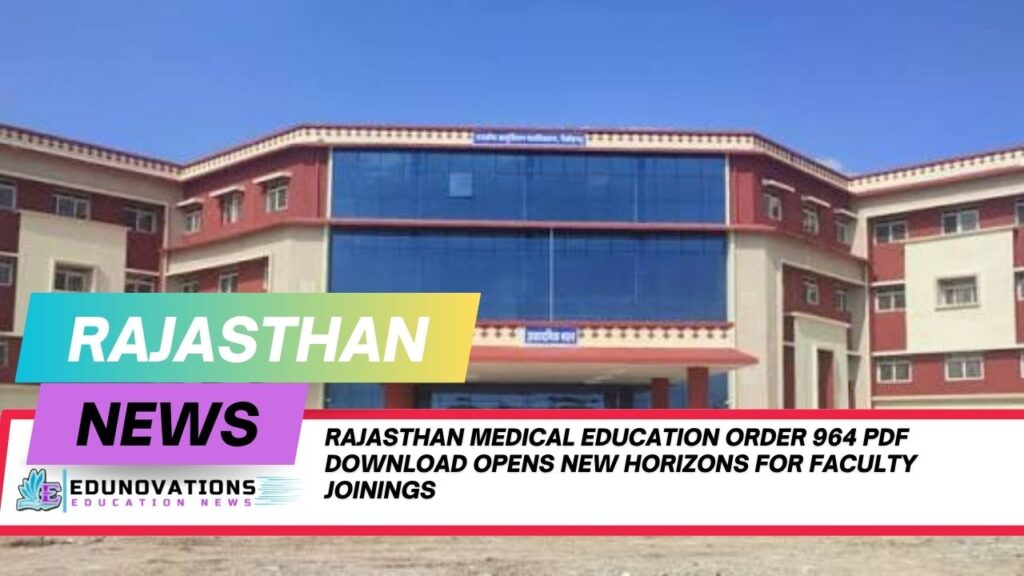
The medical education ecosystem in India has always required meticulous administrative oversight, transparent policy frameworks
Introduction to the Administrative Landscape of Medical Governance
The medical education ecosystem in India has always required meticulous administrative oversight, transparent policy frameworks, and streamlined bureaucratic procedures to ensure that healthcare delivery reaches the grassroots level. Recently, the administrative corridors of the state witnessed a significant regulatory update that has captured the attention of medical aspirants, academic professionals, and institutional administrators alike. The official release concerning rajasthan medical education order 964 pdf download has emerged as a landmark development, providing crucial clarifications regarding faculty appointments, joining extensions, and service regularization under the Rajasthan Medical Education Society (RajMES).
For years, healthcare policy analysts, academic consultants, and student representatives have emphasized the necessity of structured governance within state-run medical colleges. Bureaucratic hurdles, shifting joining deadlines, and ambiguous administrative circulars often created bottlenecks for newly appointed medical teachers, assistant professors, and senior clinical demonstrators. By addressing these systemic gaps through an official directive, the state government has reinforced its commitment to transparency, institutional efficiency, and academic excellence.
To explore related academic modules, aspiring candidates and students can review comprehensive resources such as NCERT Courses to build strong foundational concepts. Furthermore, keeping track of daily developments is vital; students can follow Current Affairs for regular updates on public administration and governance policies. Educational institutions seeking digital infrastructure and web solutions can partner with Mart Ind Infotech (“Mart Ind Infotech”) for robust school management systems and portal development.
Understanding the Core Significance of Order 964
Administrative orders issued by state medical education departments serve as the backbone for operational protocols across government medical colleges, teaching hospitals, and affiliated health societies. Order 964 specifically targets the administrative flexibility required by newly inducted medical educators who face logistical, relocation, or institutional clearance delays prior to assuming their official responsibilities.
In public administration, flexibility without compromising accountability is a delicate balance to achieve. Medical faculty members appointed through competitive selection boards often require adequate transition time to relocate, complete relieving formalities from previous institutions, and settle into new academic environments. The provisions outlined in the official documentation provide this necessary breather, ensuring that talent retention remains high and qualified professionals are not discouraged by rigid, unforgiving deadlines.
For comprehensive exam preparation, candidates can access detailed Notes covering administrative structures, Indian polity, and healthcare policies. Additionally, practicing subject-specific MCQ’s helps students test their comprehension of public policy frameworks.
Expert Insights and Public Commentary on Medical Education Reforms
The state’s ongoing push toward revamping medical education governance has drawn praise from prominent public health experts and political leaders. Commenting on the broader vision of strengthening healthcare infrastructure and administrative transparency, Shri Bhajan Lal Sharma, Chief Minister of Rajasthan, noted:
“Our government is resolutely committed to ensuring absolute transparency, meritocracy, and administrative ease across all public institutions. Streamlining recruitment and joining frameworks in our medical colleges is not merely an administrative exercise; it is a solemn pledge to elevate the standard of healthcare and medical education available to every citizen of Rajasthan.”
Healthcare economists and medical administrators have similarly lauded the pragmatic approach embedded in recent departmental circulars. Dr. Alok Ranjan, a senior public health policy analyst and former medical education advisor, observed:
“The primary bottleneck in expanding medical education capacity across India has never been a lack of qualified doctors, but rather the rigidity of our institutional recruitment and joining mechanisms. Orders that provide sensible extensions while preserving accountability bridge the gap between bureaucratic rulebooks and ground-level realities. This ensures that skilled medical faculty can join public institutions without undue mental stress or administrative harassment.”
For visual learners and those looking for structured breakdowns of administrative subjects, expert-led Videos offer deep dives into governance models. Students can also refer to the prescribed Syllabus for structured academic pathways.
Detailed Breakdown of Provisions and Joining Extensions
The administrative text underlying the rajasthan medical education order 964 pdf download addresses several critical operational parameters governing medical faculty appointments under RajMES. A closer examination of the circular reveals key structural components designed to streamline human resource management in medical institutions:
1. Extension of Joining Timelines
One of the most immediate reliefs provided in the order involves granting formal extensions to newly appointed medical faculty members who were unable to report to their designated medical colleges within the initial timeframe. Administrative delays in relieving notices from parent institutions or personal exigencies are now accommodated through a standardized application window, reducing arbitrary decision-making.
2. Departmental Allocation and Vacancy Management
The order outlines clear protocols for managing vacancies across various clinical and non-clinical departments, including General Medicine, Surgery, Pediatrics, Anatomy, Physiology, and Pharmacology. By maintaining transparent waiting lists and reserve rosters, the department ensures that no teaching post remains vacant due to administrative inertia.
3. Verification of Credentials and NMC Compliance
All appointments and extensions remain strictly anchored to the regulatory guidelines established by the National Medical Commission (NMC). The order emphasizes rigorous verification of postgraduate medical degrees (MD/MS/DNB), teaching experience certificates, and valid medical council registrations, preserving the academic integrity of state medical colleges.
For aspirants looking for offline reading materials and reference guides, free downloadable resources are accessible via Downloads of Free NCERT PDFs. Furthermore, conceptual clarity can be reinforced using NCERT Mind Maps for streamlined revision.
Comparative Analysis: Administrative Hurdles vs. Policy Solutions
To fully appreciate the impact of these administrative notifications, it is instructive to examine the traditional challenges faced by medical educators and how recent policy reforms attempt to resolve them:
| Administrative Parameter | Pre-Reform Scenario | Current Framework Under Order 964 |
| Joining Deadline Flexibility | Rigid timelines with immediate cancellation of candidature upon minor delays. | Structured extension windows accommodating relieving and relocation delays. |
| Transparency in Allotment | Fragmented communication channels leading to confusion among candidates. | Centralized digital notifications via official department portals ensuring easy access. |
| Faculty Retention Rates | Higher attrition due to administrative friction and punitive joining clauses. | Improved retention through supportive transition policies and clear communication. |
| Regulatory Alignment | Occasional friction with national medical standards and accreditation norms. | Seamless compliance with National Medical Commission (NMC) faculty guidelines. |
This structural shift reflects a mature governance model that prioritizes institutional capacity-building over rigid bureaucratic compliance.
The Broader Impact on Healthcare Delivery and Student Welfare
While administrative orders primarily address bureaucratic and personnel workflows, their downstream effects on medical students, resident doctors, and general patients are profound. When medical colleges operate with a full complement of qualified professors, associate professors, and assistant professors, several positive outcomes naturally follow:
- Enhanced Student-Teacher Ratios: Medical undergraduates receive closer academic mentorship, vital for clinical rotations and surgical training.
- Improved Research Output: Fully staffed departments foster an environment conducive to clinical research, medical innovation, and paper publications.
- Elevated Patient Care Standards: Teaching hospitals attached to government medical colleges handle massive patient loads; adequate specialist staffing directly reduces patient wait times and improves treatment outcomes.
Public health advocates continually stress that administrative efficiency in medical education is the bedrock of universal health coverage. When state machinery operates with clarity and speed, public trust in governmental institutions multiplies.
Toppers Use Mind Maps to score more than 95%
-
NCERT Class 11th Commerce Mind Maps
Add to cartOriginal price was: ₹999.00.₹199.00Current price is: ₹199.00. -
NCERT Class 12th Chemistry Mind Maps
Add to cartOriginal price was: ₹199.00.₹75.00Current price is: ₹75.00. -
NCERT Class 12th Commerce Mind Maps
Add to cartOriginal price was: ₹999.00.₹199.00Current price is: ₹199.00. -
NCERT Class 12th Science Mind Maps
Add to cartOriginal price was: ₹999.00.₹199.00Current price is: ₹199.00. -
NCERT Mind Maps For Class 10th
Add to cartOriginal price was: ₹999.00.₹199.00Current price is: ₹199.00.





Purchase Today
Frequently Asked Questions
1. What is the primary purpose of the Rajasthan Medical Education Order 964?
The order primarily regulates faculty appointments, vacancy management, and provides structured extensions for joining timelines for medical teachers under the Rajasthan Medical Education Society (RajMES).
2. Where can candidates find the official notification document?
Aspirants can access the official notification and circular details directly through the official portal of the Medical Education Department, Rajasthan.
3. Who is eligible for joining extensions under this administrative order?
Newly appointed medical faculty members and assistant professors who face verified administrative delays, relieving issues from previous posts, or unavoidable personal exigencies are eligible to apply for extensions.
4. How does this order impact medical college students in Rajasthan?
By ensuring timely faculty joinings and filling critical teaching vacancies, the order helps maintain optimal student-teacher ratios and improves the quality of clinical education.
5. Are the recruitment guidelines aligned with national standards?
Yes, all provisions and eligibility criteria outlined in the administrative directives strictly adhere to the regulatory framework set by the National Medical Commission (NMC).
6. What departments are typically covered under RajMES faculty recruitment drives?
Recruitment drives and associated administrative orders cover both clinical departments (such as Medicine, Surgery, Pediatrics, Orthopedics) and non-clinical departments (such as Anatomy, Physiology, Pharmacology, Pathology).
7. Why are long-tail keywords important when searching for government orders?
Long-tail keywords such as specific document titles, department names, and action verbs help users pinpoint exact official circulars, avoiding broad and crowded search results.
8. What role do digital portals play in modern government administration?
Digital portals ensure transparency, instant accessibility, and real-time updates for candidates, eliminating traditional information asymmetries in public sector hiring.
9. Can existing faculty members benefit from administrative clarification orders?
Yes, administrative orders often clarify promotion pathways, DACP (Dynamic Assured Career Progression) guidelines, and service rules, benefiting existing staff as well.
10. How can candidates prepare for upcoming medical faculty selections in Rajasthan?
Candidates should regularly monitor official departmental announcements, ensure their National Medical Commission registrations are up to date, and review prescribed academic syllabi.