
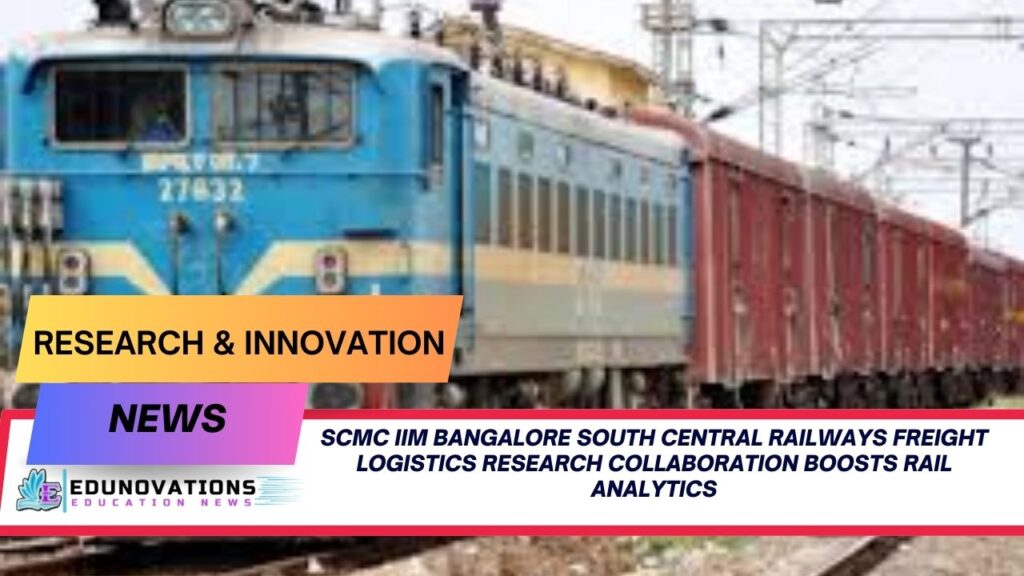
The SCMC IIM Bangalore South Central Railways freight logistics research collaboration marks a powerful step toward AI-driven rail analytics, freight efficiency, and supply chain innovation in India.
India’s freight and logistics ecosystem is entering a transformative phase, and at the center of this evolution is the SCMC IIM Bangalore South Central Railways freight logistics research collaboration. In a significant move aimed at strengthening research-driven rail freight solutions, the Supply Chain Management Centre (SCMC) at Indian Institute of Management Bangalore has signed a Memorandum of Understanding (MoU) with South Central Railway.
This partnership represents far more than a formal agreement. It signals a strategic shift toward data-backed decision-making, AI-powered analytics, and supply chain optimization within the Indian rail freight sector. The initiative is expected to generate actionable insights that could enhance operational efficiency, reduce logistics costs, and modernize rail-based freight systems across the country.
As India aims to become a $5 trillion economy, such industry-academia partnerships are vital. The SCMC IIM Bangalore South Central Railways freight logistics research collaboration demonstrates how leading academic institutions and public sector transport networks can jointly address structural inefficiencies in freight logistics.
A Strategic MoU for India’s Rail Freight Modernization
The MoU between IIM Bangalore’s SCMC and South Central Railway lays the groundwork for structured research, knowledge exchange, and data-driven innovation. Under this framework:
- Joint studies will be conducted on freight operations.
- Analytics tools will be developed for improving rail cargo movement.
- Research scholars and railway professionals will collaborate.
- Real-world freight data will inform academic modeling and simulation.
The SCMC IIM Bangalore South Central Railways freight logistics research collaboration is designed to bridge the gap between theory and practice. By combining managerial expertise from IIM Bangalore with operational insights from South Central Railway, the partnership aims to generate scalable solutions.
South Central Railway is one of the key freight-carrying zones of Indian Railways, handling substantial volumes of coal, cement, food grains, and container traffic. Optimizing these flows has nationwide economic implications.
Why Rail Freight Needs Data-Driven Research
India’s logistics costs account for nearly 13–14% of GDP, significantly higher than global benchmarks. Railways play a crucial role in reducing this burden. However, inefficiencies in route planning, wagon utilization, and freight scheduling often limit productivity.
The SCMC IIM Bangalore South Central Railways freight logistics research collaboration directly addresses these bottlenecks. Through advanced modeling and predictive analytics, the initiative seeks to:
- Improve wagon turnaround time
- Enhance freight route optimization
- Strengthen demand forecasting
- Introduce AI-based decision support systems
This aligns with broader national efforts to modernize infrastructure and integrate digital solutions into traditional sectors.
Academic Excellence Meets Operational Experience
The Supply Chain Management Centre at IIM Bangalore is recognized for its research contributions in logistics, operations management, and supply chain strategy. The SCMC IIM Bangalore South Central Railways freight logistics research collaboration leverages this expertise to solve real-time freight challenges.
By embedding academic rigor into railway operations, the collaboration ensures:
- Evidence-based policy recommendations
- Improved freight revenue management
- Scalable models for national replication
- Capacity-building workshops for railway officials
Experts believe such collaborations can create a blueprint for other railway zones.
AI and Technology in Rail Parcel Logistics
One of the significant components linked to this initiative is the focus on AI-driven freight systems. Industry observers note the rising importance of AI-powered rail parcel logistics platforms in India’s freight market.
While the MoU emphasizes research, it also opens avenues for exploring digital tools and automation. The integration of analytics with operational data can enhance:
- Real-time cargo tracking
- Predictive maintenance
- Dynamic freight pricing
- Resource allocation efficiency
The SCMC IIM Bangalore South Central Railways freight logistics research collaboration could potentially shape India’s next-generation rail freight ecosystem.
Strengthening Supply Chain Resilience
The COVID-19 pandemic exposed vulnerabilities in global and domestic supply chains. Railways played a crucial role in maintaining essential goods movement. However, data gaps and coordination challenges were evident.
This is where the SCMC IIM Bangalore South Central Railways freight logistics research collaboration becomes highly relevant. By focusing on resilience modeling and disruption analysis, the partnership aims to develop frameworks that:
- Reduce freight delays during emergencies
- Enhance contingency planning
- Improve multimodal integration
- Support sustainable logistics policies
India’s push toward integrated logistics parks and dedicated freight corridors further underscores the need for such research-backed insights.
Economic and Policy Implications
The collaboration has broader economic implications beyond academic research. Rail freight modernization directly influences:
- Industrial competitiveness
- Export efficiency
- Agricultural supply chains
- Energy transportation
With South Central Railway being a key transporter of coal and cement, optimization efforts could significantly reduce input costs for industries.
The SCMC IIM Bangalore South Central Railways freight logistics research collaboration thus aligns with national initiatives promoting infrastructure growth and logistics reform.
Expert Perspectives on Industry-Academia Partnerships
Industry experts have long advocated deeper collaboration between academia and public sector enterprises. According to supply chain analysts, partnerships like the SCMC IIM Bangalore South Central Railways freight logistics research collaboration create a knowledge loop:
- Railways provide operational data
- Academics analyze and model solutions
- Insights are tested in field conditions
- Results inform policy decisions
Such cyclical innovation ensures long-term sustainability rather than one-time reforms.
Opportunities for Students and Researchers
This collaboration also benefits students and research scholars at IIM Bangalore. Exposure to live freight datasets offers unparalleled practical learning opportunities.
Students pursuing logistics and operations management can:
- Participate in field studies
- Analyze freight analytics cases
- Publish research papers
- Develop AI-based freight optimization tools
For aspirants preparing for competitive exams, resources like NCERT Courses and Current Affairs can help build foundational knowledge. Readers may explore:
- NCERT Courses
- Current Affairs Updates
- Notes for Competitive Exams
- MCQs for Practice
- Video Lectures
- Syllabus Insights
- Free NCERT PDF Downloads
- NCERT Mind Maps
These educational tools complement understanding of national infrastructure developments such as the SCMC IIM Bangalore South Central Railways freight logistics research collaboration.
Digital Infrastructure and Rail Analytics
The digitization of rail freight operations is no longer optional. Big data, machine learning, and predictive algorithms are shaping transport networks globally.
The SCMC IIM Bangalore South Central Railways freight logistics research collaboration is positioned to:
- Develop freight data dashboards
- Create simulation-based decision tools
- Design performance benchmarking frameworks
- Enhance revenue optimization models
If successfully implemented, these tools can reduce idle wagon time and improve network throughput.
Broader Impact on Indian Railways
Indian Railways is one of the largest rail networks in the world. While passenger services receive significant attention, freight operations contribute a substantial share of revenue.
The SCMC IIM Bangalore South Central Railways freight logistics research collaboration could become a model for other zones. Replication across multiple railway divisions may:
- Standardize analytics frameworks
- Improve cross-zone coordination
- Increase national freight capacity
- Enhance private sector confidence
This systematic improvement would strengthen India’s position in global logistics rankings.
Linking Research to Sustainable Development
Sustainability is a growing priority in transport systems. Railways are inherently more energy-efficient than road freight. However, optimizing load management and route planning can further reduce carbon emissions.
The SCMC IIM Bangalore South Central Railways freight logistics research collaboration has the potential to integrate sustainability metrics into freight analytics. By measuring emissions intensity and energy use, rail freight operations can align with India’s climate commitments.
Role of Technology Partners
To ensure seamless digital transformation, institutions often collaborate with technology service providers. Organizations like Mart Ind Infotech support schools and institutions in digital infrastructure development.
As railway research integrates advanced analytics, digital expertise becomes essential for scaling pilot projects into operational tools.
Future Outlook
Looking ahead, the SCMC IIM Bangalore South Central Railways freight logistics research collaboration may expand into:
- Multimodal freight integration research
- Blockchain-based freight documentation
- Smart warehousing models
- Dedicated freight corridor analytics
The partnership marks a forward-looking approach where academic rigor and operational intelligence converge.
Toppers Use Mind Maps to score more than 95%
-
NCERT Class 11th Commerce Mind Maps
Add to cartOriginal price was: ₹999.00.₹199.00Current price is: ₹199.00. -
NCERT Class 12th Chemistry Mind Maps
Add to cartOriginal price was: ₹199.00.₹75.00Current price is: ₹75.00. -
NCERT Class 12th Commerce Mind Maps
Add to cartOriginal price was: ₹999.00.₹199.00Current price is: ₹199.00. -
NCERT Class 12th Science Mind Maps
Add to cartOriginal price was: ₹999.00.₹199.00Current price is: ₹199.00. -
NCERT Mind Maps For Class 10th
Add to cartOriginal price was: ₹999.00.₹199.00Current price is: ₹199.00.





Purchase Today
Frequently Asked Questions (FAQs)
1. What is the SCMC IIM Bangalore South Central Railways freight logistics research collaboration?
It is a strategic MoU between IIM Bangalore’s SCMC and South Central Railway to conduct freight analytics and supply chain research.
2. How will the SCMC IIM Bangalore South Central Railways freight logistics research collaboration improve rail freight?
It will use data analytics, AI models, and research frameworks to optimize freight operations.
3. Why is rail freight analytics important in India?
Rail freight reduces logistics costs and supports industrial growth through efficient cargo movement.
4. What role does AI play in rail freight research?
AI enables predictive scheduling, dynamic pricing, and route optimization.
5. Who benefits from this freight logistics research collaboration?
Railway officials, researchers, students, and industries relying on rail transport.
6. Can this partnership influence national logistics policies?
Yes, research insights can inform broader infrastructure and freight reforms.
7. What sectors are impacted by rail freight optimization?
Coal, cement, agriculture, manufacturing, and export industries.
8. How does this initiative strengthen supply chain resilience?
It develops models to manage disruptions and improve contingency planning.
9. Will other railway zones adopt similar collaborations?
If successful, the model can be replicated nationwide.
10. How can students prepare to understand such logistics developments?
They can use NCERT courses, notes, current affairs updates, and MCQs for conceptual clarity.