
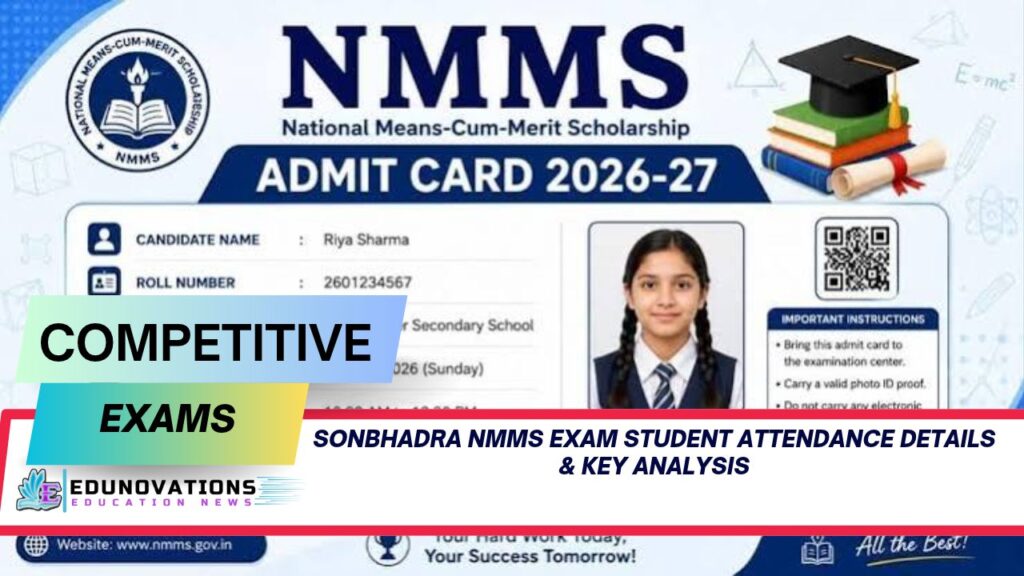
Explore complete insights into the Sonbhadra NMMS exam student attendance details, exam patterns, and scholarship benefits for young scholars.
The landscape of education in rural and semi-urban districts of India is undergoing a paradigm shift, largely catalyzed by merit-based financial support mechanisms. Recently, the educational framework of Uttar Pradesh witnessed a significant milestone as aspiring young minds stepped forward to secure their academic futures. Centered around the region’s academic zeal, the execution of scholarship evaluations highlights a growing awareness among students and parents alike. Understanding the core metrics of participation, test layouts, and expert analysis provides a crystal-clear lens into how localized academic drives shape future leaders.
For students gearing up for upcoming competitive milestones, structured preparation is non-negotiable. Utilizing resources like NCERT Courses can significantly bridge foundational gaps. Furthermore, keeping track of developments through Current Affairs ensures that aspirants remain ahead of the curve.
The Scale of Participation: Looking at Sonbhadra’s Turnout
When examining regional academic participation, the numbers tell an inspiring story of determination. In the recent assessment cycle, the district recorded a notable turnout where hundreds of young scholars appeared to test their academic mettle. Out of a total of 1,175 registered candidates, 994 students actively participated in the examination centers. This robust participation rate underscores the growing enthusiasm for academic validation and financial assistance among economically weaker sections.
To master similar competitive formats, students often require targeted revision tools. Accessing structured Notes can streamline complex subjects, while practicing regularly through dedicated MCQ’s helps build time-management skills under examination pressure.
Decoding the Examination Structure: MAT and SAT Breakdown
The assessment structure is methodically designed to evaluate both logical reasoning and core subject knowledge. Divided into two distinct sections, the evaluation format demands rigorous preparation.
- First Section (GMAT): The General Mental Ability Test focuses heavily on logical reasoning, spatial awareness, and analytical thinking. Students are tested on their ability to decode patterns, solve analogies, and apply critical deduction.
- Second Section (SAT): The Scholastic Aptitude Test evaluates a student’s grasp of school-level curriculum, encompassing science, mathematics, and social studies.
Each section consists of 90 objective-type questions carrying a total weightage of 180 marks, with a strict time allocation of 90 minutes per section.
For comprehensive audio-visual explanations of these topics, students can explore curated Videos, while aligning their preparation path strictly with the official Syllabus.
Student Experiences and Academic Insights
The diversity of the question paper elicited varied responses from test-takers across different examination blocks. While mathematical calculations and scientific principles tested foundational clarity, general awareness and mental agility segments required intense cognitive processing.
- Ankit, a student from Chapail, noted that while mathematical and scientific queries were relatively straightforward, the mental ability section demanded high-level logical interpretation.
- Arvind from Kharhara emphasized that social science and general awareness sections required careful time management to ensure comprehensive completion.
- Manvi from Gayghat shared that despite the conceptual complexity of certain questions, the prospect of securing continuous financial aid served as a massive driving force.
Expert Perspectives on Rural Talent and Financial Empowerment
Educational analysts and local guardians have continuously underscored the transformative impact of these scholarships. Rajendra Pratap, Secretary of the Examination Regulatory Authority, has frequently highlighted that aligning examination centers close to students’ home districts drastically reduces travel fatigue and enhances overall attendance rates.
Guardians echoed similar sentiments. Pradeep, a local parent, noted that financial constraints often force talented children to compromise on their educational trajectories. Initiatives providing monthly stipends from the ninth grade through the twelfth grade act as a vital cushion, preventing dropouts and encouraging persistent academic pursuit. Another local guardian, Vijay Bahadur Singh, remarked that introducing competitive formats at an early developmental stage builds long-term resilience and sharpens cognitive reflexes.
For institutions looking to upgrade their digital and administrative infrastructure to support such large-scale academic events, partnering with technology solution providers like Mart Ind Infotech offers reliable management frameworks.
Leveraging Foundational Study Materials and Visual Aids
Success in rigorous scholarship tests is rarely accidental; it stems from meticulous planning and the utilization of premier study resources. Students aiming to clear high cutoff thresholds must incorporate diverse learning aids into their daily routines.
- Free Study Artifacts: Students can leverage Downloads of Free NCERT PDFs to strengthen their textbook command without financial barriers.
- Conceptual Retention: Utilizing NCERT Mind Maps allows learners to visualize interlinked scientific and historical concepts effectively, ensuring rapid last-minute revisions.
Toppers Use Mind Maps to score more than 95%
-
NCERT Class 11th Commerce Mind Maps
Add to cartOriginal price was: ₹999.00.₹199.00Current price is: ₹199.00. -
NCERT Class 12th Chemistry Mind Maps
Add to cartOriginal price was: ₹199.00.₹75.00Current price is: ₹75.00. -
NCERT Class 12th Commerce Mind Maps
Add to cartOriginal price was: ₹999.00.₹199.00Current price is: ₹199.00. -
NCERT Class 12th Science Mind Maps
Add to cartOriginal price was: ₹999.00.₹199.00Current price is: ₹199.00. -
NCERT Mind Maps For Class 10th
Add to cartOriginal price was: ₹999.00.₹199.00Current price is: ₹199.00.


Purchase Today
Frequently Asked Questions (FAQs)
1. What are the key highlights of the Sonbhadra NMMS exam student attendance details?
Out of 1,175 registered students in Sonbhadra, a total of 994 candidates actively appeared for the scholarship examination across designated centers.
2. How can aspirants prepare effectively using the UP NMMS scholarship exam MAT and SAT paper review?
Reviewing past paper analyses helps candidates identify high-weightage topics, time-management bottlenecks, and recurring logical reasoning patterns.
3. Where can candidates find verified information regarding the National Means Cum Merit Scholarship Sonbhadra center allocations?
Center allocations are officially published through district education portals and the primary examination regulatory authority website prior to the exam date.
4. Why is tracking the UP NMMS exam district wise total examinees list important for trend analysis?
It allows educational researchers and policymakers to measure regional participation spikes, literacy awareness, and rural student engagement levels.
5. What core topics dominate the Sonbhadra scholarship exam question paper pattern?
The pattern is divided into MAT (Mental Ability Test) and SAT (Scholastic Aptitude Test), covering mathematics, science, social studies, and logical reasoning.
6. What is the financial benefit provided to qualifying students under this scheme?
Successful candidates receive a monthly scholarship stipend of ₹1,000 from class 9 through class 12 to support their secondary education.
7. What was the total duration and mark distribution of the scholarship test?
The exam comprised 180 multiple-choice questions across two 90-minute sessions, with each correct answer carrying one mark.
8. Who is eligible to register for the National Means-cum-Merit Scholarship examination?
Students studying in class 8 within government, government-aided, or local body schools with requisite previous-year academic percentages are eligible.
9. How do mental ability tests impact a student’s overall cognitive development?
MAT questions test lateral thinking, pattern recognition, and problem-solving speed, which are essential for cracking future national competitive benchmarks.
10. What steps should students take post-exam while awaiting results?
Candidates should verify their responses using provisional answer keys and continue building their core academic foundation through advanced practice modules.