
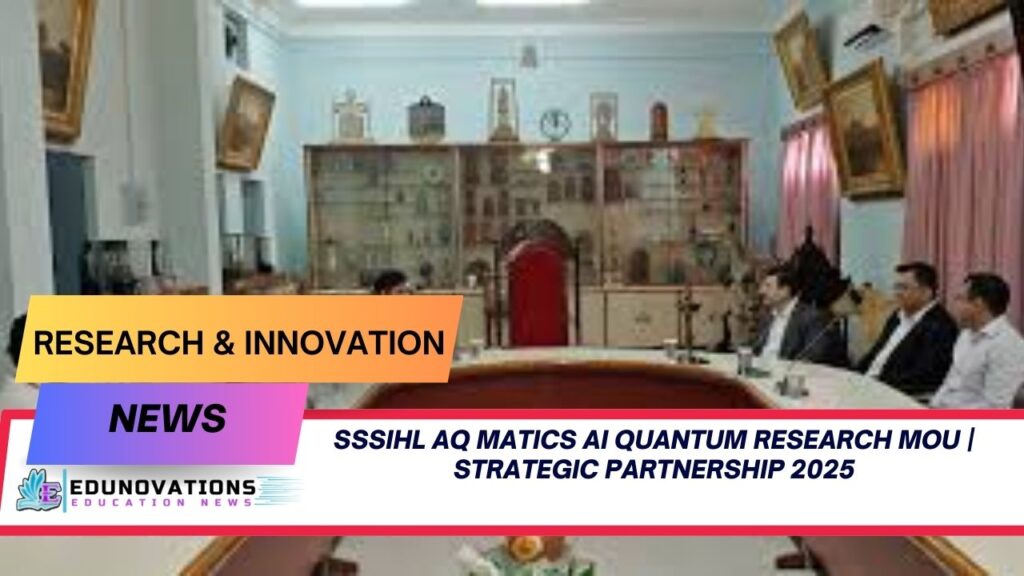
Discover the groundbreaking SSSIHL AQ MATiCS AI Quantum research MoU fostering AI and quantum computing innovation, labs, internships, and industry-academia collaboration in India.
Introduction
Sri Sathya Sai Institute of Higher Learning (SSSIHL) has recently signed a strategic MoU with AQ MATiCS Inc., marking a milestone in AI and quantum computing research in India. The SSSIHL AQ MATiCS AI Quantum research MoU aims to foster collaborative research, develop cutting-edge laboratories, and offer internship opportunities, positioning India at the forefront of emerging technology innovation.
This partnership is set to strengthen the academic-industry interface, enabling students and researchers at SSSIHL to gain hands-on experience with state-of-the-art AI and quantum computing tools, while also contributing to the development of intellectual property and new technological solutions.
Key Objectives of the SSSIHL–AQ MATiCS Collaboration
The MoU emphasizes a multi-faceted approach to research and innovation:
- Joint Research Programs: Focused on AI-driven quantum computing applications, algorithm development, and real-world problem-solving.
- Curriculum Support: Integration of advanced AI and quantum modules into SSSIHL’s academic programs.
- Innovation Labs: Establishment of cutting-edge laboratories equipped with quantum simulators and AI frameworks.
- Internship Opportunities: Students will engage in hands-on research projects under expert mentorship.
- Intellectual Property Development: Joint patents and publications resulting from research collaborations.
This collaboration reflects a forward-looking strategy to cultivate expertise in next-generation technologies while offering students career-enhancing opportunities.
Enhancing Research Capabilities Through AI and Quantum Computing
Quantum computing is recognized as a transformative technology with the potential to revolutionize industries ranging from healthcare to finance. By combining it with artificial intelligence, researchers can unlock unprecedented computational capabilities.
The SSSIHL AQ MATiCS AI Quantum research MoU provides SSSIHL with access to AQ MATiCS’ advanced platforms and research infrastructure. Experts predict that this partnership could significantly accelerate India’s global competitiveness in emerging technologies.
For students interested in foundational knowledge, NCERT courses provide valuable background in AI and computing fundamentals. These can be accessed here.
Opportunities for Students and Researchers
Students and faculty stand to benefit from immersive educational experiences through this collaboration:
- Hands-on Training: Utilizing AI-powered quantum simulation tools for research projects.
- Internships & Mentorships: Guided by AQ MATiCS researchers and faculty experts.
- Collaborative Publications: Opportunities to co-author papers in peer-reviewed journals.
- Entrepreneurial Ventures: Support for startups and tech innovation initiatives emerging from lab projects.
Students can also leverage resources such as NCERT Mind Maps for structured learning in related subjects, available here.
Expert Insights on the MoU
Dr. S. Rajagopal, a leading AI researcher, commented, “The SSSIHL AQ MATiCS AI Quantum research MoU is a landmark initiative. It bridges academic expertise and industrial know-how, offering students a platform to work on technologies shaping the future.”
Such collaborations highlight the growing importance of industry-academia partnerships in nurturing talent, fostering research, and driving innovation in India.
Strategic Significance for India’s Emerging Tech Ecosystem
India is rapidly advancing in AI and quantum computing, and partnerships like this play a pivotal role:
- Strengthening Research Capabilities: Access to cutting-edge technology and collaborative projects.
- Developing Talent: Providing a pipeline of skilled professionals in AI and quantum computing.
- Promoting Innovation: Encouraging the creation of IP and novel technological solutions.
- Global Recognition: Positioning Indian institutions as leaders in high-tech research.
For current affairs enthusiasts, following similar technology partnerships in India can provide insights into national innovation trends, available here.
Collaboration Highlights
- Duration: Five-year strategic partnership.
- Scope: AI, quantum computing, research labs, curriculum integration, internships.
- Key Beneficiaries: SSSIHL students, faculty, AQ MATiCS researchers.
- Expected Outcome: Patents, publications, advanced research capabilities, industry-ready graduates.
Additional resources for students include free NCERT PDFs on computing and AI, which can be downloaded here.
Enhancing Learning with Technology
This MoU underscores the importance of emerging technologies in higher education:
- Interactive Labs: Hands-on learning for AI and quantum computing.
- Virtual Simulations: Realistic problem-solving environments for research and experimentation.
- Research Seminars: Knowledge sharing between AQ MATiCS experts and SSSIHL faculty.
- Skill Development Workshops: Training in specialized AI and quantum techniques.
For those interested in comprehensive video tutorials, SSSIHL students can explore educational videos aligned with AI and quantum research topics.
Integration with Academic Curriculum
The partnership ensures seamless integration of AI and quantum computing modules into SSSIHL’s academic programs, fostering:
- Interdisciplinary research skills.
- Advanced programming and algorithmic knowledge.
- Exposure to cutting-edge hardware and software environments.
- Preparation for careers in high-tech industries.
Students may also refer to NCERT Syllabus and notes for foundational learning.
The Road Ahead
The SSSIHL AQ MATiCS AI Quantum research MoU is more than a formal agreement—it represents a strategic vision for India’s technological future. Experts believe this model can be replicated across other institutions, creating a robust ecosystem for AI and quantum research.
- Encourages innovation-driven entrepreneurship.
- Supports skill development in niche technology areas.
- Strengthens India’s position in global research rankings.
Institutions and schools can explore technology partnerships for research development through expert consultancies such as Mart India Infotech.
Conclusion
The collaboration between SSSIHL and AQ MATiCS through the SSSIHL AQ MATiCS AI Quantum research MoU is a transformative step towards advancing India’s emerging technology ecosystem. By combining academic excellence with industrial expertise, the MoU ensures students, faculty, and researchers are well-equipped to tackle the challenges and opportunities of the AI and quantum computing era.
This strategic partnership is a testament to India’s commitment to innovative research, industry-academia collaboration, and future-ready education.
Toppers Use Mind Maps to score more than 95%
-
NCERT Class 11th Commerce Mind Maps
Add to cartOriginal price was: ₹999.00.₹199.00Current price is: ₹199.00. -
NCERT Class 12th Chemistry Mind Maps
Add to cartOriginal price was: ₹199.00.₹75.00Current price is: ₹75.00. -
NCERT Class 12th Commerce Mind Maps
Add to cartOriginal price was: ₹999.00.₹199.00Current price is: ₹199.00. -
NCERT Class 12th Science Mind Maps
Add to cartOriginal price was: ₹999.00.₹199.00Current price is: ₹199.00. -
NCERT Mind Maps For Class 10th
Add to cartOriginal price was: ₹999.00.₹199.00Current price is: ₹199.00.
Purchase Today
FAQs
- What is the SSSIHL AQ MATiCS AI Quantum research MoU?
It is a five-year strategic partnership to promote AI and quantum computing research, labs, and internships. - Which areas of research does the MoU cover?
AI-driven quantum computing applications, algorithm development, and interdisciplinary research. - How will students benefit from this collaboration?
Through internships, lab projects, mentorship, publications, and entrepreneurship opportunities. - What is the role of AQ MATiCS in the MoU?
Providing advanced research platforms, technical expertise, and mentoring for collaborative projects. - Will the MoU result in patents or publications?
Yes, joint intellectual property development and research publications are key outcomes. - How does the MoU support curriculum enhancement?
By integrating AI and quantum computing modules into SSSIHL academic programs. - Can students access practical labs under this MoU?
Yes, hands-on labs and virtual simulation environments are part of the program. - Is this MoU significant for India’s tech ecosystem?
Absolutely, it strengthens research capabilities, talent development, and global recognition. - Are there workshops and seminars under this MoU?
Yes, workshops, seminars, and skill development programs are planned for students and faculty. - Where can students find additional resources related to AI and quantum research?
Resources are available via NCERT courses, mind maps, PDFs, and educational videos.