
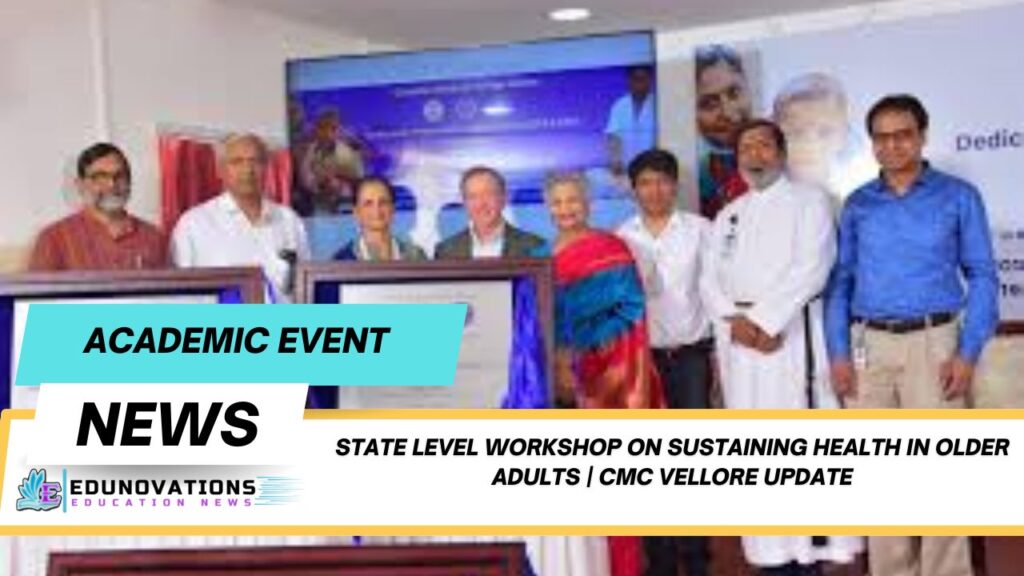
The state level workshop on sustaining health in older adults highlights breakthroughs in geriatric care, diagnostics, AMR awareness, and medical education initiatives in India.
Introduction
The state level workshop on sustaining health in older adults has emerged as a significant academic and public health milestone, reflecting India’s growing focus on geriatric care and evidence-based healthcare delivery. Organised under the academic ecosystem supported by Christian Medical College (CMC), Vellore, the initiative brought together clinicians, researchers, educators, and policymakers to address the evolving healthcare needs of an ageing population.
With India projected to have more than 300 million senior citizens by 2050, experts agree that sustainable geriatric healthcare is no longer optional—it is essential. The state level workshop on sustaining health in older adults focused on preventive care, chronic disease management, ethical decision-making, and interdisciplinary collaboration, reinforcing India’s preparedness to address age-related health challenges.
Growing Importance of Geriatric Healthcare in India
India’s demographic shift has been rapid and unprecedented. According to public health experts, nearly 10% of the Indian population is already above the age of 60, a figure expected to double in the coming decades. Against this backdrop, the state level workshop on sustaining health in older adults assumed critical importance by highlighting structured approaches to elderly wellness.
Key areas discussed included:
- Age-friendly healthcare systems
- Integrated care models for chronic diseases
- Mental health and cognitive well-being
- Community-based elderly care solutions
Medical educators noted that the state level workshop on sustaining health in older adults also bridged gaps between clinical practice and public health policy.
Academic Leadership and Institutional Role
Christian Medical College, Vellore, has long been recognised for its contribution to medical education and community health. The academic leadership behind the state level workshop on sustaining health in older adults ensured that discussions remained grounded in real-world challenges while being guided by global best practices.
Senior faculty members emphasised that geriatric medicine must be embedded across undergraduate and postgraduate medical curricula. This aligns with India’s broader medical education reforms aimed at competency-based learning and patient-centric care.
Diagnostic Accuracy and Evidence-Based Guidelines
One of the major highlights alongside the state level workshop on sustaining health in older adults was a parallel focus on strengthening diagnostic accuracy in clinical practice. Sessions addressed how diagnostic test accuracy studies contribute to the development of reliable clinical guidelines.
Experts stressed that misdiagnosis disproportionately affects older adults due to multiple comorbidities. Evidence-based diagnostic frameworks were presented as a solution to reduce unnecessary interventions and improve patient outcomes.
This academic emphasis resonates with medical aspirants and professionals who regularly consult structured learning resources such as:
- NCERT-aligned courses
- Topic-wise medical notes
- Practice MCQs for clinical reasoning
Learners can explore structured resources through platforms offering courses, notes, MCQs, videos, and syllabus-aligned materials, helping them connect theory with real-world clinical practice.
Continuing Medical Education and Clinical Toxicology
Another major academic development featured in the weekly update was a Continuing Medical Education programme focused on advanced clinical toxicology. This CME complemented the state level workshop on sustaining health in older adults by addressing poisoning risks and drug interactions, which disproportionately affect elderly patients.
Medical experts highlighted:
- Polypharmacy risks in older adults
- Early identification of toxic exposure
- Evidence-based management protocols
The CME initiative reinforced the importance of lifelong learning for healthcare professionals, a theme strongly aligned with India’s National Medical Commission guidelines.
Addressing Antimicrobial Resistance Through Education
Antimicrobial Resistance (AMR) remains one of the biggest threats to global health. During academic discussions connected to the state level workshop on sustaining health in older adults, clinicians highlighted how irrational antibiotic use severely impacts elderly patients.
Key insights included:
- Age-related immune vulnerability
- Risks of multidrug-resistant infections
- Importance of antimicrobial stewardship
Experts referenced global health data showing that AMR could cause millions of deaths annually if unchecked. Educational webinars and academic dialogues were positioned as crucial tools to promote rational prescribing practices among clinicians.
Expert Insights on Elderly Wellness
Senior geriatricians participating in the state level workshop on sustaining health in older adults emphasised a holistic approach to ageing. According to them, healthcare for older adults must go beyond disease treatment and include:
- Nutrition and physical activity
- Social engagement and mental health
- Ethical end-of-life care planning
One senior academic noted that India must invest in community-based geriatric care models to reduce hospital dependency while improving quality of life.
Role of Medical Education Platforms
The academic outcomes of the state level workshop on sustaining health in older adults are expected to influence how medical content is delivered to students and professionals. Structured digital platforms now play a crucial role in disseminating updated knowledge through:
- NCERT-based courses
- Current affairs for competitive exams
- Topic-wise medical notes
- Video lectures and mind maps
- Downloadable PDFs for revision
Such platforms ensure that academic developments reach aspirants preparing for medical and allied health examinations.
Technology and Healthcare Outreach
Experts also discussed how digital infrastructure can improve elderly healthcare access. Telemedicine, electronic health records, and AI-assisted diagnostics were highlighted as tools that can support outcomes discussed in the state level workshop on sustaining health in older adults.
Healthcare technology partners stressed the importance of reliable digital ecosystems for institutions and schools. Organisations offering IT solutions for educational and healthcare institutions were cited as enablers of scalable learning and outreach.
Broader Public Health Implications
Public health analysts believe that initiatives like the state level workshop on sustaining health in older adults signal a shift from reactive to preventive healthcare in India. With ageing populations placing increasing pressure on health systems, prevention-focused strategies are seen as both cost-effective and humane.
Policy experts noted that geriatric-centric health planning must align with national programmes such as Ayushman Bharat and state-level elderly welfare schemes.
Impact on Students and Competitive Exam Aspirants
For students preparing for medical entrance exams, nursing recruitment, and public health services, the themes emerging from the state level workshop on sustaining health in older adults are highly relevant.
Questions related to:
- Geriatric medicine
- AMR awareness
- Diagnostic accuracy
- Public health ethics
frequently appear in competitive examinations. Aspirants benefit from staying updated through current affairs, structured notes, MCQs, and revision materials.
Future Roadmap for Geriatric Healthcare
The success of the state level workshop on sustaining health in older adults has set the stage for future academic collaborations. Experts have recommended:
- Annual state-level geriatric summits
- Inclusion of geriatric modules in medical syllabi
- Community outreach programmes for elderly wellness
- Interdisciplinary research on ageing
Such initiatives are expected to strengthen India’s healthcare resilience.
Conclusion
The state level workshop on sustaining health in older adults stands as a powerful example of how academic leadership, evidence-based medicine, and public health priorities can converge to address one of India’s most pressing demographic challenges. By integrating geriatric care, diagnostic accuracy, antimicrobial stewardship, and continuing medical education, the initiative reinforces India’s commitment to sustainable and inclusive healthcare.
As India moves toward a future with a significantly larger elderly population, such academic interventions will play a defining role in shaping healthcare outcomes, policy decisions, and medical education standards.
Toppers Use Mind Maps to score more than 95%
-
NCERT Class 11th Commerce Mind Maps
Add to cartOriginal price was: ₹999.00.₹199.00Current price is: ₹199.00. -
NCERT Class 12th Chemistry Mind Maps
Add to cartOriginal price was: ₹199.00.₹75.00Current price is: ₹75.00. -
NCERT Class 12th Commerce Mind Maps
Add to cartOriginal price was: ₹999.00.₹199.00Current price is: ₹199.00. -
NCERT Class 12th Science Mind Maps
Add to cartOriginal price was: ₹999.00.₹199.00Current price is: ₹199.00. -
NCERT Mind Maps For Class 10th
Add to cartOriginal price was: ₹999.00.₹199.00Current price is: ₹199.00.
Purchase Today
Frequently Asked Questions (FAQs)
1. What is the state level workshop on sustaining health in older adults?
It is an academic initiative focused on improving geriatric healthcare through evidence-based practices and policy discussions.
2. Why is sustaining health in older adults important in India?
India’s ageing population requires structured healthcare systems to manage chronic diseases and improve quality of life.
3. How does this workshop benefit medical professionals?
It enhances clinical knowledge, promotes evidence-based care, and supports continuing medical education.
4. What role does diagnostic accuracy play in elderly care?
Accurate diagnostics reduce misdiagnosis and prevent unnecessary treatments in older adults.
5. How is antimicrobial resistance linked to geriatric health?
Older adults are more vulnerable to resistant infections due to frequent antibiotic exposure.
6. Does the workshop influence medical education curricula?
Yes, insights contribute to curriculum updates and competency-based learning models.
7. How can students benefit from such academic developments?
They gain exam-relevant knowledge for medical and public health competitive exams.
8. Are digital platforms important for elderly healthcare education?
Yes, they help disseminate updated clinical guidelines and learning resources efficiently.
9. What public health policies align with elderly healthcare initiatives?
National elderly welfare schemes and preventive healthcare programmes support such goals.
10. Will similar workshops be organised in the future?
Experts recommend regular academic forums to address evolving geriatric healthcare needs.