
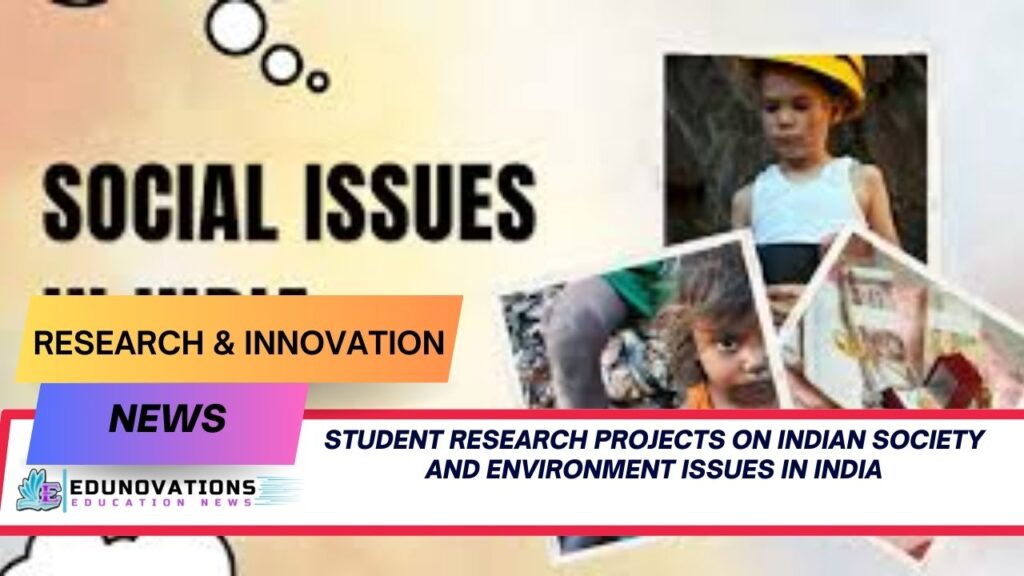
Student research projects on Indian society and environment issues uncover realities of development, health, economy, and ecological change in India through field-based studies and case analyses.
Introduction
Student research projects on Indian society and environment issues are increasingly emerging as a critical lens to understand the country’s complex development challenges. At a time when policy debates often rely on macro-level data, field-based academic research conducted by students offers grounded, people-centric insights into how economic growth, environmental change, and social transformation intersect in everyday life.
Recent academic initiatives have highlighted how student research projects on Indian society and environment issues are documenting lived realities across urban settlements, rural communities, industrial corridors, and ecologically fragile regions. These studies go beyond theoretical frameworks, capturing voices from the margins while presenting evidence-based findings that contribute meaningfully to policy discussions, education reforms, and sustainable development planning.
This article explores how student research projects on Indian society and environment issues are reshaping conversations around development, health, inequality, ecology, and governance in India, while also examining why such research holds increasing relevance for students, educators, and policymakers alike.
Why Student Research Matters in Understanding India’s Development
India’s development story is neither linear nor uniform. While economic indicators often show growth, disparities persist across regions, social groups, and environmental zones. Student research projects on Indian society and environment issues help bridge this gap by examining development at the grassroots level.
Unlike large-scale surveys, student-led research often involves:
- Extended fieldwork
- Direct interaction with communities
- Qualitative and mixed-method approaches
- Context-specific case studies
These approaches allow researchers to capture nuanced realities related to livelihoods, access to healthcare, education inequality, nutrition, environmental degradation, and urbanisation pressures.
Education experts frequently emphasise that such student research projects on Indian society and environment issues strengthen critical thinking and methodological rigour while producing socially relevant knowledge.
Mapping Social Change Through Field-Based Studies
One of the strongest contributions of student research projects on Indian society and environment issues lies in their focus on social transformation at the local level. Students examine how caste, gender, migration, and labour dynamics shape everyday experiences in changing economic environments.
Key social themes explored include:
- Informal labour conditions in urban economies
- Gendered access to education and healthcare
- Migration patterns linked to climate stress
- Social security access among vulnerable communities
By grounding their analysis in lived experience, student research projects on Indian society and environment issues provide evidence that complements national-level datasets and policy reports.
Health and Nutrition as Core Research Areas
Health and nutrition remain central to many student research projects on Indian society and environment issues. These studies often examine how environmental factors, income inequality, and public service delivery affect health outcomes.
Common research findings highlight:
- Gaps in primary healthcare access
- Nutrition insecurity among children and women
- Impact of pollution on respiratory health
- Role of community health workers in rural regions
Several public health experts have noted that student research projects on Indian society and environment issues play a crucial role in identifying implementation gaps in government programmes, especially in underserved regions.
Understanding Environmental Challenges at the Local Level
Environmental degradation is one of the most pressing challenges facing India today. Student research projects on Indian society and environment issues increasingly focus on ecological stress caused by industrialisation, mining, urban expansion, and climate variability.
Environmental themes frequently studied:
- Water scarcity and groundwater depletion
- Air pollution in industrial zones
- Waste management in growing cities
- Impact of infrastructure projects on ecosystems
These student-led investigations often reveal how environmental damage disproportionately affects marginalised communities, reinforcing social and economic inequalities.
Economic Change and Livelihood Studies
Economic development is another core pillar of student research projects on Indian society and environment issues. Rather than focusing only on GDP growth, students examine how economic policies influence livelihoods at the grassroots.
Areas of focus include:
- Informal sector employment conditions
- Agricultural distress and farmer livelihoods
- Small enterprise sustainability
- Impact of welfare schemes on poverty reduction
By analysing economic change through field studies, student research projects on Indian society and environment issues offer grounded insights into the successes and limitations of development models.
Urbanisation, Industrialisation, and Their Social Costs
Rapid urbanisation and industrial growth have transformed India’s physical and social landscape. Student research projects on Indian society and environment issues critically examine how these processes reshape cities and rural hinterlands.
Students document:
- Displacement due to infrastructure projects
- Housing insecurity in informal settlements
- Environmental pollution near industrial hubs
- Changing labour relations in urban economies
These findings often challenge dominant narratives of development by foregrounding social and environmental costs that remain underrepresented in official planning documents.
Expert Perspectives on Student-Led Research
Senior academics and development practitioners widely acknowledge the importance of student research projects on Indian society and environment issues. According to noted economist Jean Drèze, grassroots research plays a vital role in revealing “what statistics alone cannot capture — the lived experience of inequality.”
Environmental activist Sunita Narain has similarly highlighted that local-level studies help policymakers understand how environmental policies translate into real-world outcomes, particularly for vulnerable populations.
Such expert perspectives reinforce the growing credibility and relevance of student research projects on Indian society and environment issues within academic and policy ecosystems.
Role of Universities in Encouraging Research-Driven Learning
Universities play a critical role in fostering student research projects on Indian society and environment issues. By integrating fieldwork, interdisciplinary approaches, and ethical research practices into curricula, institutions help students develop both academic depth and social awareness.
Key academic practices include:
- Mentored field research
- Interdisciplinary project design
- Community engagement
- Policy-oriented analysis
These approaches ensure that student research projects on Indian society and environment issues maintain methodological rigour while remaining socially relevant.
Why This Research Matters for Competitive Exam Aspirants
For students preparing for competitive examinations, insights from student research projects on Indian society and environment issues are especially valuable. Such studies align closely with syllabi covering:
- Indian society and social justice
- Environment and ecology
- Economic development
- Public health and nutrition
Aspirants can strengthen their preparation by accessing:
- Conceptual clarity through real-world examples
- Case studies for answer enrichment
- Current affairs-linked academic insights
Learners can further enhance their understanding through NCERT courses, current affairs analysis, topic-wise notes, practice MCQs, video explanations, updated syllabi, free NCERT PDF downloads, and mind maps available on trusted educational platforms.
Digital Platforms and Research Accessibility
The digital ecosystem has expanded access to academic research. Student research projects on Indian society and environment issues are increasingly being disseminated through online platforms, making them accessible to educators, policymakers, and the general public.
Educational technology experts emphasise that digital dissemination ensures wider impact and encourages evidence-based discourse beyond academic circles.
Implications for Policy and Governance
Student research projects on Indian society and environment issues contribute indirectly to governance by:
- Highlighting policy implementation gaps
- Identifying unintended consequences of development projects
- Offering data-driven recommendations
- Supporting participatory planning approaches
While student research may not always directly influence policy, it strengthens the knowledge ecosystem necessary for informed decision-making.
Conclusion
Student research projects on Indian society and environment issues represent a powerful intersection of education, evidence, and social responsibility. By documenting realities on the ground, these studies challenge simplified narratives of development and bring visibility to voices often excluded from mainstream discourse.
As India continues to navigate complex social, economic, and environmental transitions, the role of student research projects on Indian society and environment issues will only grow in importance. Encouraging such inquiry not only enriches academic learning but also contributes to a more inclusive, informed, and sustainable development pathway.
Toppers Use Mind Maps to score more than 95%
-
NCERT Class 11th Commerce Mind Maps
Add to cartOriginal price was: ₹999.00.₹199.00Current price is: ₹199.00. -
NCERT Class 12th Chemistry Mind Maps
Add to cartOriginal price was: ₹199.00.₹75.00Current price is: ₹75.00. -
NCERT Class 12th Commerce Mind Maps
Add to cartOriginal price was: ₹999.00.₹199.00Current price is: ₹199.00. -
NCERT Class 12th Science Mind Maps
Add to cartOriginal price was: ₹999.00.₹199.00Current price is: ₹199.00. -
NCERT Mind Maps For Class 10th
Add to cartOriginal price was: ₹999.00.₹199.00Current price is: ₹199.00.





Purchase Today
Frequently Asked Questions (FAQs)
1. What are student research projects on Indian society and environment issues?
They are field-based academic studies that examine social, economic, health, and environmental challenges in India.
2. Why are student research projects important for understanding development?
They provide grassroots insights that complement official data and policy reports.
3. How do these research projects help competitive exam preparation?
They offer real-world case studies useful for GS papers and answer enrichment.
4. What topics are commonly covered in such research?
Health, nutrition, environment, livelihoods, urbanisation, and social inequality.
5. Do student research projects influence policy decisions?
Indirectly, by identifying gaps and offering evidence-based insights.
6. How do universities support student research in India?
Through mentored fieldwork, interdisciplinary learning, and community engagement.
7. Are environmental issues a major focus of student research?
Yes, especially pollution, resource depletion, and climate impacts.
8. Can student research contribute to sustainable development goals?
Yes, by linking local realities with broader development objectives.
9. Why are case studies important in social science research?
They help explain complex issues through specific, real-world contexts.
10. Where can students access learning resources related to these topics?
Through NCERT courses, current affairs portals, notes, MCQs, videos, and digital learning platforms.