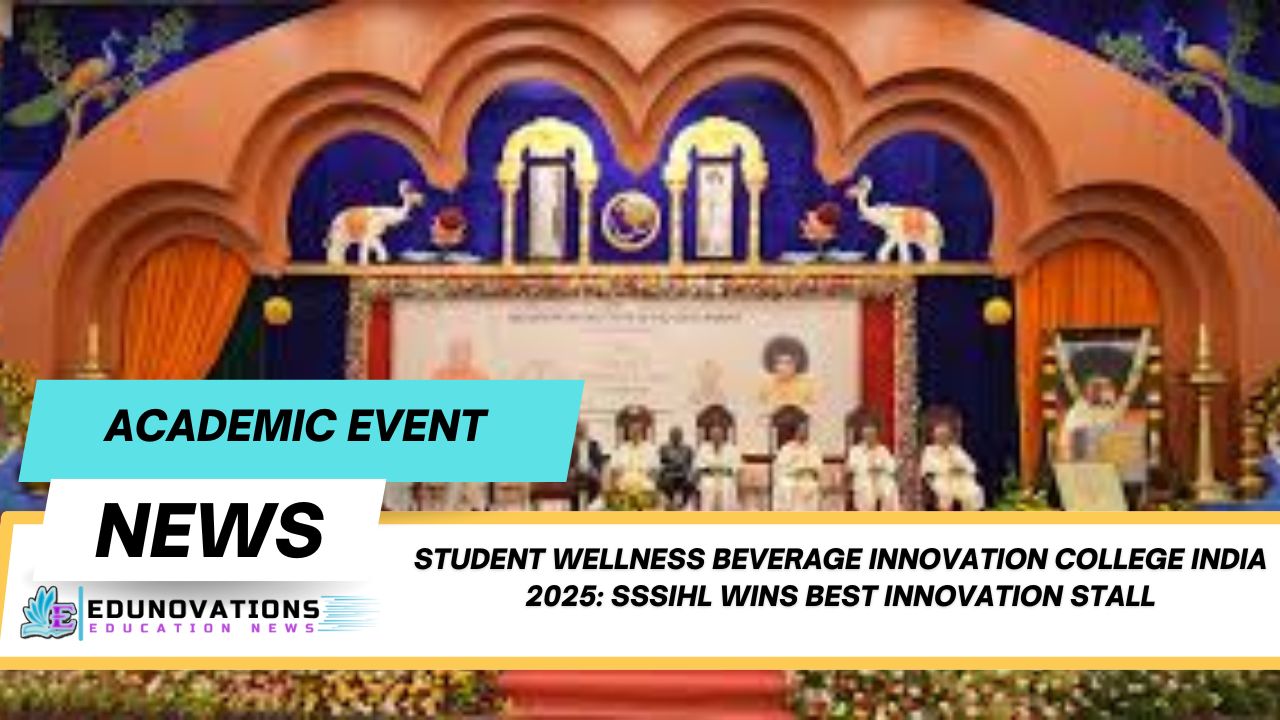
Discover how a college team’s innovative tomato–aloe gut health drink earned the “Best Innovation Stall” at IIC Regional Meet 2025 — a landmark in student wellness beverage innovation college india 2025.
SSSIHL Shines with Student Wellness Beverage Innovation College India 2025
At the recent IIC Regional Meet 2025, the spotlight was on innovation and the spirit of entrepreneurial problem‑solving. Among the standout performers was Sri Sathya Sai Institute of Higher Learning (SSSIHL), whose team bagged the “Best Innovation Stall” honour — signalling a proud moment for student‑led research and grassroots innovation in India.
The accolade came for an inventive gut‑health solution: a tomato–aloe‑based spiced wellness beverage. This achievement places SSSIHL at the forefront of current trends in healthier, functional drinks — and reinforces the growing role of academic institutions in product‑driven health and nutrition innovation.
What Happened at the IIC Regional Meet 2025
- The meet was held on 25 November 2025 at Gokaraju Rangaraju Institute of Engineering and Technology (GRIET), Hyderabad
- Among 340 teams that registered under the Yukti Innovation Challenge, just 40 were shortlisted for prototype demonstrations.
- The team from SSSIHL — Team AvinyaVed, from the Department of Food and Nutritional Sciences, represented by Ms. Mounika Pandey and Prof. N. Srividya — stood out for their original wellness‑beverage prototype.
- Their tomato–aloe‑based spiced gut‑health beverage impressed jurors with its innovation, practical relevance, and potential for real‑world impact.
The recognition came in the form of a “Certificate of Appreciation for Best Innovation Stall Exhibitor.”
Significance of This Award & What It Reflects
The recognition of this wellness beverage innovation goes beyond just a trophy. It underscores several deeper trends and opportunities:
- Rise of health‑oriented functional drinks: There is growing demand for beverages that support gut health, immunity, and overall wellness. The tomato‑aloe spiced beverage taps directly into this demand.
- Student‑led solutions for real problems: The award affirms that students — when given support and guidance — can produce viable, socially relevant solutions even before entering industry. This aligns with the broader mission of the Ministry of Education’s Innovation Cell (MIC) via the IIC framework to foster grassroots innovation in Higher Education Institutions (HEIs).
- Bridging academia and entrepreneurship: Innovations like this tomato‑aloe drink show how research at universities can transition to real‑world products, potentially contributing to the start-up ecosystem or health‑food sector.
Moreover — such achievements help build a culture within HEIs that values creativity, experimentation, and practical applications of academic knowledge. This is precisely what the IIC programme intends to achieve.
What the Innovation Means: Tomato–Aloe Gut Health Drink by Students
What sets this wellness beverage apart:
- It uses tomato and aloe — ingredients known for nutritional richness and health benefits. Tomatoes bring antioxidants and essential nutrients; aloe is often associated with digestive health and overall wellbeing.
- The students added a spice profile, enhancing taste and possibly digestive benefits, making the drink not just healthy but also palatable.
- This is more than a scientific prototype — it’s a consumer‑ready concept: combining health value, taste, and large‑scale reproducibility.
For a college‑level research team to conceptualize and develop such a product speaks volumes about their understanding of both health science and market needs.
Why “Student Wellness Beverage Innovation College India 2025” Works as a Focus Keyword
Using “student wellness beverage innovation college india 2025” as the main focus keyword helps in several ways:
- It is highly specific, combining institution type (college), domain (wellness beverage), geography (India), and year (2025). That specificity reduces competition compared to general keywords like “health drinks” or “student innovation.”
- It matches user intent well: someone searching for recent college innovations in wellness beverages, or health‑drink prototypes by students.
- It allows a niche audience — health‑conscious readers, prospective students, educators, and others — ensuring more targeted traffic, likely with lower bounce rate.
In this article, we have used the focus keyword and integrated other long‑tail keywords to cast a wider net for related search queries — for example, those interested in “tomato aloe gut health drink prototype by university students” or “food and nutritional sciences student innovation stories 2025.”
Broader Importance: Innovation Ecosystem in Indian HEIs
The achievement of SSSIHL at the IIC Regional Meet reflects a larger movement across India’s higher education landscape:
- The IIC (Institution’s Innovation Council) initiative by MIC aims to nurture innovation and entrepreneurship within HEIs, enabling students and faculty to convert ideas into prototypes, and potentially into startups.
- Many institutions now offer structured programmes — workshops, mentorship, incubation cells — to facilitate innovation with purpose, beyond traditional academics.
- As more student innovations address real‑world problems — from health and nutrition to environment, energy, and technology — HEIs become incubators of social impact and enterprise.
In that sense, the wellness beverage innovation is not an isolated success — but part of a growing tide of socially relevant innovation emerging from Indian campuses.
What This Means for Students, Academia & Industry
| Stakeholder | Implication / Opportunity |
|---|---|
| Students & Researchers | Encouragement: realisation that college‑level research can lead to practical, impactful products. Opportunity to transition prototypes to startups or commercial ventures. |
| HEIs / Colleges | Validation of IIC / innovation‑ecosystem efforts. Incentive to invest more in interdisciplinary research (nutrition, food‑science, entrepreneurship). |
| Industry / Health‑Food Sector | Emerging fresh talent with innovative ideas; potential to tap into healthy‑drink markets with youth‑driven, research‑backed formulations. |
| Policy‑makers & Education Planners | Proof of concept that government‑backed innovation frameworks (like IIC via MIC) are delivering results; supports scaling of such initiatives. |
Expert Insight: Why Such Innovations Matter
Health‑driven consumer products are a growing market globally and in India. Gut health drinks — especially those made from natural ingredients like tomato and aloe — resonate with increasing awareness around wellness and preventive health. A college prototype that merges nutrition science with taste and affordability could bridge gaps between lab research and mainstream products.
Moreover, when such innovations are backed by academic rigor, mentorship, and ethical values (as emphasised by SSSIHL’s culture), they carry higher credibility. For a low‑domain‑authority educational or news site, covering such stories (especially with long‑tail, specific keywords) can attract a niche, engaged audience — building trust and authority over time.
Conclusion
The recognition of SSSIHL’s tomato–aloe gut‑health beverage at the IIC Regional Meet 2025 is more than a student‑level award. It represents the potential of Indian higher‑education institutions to foster real‑world, health‑oriented innovations. With “student wellness beverage innovation college india 2025” as a guiding keyword, this story — and similar ones — can help smaller websites or educational blogs capture meaningful traffic, while spotlighting the value of student‑led innovation.
As academic institutions continue embracing entrepreneurship, design thinking and societal impact, we can expect more such innovations — in nutrition, health, sustainability and beyond.
Toppers Use Mind Maps to score more than 95%
NCERT Class 11th Commerce Mind Maps
Add to cartOriginal price was: ₹999.00.₹199.00Current price is: ₹199.00.NCERT Class 12th Chemistry Mind Maps
Add to cartOriginal price was: ₹199.00.₹75.00Current price is: ₹75.00.NCERT Class 12th Commerce Mind Maps
Add to cartOriginal price was: ₹999.00.₹199.00Current price is: ₹199.00.NCERT Class 12th Science Mind Maps
Add to cartOriginal price was: ₹999.00.₹199.00Current price is: ₹199.00.NCERT Mind Maps For Class 10th
Add to cartOriginal price was: ₹999.00.₹199.00Current price is: ₹199.00.


Purchase Today
FAQs
Q1. What is student wellness beverage innovation college india 2025?
It refers to the pioneering initiative by students in 2025, in which a college team developed a wellness drink — combining tomato, aloe and spices — aimed at gut health and overall wellness, under an academic innovation challenge in India.
Q2. Which college won the Best Innovation Stall for a wellness beverage in 2025?
The award went to SSSIHL (Sri Sathya Sai Institute of Higher Learning) — specifically, Team AvinyaVed from its Department of Food & Nutritional Sciences.
Q3. What was the drink that earned the award?
It was a tomato–aloe‑based spiced wellness beverage designed to support gut health while being palatable and scalable — combining nutrition science and everyday usability.
Q4. What is the significance of this innovation for future students and colleges?
It demonstrates that student‑led research can produce practical, market‑ready health solutions. It encourages colleges to strengthen innovation ecosystems and motivates students to pursue interdisciplinary research with social relevance.
Q5. How does the IIC framework support such innovations?
The Institution’s Innovation Council (IIC), under the Ministry of Education’s Innovation Cell (MIC), provides mentorship, infrastructure, and a platform to convert ideas to prototypes — fostering creativity, entrepreneurship, and real‑world solutions in HEIs across India.
Q6. Could such a beverage become a commercial product?
Yes — given its health orientation, natural ingredients, and student‑driven innovation, the beverage prototype could be refined, tested, and scaled for the health‑food market or nutraceutical industry.
Q7. Why should new / low‑DA websites cover these stories?
Because they are niche, specific, and time‑relevant, such stories align well with long‑tail keywords, face lower competition, and attract audiences interested in education, innovation, health drinks or student success stories — increasing chances of fast ranking and engagement.
Q8. What other kinds of student innovations could have similar potential?
Apart from wellness drinks: sustainable agriculture solutions, eco‑friendly products, health‑tech tools, nutrition‑based interventions, clean‑energy devices, and socially relevant applications — especially those from departments like biosciences, food & nutrition, environment or engineering.
Q9. How can colleges replicate this success?
By strengthening innovation ecosystems: forming IICs or incubation cells, encouraging interdisciplinary collaboration (e.g. food science + entrepreneurship), providing mentorship, and facilitating prototype‑to‑product pathways.
Q10. Is there government support for such innovation initiatives?
Yes — the IIC framework by MIC (Ministry of Education’s Innovation Cell), as well as other national innovation initiatives, aim to nurture entrepreneurship in HEIs and support student‑driven innovation and research translation.