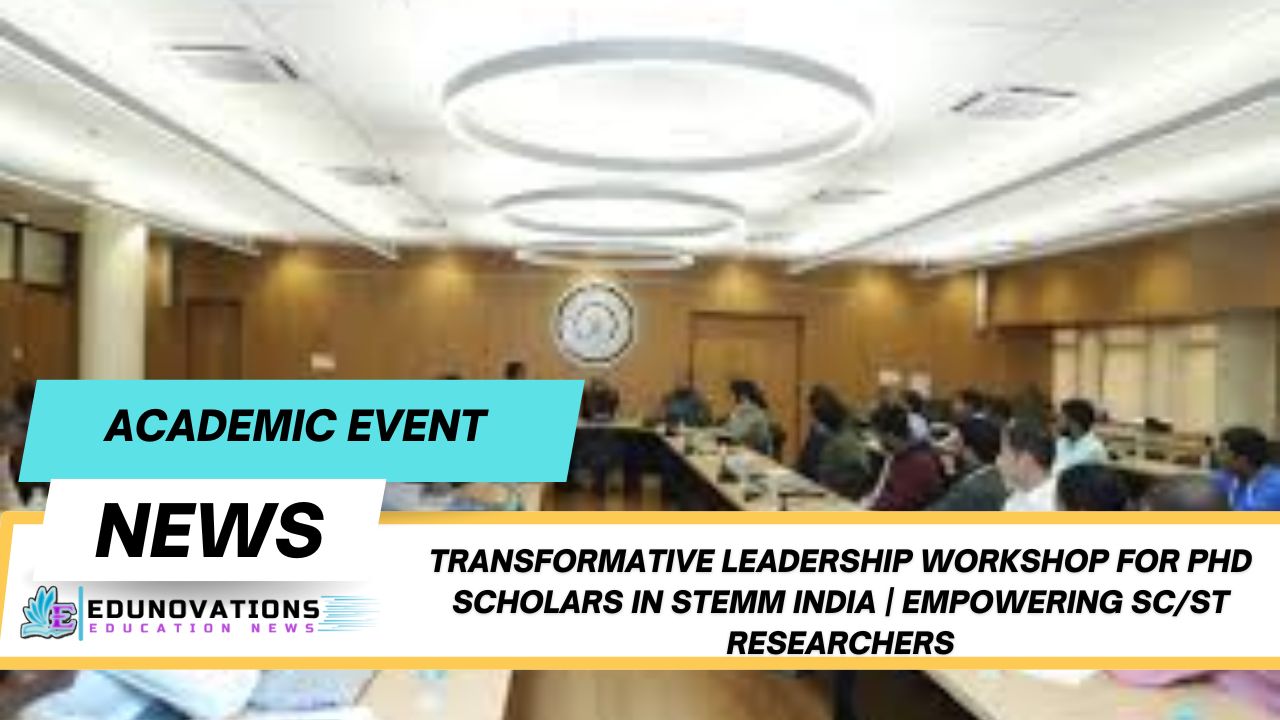
Discover how the transformative leadership workshop for PhD scholars in STEMM India equips SC/ST researchers with advanced skills for research, teaching, and leadership roles.
In a significant stride toward nurturing inclusive academic leadership, the Indian Institute of Technology (IIT) Delhi recently hosted a transformative leadership workshop for PhD scholars in STEMM India, bringing together promising researchers from across the country. This three‑day initiative not only reinforced research competencies but also highlighted leadership, communication, and professional development—areas often overlooked in doctoral training. The workshop is part of a broader effort to uplift scholars from marginalized communities and foster diverse representation in higher education leadership.
The transformative leadership workshop for PhD scholars in STEMM India was designed as a national‑level mentoring programme with a clear mission: to empower advanced‑stage PhD candidates, particularly from Scheduled Caste (SC) and Scheduled Tribe (ST) communities, to navigate academic and research careers with confidence. Organized by the Initiative for Caste Equity (ICE), the Office of Diversity & Inclusion (ODI), and the SC/ST Cell at IIT Delhi, the event drew participants from premier institutions including IITs, National Institutes of Technology (NITs), and other reputed higher education institutes.
A Strategic Platform for Academic Excellence
The core objective of the transformative leadership workshop for PhD scholars in STEMM India was to provide a structured platform where doctoral researchers could refine their professional profiles and prepare for faculty roles at leading universities and research centres. Over the span of three days, attendees engaged in intensive sessions that combined rigorous academic critique with practical leadership training.
This unique initiative is rooted in the understanding that conventional PhD programmes often focus heavily on research outcomes but may not equip scholars with the full spectrum of skills needed to succeed as educators, leaders, or independent investigators. To bridge this gap, the workshop emphasised the following pillars:
- Research Presentation and Peer Review: Participants presented their current research projects to panels of eminent faculty members, receiving constructive feedback aimed at strengthening their academic impact and publication prospects.
- Teaching and Communication Skills: Researchers learned how to design and deliver effective lectures, engage diverse student audiences, and articulate complex ideas with clarity and confidence, essential components of academic leadership.
- Leadership & Career Planning: Sessions included expert advice on faculty recruitment strategies, networking techniques, and insights into navigating the competitive landscape of higher education.
By the end of the workshop, participants had gained exposure to both the intellectual and interpersonal aspects of academic success, making the transformative leadership workshop for PhD scholars in STEMM India a watershed event in their professional journeys.
Addressing Under‑Representation in Academia
One of the most compelling facets of the programme was its targeted approach toward scholars from SC and ST communities. For decades, these groups have been under‑represented in STEMM leadership roles, particularly within faculty positions at top institutions. The workshop’s focus on inclusive development signals a broader commitment to equity within the Indian academic ecosystem.
According to expert observers, creating spaces that celebrate diverse perspectives not only strengthens institutional excellence but also enriches the research environment with varied lived experiences. With a cohort selected through rigorous academic criteria and potential for future impact, the workshop demonstrated how targeted interventions can help break systemic barriers and open doors for under‑represented talent.
The emphasis on inclusion was reinforced by sessions on confidence building and self‑advocacy—skills that are particularly valuable for scholars who may face social or cultural pressure within academic circles. Alongside technical mentorship, workshop facilitators included activities on interpersonal communication, resilience, and strategies for managing career uncertainties—complementary skills that distinguish future leaders.
Interdisciplinary Engagement and Networking
Consistent with the expansive theme of leadership, the workshop encouraged cross‑disciplinary interactions among participants specializing in Chemical Engineering, Materials Science & Engineering, Atmospheric Sciences, Textile & Fibre Engineering, and related STEMM fields. This interdisciplinary engagement not only broadened academic perspectives but also fostered collaborations that could extend beyond the workshop itself.
Participants were grouped into interactive cohorts where they shared research challenges, proposed solutions, and learned to communicate complex ideas to peers outside their immediate domain. Such exercises are especially valuable in today’s academic landscape, where interdisciplinary collaborations are increasingly becoming the norm and scholarship is enhanced by diverse methodological insights.
Networking opportunities during the workshop enabled scholars to interact with senior faculty, visiting researchers, and institutional leaders. Building these professional connections early in one’s career can significantly boost visibility and access to postdoctoral or teaching positions. These connections extend beyond the immediate hosting institution, further amplifying the potential reach of participants’ academic careers.
Skill Building for the Next Generation of Educators
A defining characteristic of the transformative leadership workshop for PhD scholars in STEMM India was its emphasis on hands‑on skill building. Workshops on job interview readiness, research grant proposal writing, and academic portfolio development were hallmarks of the event. These skill sets are indispensable for aspiring faculty members and researchers looking to transition from doctoral training to independent roles.
Seasoned educators shared personalised insights on how to craft teaching statements, design effective curricula, and articulate future research goals—components that are often key determinants in faculty appointment processes. Participants also benefited from mock interviews and portfolio evaluations, which replicate real‑world hiring scenarios and provide crucial experience for navigating selection committees with confidence.
Sessions dedicated to publication strategy equipped researchers with tools for selecting high‑impact journals, navigating peer review, and managing revisions effectively—skills that directly influence academic visibility and success. These strategic areas of professional development help position participants competitively in an academic job market that values both scholarly output and leadership potential.
Expert Perspectives on Leadership and Diversity
In dialogue sessions, thought leaders emphasised the changing landscape of higher education globally. “Leadership in academia today requires more than scholarly excellence,” noted one academic expert during a panel discussion. “It demands the ability to mentor diverse student cohorts, communicate across disciplines, and contribute meaningfully to society.” This insight resonates with broader trends in academic hiring, where institutions are increasingly prioritising inclusive leadership and community engagement.
Experts also highlighted the importance of cultural competency in academic leadership. As classrooms and research teams become more diverse, educators must be prepared to navigate cultural dynamics with sensitivity and respect. Workshops that blend technical expertise with social awareness thus offer a competitive edge to emerging scholars and uphold the values of inclusive excellence.
One philosopher and academic referenced during discussions remarked that leadership goes beyond administrative function— it is rooted in empathy, equity, and intellectual curiosity. Drawing from their own journey in higher education, this perspective added a nuanced understanding of how leadership can be reimagined within the Indian context.
Measuring the Impact of the Workshop
While it may be too early to quantify long‑term outcomes, preliminary indicators suggest that the transformative leadership workshop for PhD scholars in STEMM India has already made a meaningful impact on participants. Many scholars reported heightened confidence in presenting their research, stronger clarity in career objectives, and increased motivation to pursue faculty positions at national and international institutions.
Feedback from faculty mentors highlighted the workshop’s effectiveness in enhancing communication skills and broadening the academic perspectives of participants. Some participants have also expressed interest in initiating collaborative research proposals and publishing joint papers with peers met during the event.
By providing a structured avenue for skill building and professional growth, the workshop contributes to strengthening the academic pipeline in STEMM fields—particularly for scholars from historically marginalised backgrounds.
Linking the Academy to Broader Educational Resources
As part of holistic academic support, researchers and aspiring educators can benefit from a suite of online resources that complement workshops like this:
- Explore comprehensive academic courses and preparation materials through internal courses designed to support deeper learning in STEM and humanities.
- Stay updated with global and national developments via the current affairs section to connect academic interests with broader trends.
- Access structured notes and MCQs that reinforce foundational concepts and enhance exam preparedness.
- Deepen understanding through videos and syllabus resources tailored to specific academic goals.
- Download free NCERT PDFs and mind maps for foundational support in teaching and research fundamentals.
Additionally, institutions and educators seeking professional services and school connections can consider outreach through established educational technology partners like Mart Ind Infotech, which offers contact and engagement platforms for academic networking and student support.
Looking Ahead
The success of the transformative leadership workshop for PhD scholars in STEMM India underscores the value of intentional, equity‑driven academic development programmes. As higher education institutions continue to prioritise diversity, equity, and inclusion, initiatives like these chart a path for systemic change—one that ensures talent from all backgrounds has a fair opportunity to excel.
With an increasing number of scholars equipped with leadership, research, and communication skills, the future of academia in India appears more inclusive and dynamic. It is anticipated that the lessons from this workshop will ripple outward, inspiring similar programmes across institutions and creating a network of empowered scholars ready to shape the next generation of scientific discovery and education.
Toppers Use Mind Maps to score more than 95%
NCERT Class 11th Commerce Mind Maps
Add to cartOriginal price was: ₹999.00.₹199.00Current price is: ₹199.00.NCERT Class 12th Chemistry Mind Maps
Add to cartOriginal price was: ₹199.00.₹75.00Current price is: ₹75.00.NCERT Class 12th Commerce Mind Maps
Add to cartOriginal price was: ₹999.00.₹199.00Current price is: ₹199.00.NCERT Class 12th Science Mind Maps
Add to cartOriginal price was: ₹999.00.₹199.00Current price is: ₹199.00.NCERT Mind Maps For Class 10th
Add to cartOriginal price was: ₹999.00.₹199.00Current price is: ₹199.00.


Purchase Today
10 FAQs
- What is the transformative leadership workshop for PhD scholars in STEMM India?
It is a three‑day national workshop designed to equip PhD researchers, especially from SC/ST communities, with leadership, research, and teaching skills. - Who can participate in the transformative leadership workshop for PhD scholars in STEMM India?
Advanced PhD scholars from SC and ST categories at IITs, NITs, and other HEIs are eligible, including recent post‑doctoral candidates. - What are the key objectives of the transformative leadership workshop for PhD scholars in STEMM India?
The workshop aims to enhance academic leadership, research presentation, teaching competence, and career planning skills. - Which fields are covered in the transformative leadership workshop for PhD scholars in STEMM India?
It includes disciplines such as Chemical Engineering, Materials Science, Atmospheric Sciences, and Textile & Fibre Engineering. - How does the transformative leadership workshop for PhD scholars in STEMM India promote inclusive academic leadership?
By focusing on under‑represented groups and providing tailored guidance for academic career development, the workshop fosters equitable opportunities. - What benefits do participants gain from the transformative leadership workshop for PhD scholars in STEMM India?
Participants benefit from mentorship, research feedback, communication skills training, and networking opportunities. - Are interdisciplinary interactions part of the transformative leadership workshop for PhD scholars in STEMM India?
Yes, interdisciplinary engagement is emphasised to broaden perspectives and foster collaboration. - Does the transformative leadership workshop for PhD scholars in STEMM India include mock interviews?
Yes, mock interviews and job readiness sessions are part of professional skill development. - How does the transformative leadership workshop for PhD scholars in STEMM India prepare participants for faculty roles?
By offering targeted sessions on teaching strategy, research portfolios, and leadership competencies. - Where can participants find additional academic resources related to the transformative leadership workshop for PhD scholars in STEMM India?
Participants can use internal educational platforms for courses, notes, MCQs, videos, and NCERT materials to support ongoing learning.