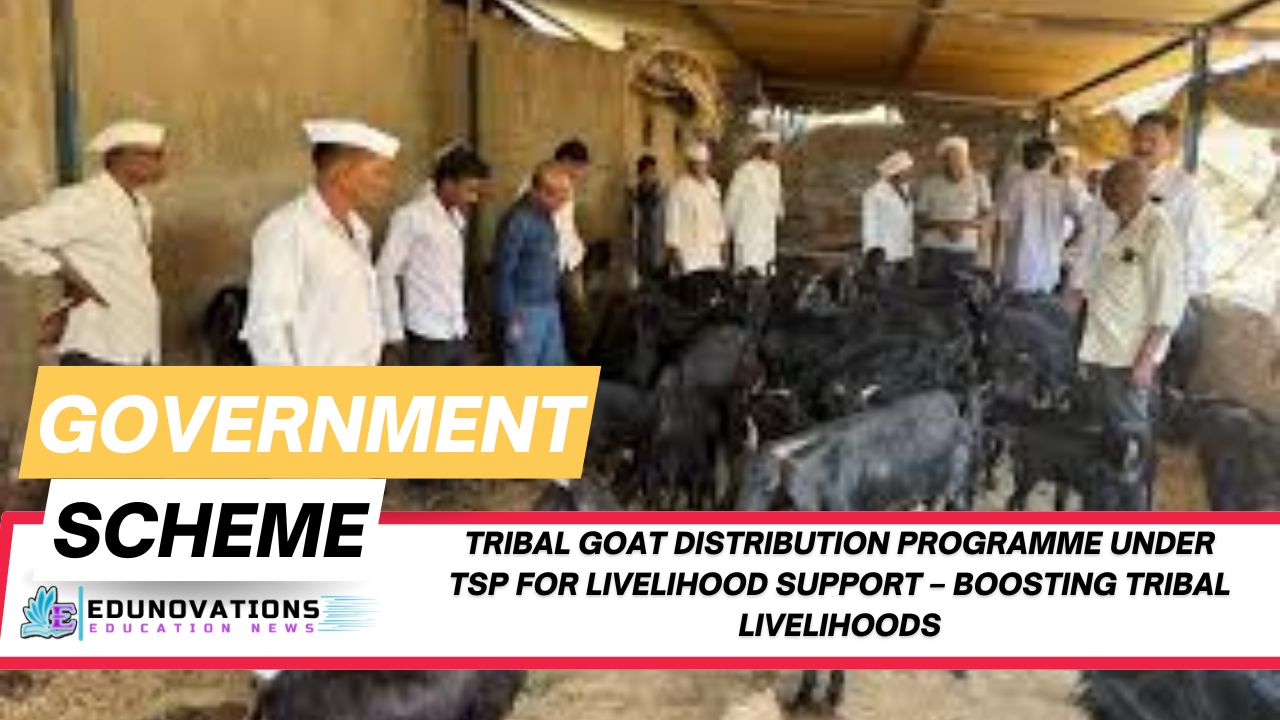
Discover how the Tribal Goat Distribution Programme under TSP empowers tribal farmers with livestock, training, and scientific goat farming for sustainable livelihood growth.
Empowering Tribal Communities Through Goat Distribution
India’s agricultural and livestock development programs have long recognized the importance of supporting tribal communities with sustainable livelihood opportunities. One such initiative, the Tribal Goat Distribution Programme under TSP for livelihood support, is designed to improve the economic status of tribal families by providing goats and training in modern goat rearing techniques. This program has become a vital tool in promoting livelihood improvement through goat farming tribal beneficiaries.
The programme specifically targets tribal farmers, ensuring that benefits reach marginalized communities. By integrating scientific goat farming training for tribal farmers in India, the initiative not only provides livestock but also equips farmers with knowledge to enhance productivity and income sustainably. Experts in livestock development emphasize that structured support and technical guidance are crucial to maximizing the impact of such schemes.
Objectives of the Tribal Goat Distribution Programme
The key goals of this initiative are:
- Livelihood Enhancement: Providing goats to tribal families to generate a stable source of income.
- Capacity Building: Conducting goat farming practices and technical training for small farmers to ensure they can manage herds effectively.
- Sustainable Development: Encouraging adoption of scientific and environmentally friendly goat-rearing practices.
- Empowerment of Women: Many tribal households are female-headed, making livestock support a critical tool for women’s economic empowerment.
This holistic approach ensures that the program goes beyond mere distribution. It fosters long-term livelihood security, reduces migration from rural areas, and strengthens local economies.
Programme Implementation and Coverage
The programme is executed under the Tribal Sub-Plan (TSP) framework, which focuses on targeted interventions in regions with high tribal populations. Farmers who meet eligibility criteria receive a specified number of goats, along with essential inputs such as feed, vaccines, and veterinary support. The distribution process often includes a demonstration on scientific goat farming techniques, reinforcing the knowledge needed to maintain healthy and productive herds.
Key steps include:
- Beneficiary Identification: Tribal households are selected based on socio-economic vulnerability.
- Training Workshops: Farmers receive hands-on training in goat management, breeding, disease prevention, and nutrition.
- Distribution of Goats and Inputs: Farmers are provided with goats, feed supplements, and veterinary medicines.
- Post-Distribution Support: Technical guidance continues post-distribution to ensure sustainable practices.
Recent data from field reports indicate that over 500 tribal families in various districts have benefited from this program, marking a substantial improvement in household income and food security.
Scientific Goat Farming Training for Tribal Farmers in India
A major feature of the program is scientific goat farming training. Farmers learn modern rearing techniques that include:
- Proper housing and sanitation for goats
- Balanced nutrition and feed management
- Vaccination and disease control measures
- Breeding strategies to improve herd quality
- Record-keeping for productivity monitoring
Such training ensures that tribal farmers not only receive livestock but also gain the knowledge to make goat farming profitable and sustainable. According to livestock experts, training increases survival rates, improves growth rates, and enhances overall profitability.
Livelihood Improvement Through Goat Farming Tribal Beneficiaries
The impact of goat distribution goes beyond income generation. It contributes to:
- Food Security: Goat milk and meat provide essential nutrition for tribal households.
- Economic Stability: Sale of goats and by-products generates regular income.
- Empowerment of Marginalized Groups: Female and young members in households gain skills that promote independence.
- Community Development: Shared knowledge spreads to neighboring villages, multiplying the benefits.
Several case studies have shown that families engaged in livelihood improvement through goat farming tribal beneficiaries often experience a 20–30% increase in annual household income.
Goat Rearing Input Distribution Under Tribal Sub Plan Scheme
The program also ensures the provision of inputs critical to goat health and productivity. This includes:
- Mineral mixtures and feed supplements
- Vaccines and medicines for disease prevention
- Breeding assistance and artificial insemination support in some regions
By distributing these inputs, the government and implementing agencies ensure that scientific goat farming practices are fully supported, reducing mortality rates and increasing productivity.
Expert Insights on Goat Farming Initiatives
Dr. Ramesh Chandra, a livestock development expert, notes:
“Livestock programs that combine asset distribution with capacity building create sustainable livelihoods. The TSP goat distribution initiative is a model for inclusive development.”
Experts also recommend that integrating goat farming practices and technical training for small farmers with access to local markets can further enhance economic benefits.
Benefits of the Programme
The program delivers tangible benefits at multiple levels:
- Economic: Increased income and reduced dependency on external aid
- Social: Empowerment of women and marginalized tribal groups
- Technical: Improved livestock management skills and adoption of scientific techniques
- Environmental: Encourages sustainable grazing and animal husbandry practices
By fostering scientific goat farming training for tribal farmers in India, the initiative aligns with national goals of rural development, poverty alleviation, and food security.
Internal & External Linking Strategy for SEO
For websites with low domain authority, integrating internal and external links enhances credibility and boosts SEO performance. Relevant internal links include:
- NCERT Courses – for education-related agricultural courses
- Current Affairs – updates on rural development programs
- Notes – reference notes for livestock schemes
- MCQs – practice questions on agricultural programs
- Videos – training videos for goat rearing
- Syllabus – academic syllabi covering agriculture
- Free NCERT PDFs – downloadable guides
- NCERT Mind Maps – concept maps for better understanding
External authoritative sources like Mart Ind Infotech provide additional credibility when referencing rural development or educational technology support.
Conclusion
The Tribal Goat Distribution Programme under TSP for livelihood support exemplifies a well-structured initiative that combines resource provision, capacity building, and sustainable practices. By focusing on scientific goat farming training for tribal farmers in India and ensuring goat rearing input distribution under tribal sub plan scheme, the program empowers tribal communities, improves livelihoods, and fosters long-term socio-economic development.
For new websites covering agricultural or rural development content, emphasizing these niche long-tail keywords can significantly enhance visibility, particularly in low-competition spaces, while delivering value to readers seeking practical guidance on tribal livelihood schemes.
Toppers Use Mind Maps to score more than 95%
NCERT Class 11th Commerce Mind Maps
Add to cartOriginal price was: ₹999.00.₹199.00Current price is: ₹199.00.NCERT Class 12th Chemistry Mind Maps
Add to cartOriginal price was: ₹199.00.₹75.00Current price is: ₹75.00.NCERT Class 12th Commerce Mind Maps
Add to cartOriginal price was: ₹999.00.₹199.00Current price is: ₹199.00.NCERT Class 12th Science Mind Maps
Add to cartOriginal price was: ₹999.00.₹199.00Current price is: ₹199.00.NCERT Mind Maps For Class 10th
Add to cartOriginal price was: ₹999.00.₹199.00Current price is: ₹199.00.





Purchase Today
FAQs on Tribal Goat Distribution Programme
- What is the Tribal Goat Distribution Programme under TSP?
It is an initiative providing goats, training, and inputs to tribal households for livelihood support. - Who benefits from goat farming training under this program?
Tribal farmers across India, especially women and marginalized groups, receive scientific goat farming training for tribal farmers in India. - What inputs are provided under the Tribal Sub Plan scheme?
Feed, vaccines, medicines, and breeding support are distributed to ensure healthy goat herds. - How does goat farming improve tribal livelihoods?
It provides sustainable income, food security, and economic empowerment for tribal households. - Are technical trainings part of the program?
Yes, farmers are taught goat farming practices and technical training for small farmers, including disease prevention and breeding. - What is the role of women in the program?
Many female-headed households participate, gaining economic independence and management skills. - How is the program linked to sustainable development?
Adoption of scientific goat rearing and proper grazing practices ensures long-term ecological balance. - Can tribal farmers sell goats and by-products?
Yes, the program encourages market participation to generate additional income. - Is there post-distribution support for farmers?
Yes, technical guidance continues post-distribution to ensure adoption of best practices. - Where can I learn more about goat rearing training for tribal farmers?
You can access courses, notes, videos, and syllabus content on platforms like NCERT Courses.