
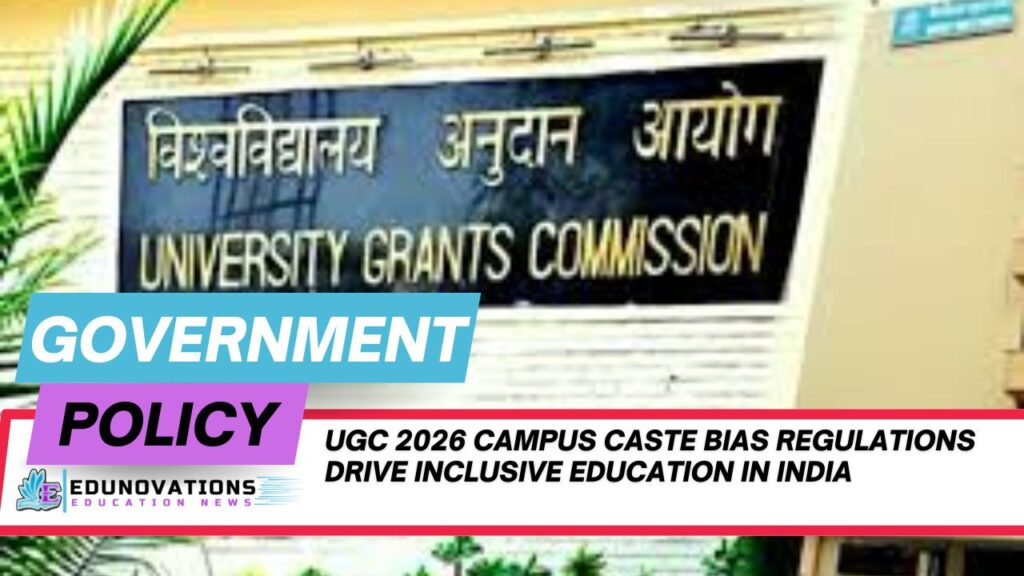
Explore UGC 2026 Campus Caste Bias Regulations Drive and university equal opportunity rules to enhance inclusion and equity across Indian higher education institutions.
India’s higher education landscape is witnessing a historic regulatory overhaul as the University Grants Commission (UGC) introduces the UGC 2026 campus caste bias regulations and university equal opportunity rules. This initiative aims to create safer, more inclusive campuses, ensuring that students from all social backgrounds—Scheduled Castes (SCs), Scheduled Tribes (STs), Other Backward Classes (OBCs), and disadvantaged groups—receive equitable treatment in academic institutions.
The move comes amid a stark rise in complaints related to caste-based discrimination in universities. Data from UGC shows a 118.4% increase over five years, from 173 cases in 2019-20 to 378 in 2023-24, highlighting persistent challenges in maintaining fair and inclusive learning environments.
Understanding the UGC 2026 Regulations
The new UGC 2026 campus caste bias regulations and university equal opportunity rules replace the earlier 2012 framework, broadening the scope of anti-discrimination measures. For the first time, these regulations explicitly define caste-based discrimination, including unfair treatment based on religion, gender, disability, or place of birth. Any act undermining human dignity or equality in education now falls under the purview of these rules.
Key highlights include:
- Mandatory Equal Opportunity Centres (EOCs): Every higher education institution must establish an EOC to monitor inclusion, assist disadvantaged students, and address complaints.
- Equity Committees: Each institution must maintain a committee led by the chief administrator, including representatives from SC, ST, OBC, women, and persons with disabilities. Committees must meet at least twice annually.
- Transparency Measures: Bi-annual reports on campus demographics, dropout rates, and complaint resolutions are required.
- Round-the-Clock Equity Helplines: Institutions will offer helplines and mobile “equity squads” to monitor vulnerable campus areas.
- Equity Ambassadors: Designated personnel across departments, hostels, and facilities will flag violations promptly.
These initiatives are supported by stringent enforcement mechanisms. Institutions failing to comply can face suspension from UGC programs, be barred from offering degrees, or, in extreme cases, lose recognition entirely. This ensures that anti-discrimination policies are not merely advisory but legally binding.
Institutional Accountability and Monitoring
The UGC 2026 campus caste bias regulations and university equal opportunity rules place clear responsibility on institutional leadership. Vice-chancellors and administrators must act swiftly on complaints. Any complaint triggers a committee meeting within 24 hours, and decisions must follow fixed timelines. Appeals can be made to an ombudsperson, creating multiple layers of accountability.
A national monitoring committee with members from professional councils and civil society will oversee implementation and review cases at least twice a year. This approach emphasizes credible reporting, data-driven oversight, and measurable outcomes—areas previously flagged by the Supreme Court.
Expert Insights on Campus Inclusion
Education experts suggest that while the framework is comprehensive, its success will hinge on transparent implementation and consistent follow-through. Dr. Meera Iyer, a leading higher education analyst, notes, “These regulations mark a shift from advisory norms to enforceable obligations. The establishment of EOCs and equity committees can fundamentally transform campus culture, but only if institutions embrace accountability genuinely.”
Additionally, incorporating equity monitoring tools like mobile squads and equity ambassadors ensures real-time protection for vulnerable students, bridging gaps that earlier frameworks failed to address.
Broader Implications for Indian Higher Education
The regulations aim to instill a culture of equity and inclusion across universities and colleges. They are expected to:
- Improve representation and participation of marginalized communities in higher education.
- Reduce dropout rates among disadvantaged students.
- Strengthen the overall quality of education by promoting equitable learning environments.
- Foster social harmony by mitigating caste-based conflicts on campuses.
By creating standardized monitoring and reporting mechanisms, the UGC 2026 campus caste bias regulations and university equal opportunity rules provide an actionable roadmap for institutional leaders, ensuring compliance with both legal and ethical standards.
Challenges and Future Directions
Despite comprehensive guidelines, challenges remain:
- Capacity Building: Institutions must train staff to handle complaints efficiently.
- Data Management: Accurate, caste-disaggregated data is critical to evaluate outcomes.
- Cultural Change: Policies alone cannot change entrenched biases; awareness campaigns and student engagement are vital.
Dr. Rajesh Chaturvedi, former UGC policy advisor, emphasizes, “Policy enforcement is necessary but insufficient. Real change requires cultural adaptation, sensitization programs, and continuous evaluation.”
Enhancing Student Support Systems
The regulations encourage universities to strengthen student support through:
- Equity Helplines: Accessible 24/7 for reporting concerns.
- Counselling Services: Specialized support for students facing discrimination.
- Regular Feedback Mechanisms: Students can voice concerns proactively, enhancing transparency.
These measures align with global best practices in higher education, positioning Indian universities as leaders in campus equity.
Integration with Digital Education Platforms
The rise of online education platforms complements the new UGC regulations. Students can access resources such as NCERT Courses, current affairs updates, notes, MCQs, videos, syllabus downloads, and free NCERT PDFs to bridge learning gaps. Equity measures now extend to digital learning spaces, ensuring inclusivity across both physical and virtual classrooms.
Conclusion
The UGC 2026 campus caste bias regulations and university equal opportunity rules represent a transformative step in Indian higher education. By combining enforceable policies, institutional accountability, and robust monitoring mechanisms, these regulations are set to create safer, more equitable learning environments nationwide. Success will depend on transparent implementation, data-driven oversight, and an ongoing commitment to fostering inclusive campus cultures.
Toppers Use Mind Maps to score more than 95%
-
NCERT Class 11th Commerce Mind Maps
Add to cartOriginal price was: ₹999.00.₹199.00Current price is: ₹199.00. -
NCERT Class 12th Chemistry Mind Maps
Add to cartOriginal price was: ₹199.00.₹75.00Current price is: ₹75.00. -
NCERT Class 12th Commerce Mind Maps
Add to cartOriginal price was: ₹999.00.₹199.00Current price is: ₹199.00. -
NCERT Class 12th Science Mind Maps
Add to cartOriginal price was: ₹999.00.₹199.00Current price is: ₹199.00. -
NCERT Mind Maps For Class 10th
Add to cartOriginal price was: ₹999.00.₹199.00Current price is: ₹199.00.




Purchase Today
FAQs on UGC 2026 Campus Caste Bias Regulations
- What are the UGC 2026 campus caste bias regulations and university equal opportunity rules?
These regulations define caste-based discrimination and mandate institutions to establish Equal Opportunity Centres, equity committees, and helplines to support marginalized students. - Who is covered under UGC 2026 anti-discrimination policies?
SC, ST, OBC, women, persons with disabilities, and other disadvantaged groups are protected under these rules. - What is the role of an Equal Opportunity Centre (EOC)?
EOCs monitor campus equity, support disadvantaged students, and manage complaints in coordination with equity committees. - How do equity committees function under UGC 2026 regulations?
Committees include representatives from SC, ST, OBC, women, and disabled students and meet at least twice annually to review complaints and campus inclusion efforts. - Are there enforcement mechanisms for institutions failing to comply?
Yes, non-compliant institutions can be barred from UGC programs, lose degree-granting authority, or be removed from UGC recognition. - What support systems exist for students facing caste-based bias?
Round-the-clock helplines, counseling services, and equity ambassadors across departments ensure proactive support. - How does UGC 2026 ensure accountability at universities?
Complaints trigger committee action within 24 hours, with appeals possible through an ombudsperson. National monitoring committees oversee compliance. - What impact will these regulations have on Indian higher education?
They aim to increase representation, reduce dropouts, improve equity, and foster social harmony on campuses. - How are digital learning platforms integrated into UGC equity measures?
Platforms like NCERT courses, MCQs, notes, and free PDFs provide accessible resources for all students, complementing on-campus equity measures. - Who can offer expert guidance on UGC 2026 implementation?
Education analysts and former UGC advisors provide training, awareness programs, and recommendations for effective policy adoption.