
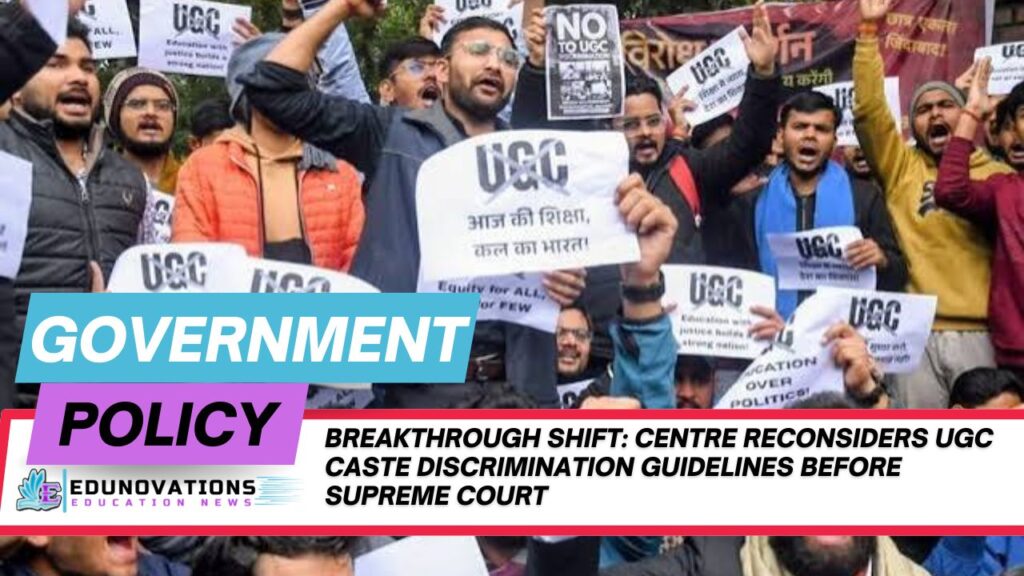
The landscape of Indian higher education governance has hit a critical juncture. In a significant development before the apex court,
The landscape of Indian higher education governance has hit a critical juncture. In a significant development before the apex court, the Union government announced that it is actively reconsidering the contentious framework governing campus equality. For students, educators, and legal scholars navigating academic policy, understanding these regulatory shifts is essential. Whether you are tracking structural policy changes or preparing for academic evaluations, staying informed through verified channels like structured Notes and comprehensive Syllabus guides helps decode complex institutional updates.
The core of the matter rests on how educational systems balance constitutional mandates of equality, social justice, and protection against prejudice. As administrative panels re-evaluate the framework, stakeholders across the academic spectrum are closely monitoring how future drafts will redefine campus inclusivity.
Background and the Genesis of the 2026 Regulations
To comprehend the current legal friction, one must examine the timeline that brought these provisions to the forefront. The University Grants Commission (UGC) notified the UGC (Promotion of Equity in Higher Education Institutions) Regulations, 2026 on January 13, 2026. Designed to establish strict institutional compliance frameworks, these rules aimed to eradicate discriminatory practices across colleges and universities nationwide.
However, the notification immediately triggered intense debates across political and social spectrums. Critics, legal analysts, and student bodies raised questions regarding definitions, scope, and potential implementation loopholes. For students utilizing structured learning aids such as MCQ’s and Videos to stay updated on socio-political developments, understanding the exact wording of the law remains vital.
The framework was originally envisioned to address historical disparities and protect vulnerable demographics. Yet, structural ambiguities quickly pushed the policy into a legal gridlock, forcing intervention from the highest court of the land.
Legal Challenges and the Supreme Court Intervention
The controversy intensified when a batch of petitions was filed before the Supreme Court challenging various provisions of the 2026 guidelines. The matter came up before a bench comprising Chief Justice of India Surya Kant, Justice Joymalya Bagchi, and Justice V Mohana.
The primary bone of contention centered around Regulation 3(1)(c), which specifically defined caste-based discrimination as bias or prejudice directed against members of the Scheduled Castes (SCs), Scheduled Tribes (STs), and Other Backward Classes (OBCs). Petitioners argued that this specific formulation inadvertently omitted students and faculty belonging to the general category from explicit protection under that specific clause, even though broader non-discrimination clauses existed.
Recognizing the sensitivity and far-reaching implications of the matter, the Supreme Court stayed the operation of the 2026 regulations on January 29, 2026. Invoking its powers, the bench ruled that the older 2012 UGC equity regulations would continue to remain in force until further orders, preventing an administrative vacuum while setting the stage for a comprehensive overhaul.
The Centre’s Stance and Solicitor General’s Submission
During the recent court proceedings, Solicitor General Tushar Mehta, appearing for the Union government and the UGC, formally informed the bench that the policy is undergoing a deep structural review.
“It is being reconsidered,” Solicitor General Tushar Mehta submitted before the bench led by Chief Justice Surya Kant, indicating that the government is evaluating all dimensions of the feedback received from various societal segments.
Legal experts note that this decision reflects the government’s intent to navigate a delicate political and social balance. The policy had placed authorities in a complex bind, drawing pushback from upper-caste organizations regarding perceived exclusions, while simultaneously causing concern among Dalit and OBC advocacy groups who viewed any rollback or stay with deep apprehension.
For scholars and competitive exam aspirants tracking these developments, reviewing foundational topics via Current Affairs modules and accessing For NCERT Courses provides the necessary context on constitutional equality and statutory law.
Societal Impact and Expert Perspectives
The debate over campus equity transcends legal technicalities; it touches upon the core ethos of an inclusive educational environment. Sociologists and educationists have long debated the efficacy of institutional equity cells. While proponents argue that explicit statutory definitions are necessary to dismantle deep-rooted systemic biases, critics caution against broad legal definitions that might lead to administrative overreach or procedural misuse.
Furthermore, educational infrastructure providers—such as Mart Ind Infotech, known for supporting digital transformation in schools—emphasize that modern institutions require clear, unambiguous compliance guidelines to foster harmony. When rules are legally contested or vague, institutional administrators face severe hurdles in implementing fair grievance-redressal mechanisms.
To deepen your understanding of educational policies, governance structures, and historical frameworks, students can explore Downloads of Free NCERT PDFs and visual study aids like For NCERT Mind Maps. These resources break down complex legislative milestones into digestible formats for learners at all levels.
Way Forward: What Lies Ahead for Higher Education Policy?
The Supreme Court has granted the UGC and the Union government a four-week window to file a comprehensive counter-affidavit detailing the scope of their reconsideration, with petitioners given subsequent time to submit their rejoinders.
As policymakers draft a revised framework, the primary challenge will be harmonizing anti-discrimination measures with universal protections that satisfy all sections of society without compromising the fundamental objective of social justice. Whether the redrafted policy will narrow legal loopholes or introduce a more balanced compliance matrix remains to be seen. One thing is certain: the evolution of India’s higher education equity policy will continue to shape campus cultures and administrative protocols for years to come.
Toppers Use Mind Maps to score more than 95%
-
NCERT Class 11th Commerce Mind Maps
Add to cartOriginal price was: ₹999.00.₹199.00Current price is: ₹199.00. -
NCERT Class 12th Chemistry Mind Maps
Add to cartOriginal price was: ₹199.00.₹75.00Current price is: ₹75.00. -
NCERT Class 12th Commerce Mind Maps
Add to cartOriginal price was: ₹999.00.₹199.00Current price is: ₹199.00. -
NCERT Class 12th Science Mind Maps
Add to cartOriginal price was: ₹999.00.₹199.00Current price is: ₹199.00. -
NCERT Mind Maps For Class 10th
Add to cartOriginal price was: ₹999.00.₹199.00Current price is: ₹199.00.




Purchase Today
Frequently Asked Questions (FAQs)
1. What are the ugc caste discrimination guidelines supreme court hearing update details?
The Centre informed the Supreme Court that the 2026 UGC equity regulations are actively being reconsidered by the government, and the court has granted four weeks to file a comprehensive counter-affidavit.
2. Why is the centre rethinking ugc equity regulations higher education policies?
The government is reviewing the policy to address complex legal challenges, bridge definitional gaps, and resolve protests and concerns raised by both general category groups and marginalized communities.
3. What led to the supreme court stay on ugc promotion of equity regulations?
The Supreme Court stayed the 2026 regulations on January 29, noting that specific provisions were prima facie vague, could lead to sweeping consequences, and risked dividing campus communities.
4. Why are ugc caste discrimination rules controversial among student groups?
The controversy stems primarily from Regulation 3(1)(c), which explicitly defines caste-based discrimination in relation to SC, ST, and OBC groups, leading general category bodies to argue they are excluded from explicit protection.
5. What are the key elements of the ugc higher education equity regulations 2026 details?
They were notified on January 13, 2026, to mandate institutional compliance frameworks, equity committees, and grievance-redressal mechanisms to prevent discrimination in colleges and universities.
6. Which previous regulations are currently in force following the Supreme Court stay?
In exercise of its powers under Article 142, the Supreme Court directed that the older University Grants Commission (Promotion of Equity in Higher Education Institutions) Regulations, 2012, remain in force.
7. Who represented the Union government and the UGC during the Supreme Court hearing?
Solicitor General Tushar Mehta represented the Centre and the UGC before the bench led by Chief Justice of India Surya Kant.
8. How do these higher education policies impact general category students and faculty?
Petitioners argued that the narrower definitions in the 2026 rules failed to offer explicit protection to general category stakeholders, prompting widespread legal and political debate.
9. Where can students find reliable study materials and updates on Indian education policies?
Students can access structured learning resources, notes, and academic portals such as Edunovations for comprehensive educational content and updates.
10. What is the next legal step scheduled by the Supreme Court in this case?
The Supreme Court has adjourned the matter for four weeks, allowing the UGC to submit its review affidavit and giving petitioners two weeks thereafter to file their rejoinders.