
Explore the UK Tamil Nadu carbon-neutral urban workshop driving sustainable urban planning, green mobility, and digital twin innovations in India.
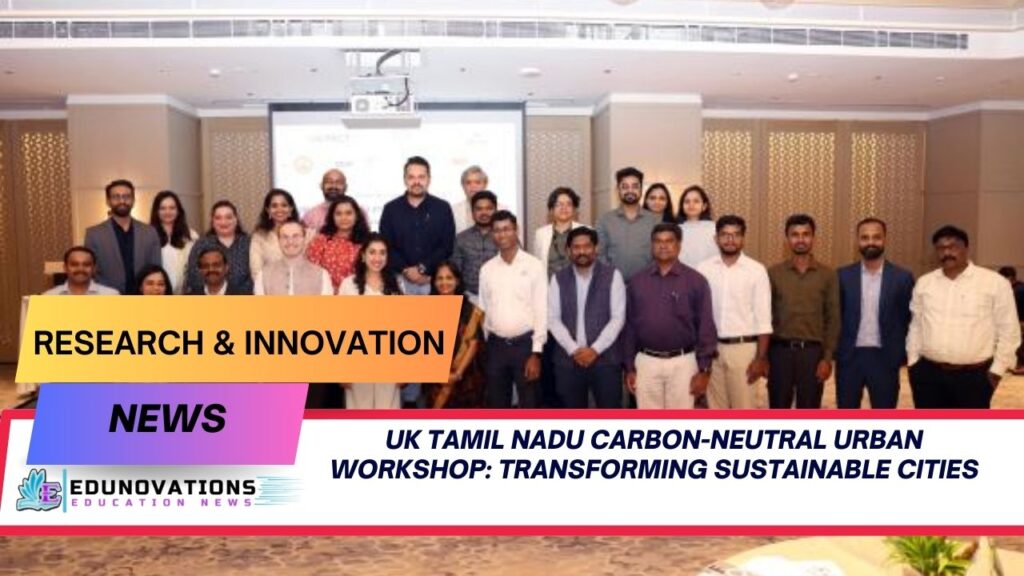
In a significant move toward sustainable urban development, the UK Tamil Nadu carbon-neutral urban workshop recently convened in Chennai, marking a milestone in international collaboration for climate action. The workshop, a cornerstone of the UK-Tamil Nadu partnership, focused on accelerating carbon-neutral urban transitions across the state. With an emphasis on green mobility, innovative urban planning, and climate-resilient infrastructure, the initiative aligns with India’s ambitious sustainability goals and global climate commitments.
State-Level Inception Workshop: Chennai as the Launchpad
The state-level inception workshop, hosted in Chennai, brought together leading urban planners, climate scientists, policymakers, and international partners to discuss actionable strategies for sustainable urban transitions. The partnership, underpinned by UK PACT (Partnering for Accelerated Climate Transitions), is designed to leverage knowledge exchange, innovative technologies, and data-driven approaches to achieve carbon neutrality in Tamil Nadu’s urban landscapes.
Key objectives of the workshop included:
- Sharing international best practices in sustainable urban development.
- Demonstrating digital twin technologies for urban planning.
- Enhancing climate resilience through evidence-based decision-making.
- Facilitating collaborations between UK and Indian urban research institutions.
Collaborative Focus: IIT Madras Leads the Way
IIT Madras, a premier Indian institute renowned for research in urban sustainability and climate technologies, played a pivotal role in this partnership. The institute’s expertise in IIT Madras Thoothukudi climate project and urban transition studies provided critical insights into scalable solutions for energy efficiency, waste management, and low-carbon transport systems.
Prof. V. Ramgopal Rao, Director of IIT Madras, highlighted the importance of integrating innovative technologies such as digital twin urban planning India UK models, which simulate urban environments for better planning and resource optimization. These models help predict emissions, optimize traffic flows, and enhance the resilience of urban infrastructure against climate-induced disruptions.
Toppers Use Mind Maps to score more than 95%
-
NCERT Class 11th Commerce Mind Maps
Add to cartOriginal price was: ₹999.00.₹199.00Current price is: ₹199.00. -
NCERT Class 12th Chemistry Mind Maps
Add to cartOriginal price was: ₹199.00.₹75.00Current price is: ₹75.00. -
NCERT Class 12th Commerce Mind Maps
Add to cartOriginal price was: ₹999.00.₹199.00Current price is: ₹199.00. -
NCERT Class 12th Science Mind Maps
Add to cartOriginal price was: ₹999.00.₹199.00Current price is: ₹199.00. -
NCERT Mind Maps For Class 10th
Add to cartOriginal price was: ₹999.00.₹199.00Current price is: ₹199.00.





Purchase Today
Pilot Cities: Erode and Thoothukudi Take the Lead
The workshop also showcased pilot projects in Erode and Thoothukudi, two cities chosen for their high potential for sustainable urban transition.
- Erode climate transition UK PACT: Erode is focusing on low-carbon urban mobility, sustainable waste management, and renewable energy integration. The collaboration aims to create a replicable model for mid-sized Indian cities.
- IIT Madras Thoothukudi climate project: Thoothukudi is leveraging cutting-edge climate monitoring tools, smart grids, and community-led adaptation strategies to achieve measurable reductions in carbon emissions.
These pilot initiatives provide actionable insights into how cities can adopt innovative technologies while addressing local challenges, making them exemplary models for other Indian states.
Green Mobility: Driving Sustainable Urban Futures
A central theme of the workshop was promoting Tamil Nadu green mobility innovation. Urban transport is a significant contributor to carbon emissions, and transforming mobility systems is essential for achieving carbon-neutral cities. Initiatives discussed included:
- Expanding electric vehicle (EV) infrastructure.
- Implementing intelligent traffic management systems.
- Encouraging non-motorized transport through cycle lanes and pedestrian-friendly zones.
- Incentivizing public transport usage through digital solutions.
Dr. Radhika Menon, a senior urban mobility expert, emphasized that “green mobility is not just about reducing emissions; it’s about creating livable, equitable, and resilient urban spaces that improve the quality of life for residents.”
Technology and Innovation: Digital Twin Urban Planning
The digital twin urban planning India UK initiative is one of the workshop’s most innovative aspects. Digital twins create virtual replicas of urban environments, allowing planners to test different scenarios and predict the impacts of policies before implementing them on the ground.
Benefits include:
- Accurate simulation of energy consumption patterns.
- Predictive modeling of traffic congestion and emissions.
- Enhanced disaster preparedness through climate scenario simulations.
- Data-driven urban policy-making for more sustainable outcomes.
By integrating these technologies, Tamil Nadu aims to become a trailblazer in climate-resilient urban planning in India.
Policy Framework and International Collaboration
The partnership also addressed the importance of policy frameworks and regulatory support. The UK-Tamil Nadu collaboration draws upon international experience to inform local policies on energy efficiency, urban greening, and emission reductions. Key policy discussions included:
- Incentivizing renewable energy adoption in urban infrastructure.
- Implementing strict emission standards for industrial and transport sectors.
- Promoting sustainable construction practices.
- Encouraging citizen participation in climate initiatives.
This multi-stakeholder approach ensures that the carbon-neutral vision is inclusive, actionable, and aligned with both local needs and global climate goals.
Expert Insights and Statistical Highlights
Experts at the workshop highlighted critical statistics:
- Urban areas contribute nearly 70% of Tamil Nadu’s carbon emissions, underscoring the urgency for targeted interventions.
- Pilot projects in Erode and Thoothukudi are projected to reduce emissions by up to 20% over the next five years.
- Digital twin simulations indicate that optimized traffic management could reduce congestion-related emissions by 15%.
Dr. Arvind Kumar, a UK-based urban sustainability consultant, noted, “The combination of technology, policy, and community engagement is key to accelerating carbon-neutral urban transitions. Tamil Nadu’s initiative could serve as a model for other states and countries.”
Community Engagement and Capacity Building
An essential component of the initiative is involving local communities in the urban transition process. Workshops and training sessions aim to build capacity among city officials, planners, and residents. This ensures that the sustainability measures are not only technologically sound but also socially accepted and maintained in the long term.
International Partnerships: Knowledge Exchange and Funding
The UK PACT program facilitates funding, technical assistance, and knowledge exchange to ensure the success of pilot projects. By sharing expertise from successful UK projects, Tamil Nadu can accelerate its urban sustainability journey without duplicating trial-and-error processes.
Key areas of collaboration include:
- Joint research on renewable energy integration.
- Capacity-building programs for urban planners and policymakers.
- Exchange of best practices in low-carbon transport and waste management.
Moving Forward: Scaling Carbon-Neutral Urban Transitions
The workshop concluded with a roadmap for scaling up carbon-neutral initiatives across Tamil Nadu. The roadmap emphasizes replicability, technology adoption, and stakeholder engagement. Future steps include:
- Expanding pilot projects to additional cities.
- Enhancing monitoring and evaluation mechanisms using digital twins.
- Developing policy incentives to support private sector participation.
- Continuous public engagement to ensure community buy-in.
This structured approach ensures that Tamil Nadu’s cities can transition toward sustainability systematically and measurably.
Conclusion
The UK Tamil Nadu carbon-neutral urban workshop is a landmark initiative demonstrating the power of international collaboration, innovative technology, and community engagement in building sustainable cities. By focusing on pilot projects in Erode and Thoothukudi, leveraging digital twin urban planning India UK, and promoting Tamil Nadu green mobility innovation, the partnership is setting a benchmark for carbon-neutral urban transitions in India.
With expert guidance, policy support, and technological innovation, Tamil Nadu is poised to become a national leader in sustainable urban development, showcasing a model that other states and countries can emulate.
FAQs
- What is the UK Tamil Nadu carbon-neutral urban workshop?
It is a collaborative initiative to accelerate sustainable urban transitions in Tamil Nadu through international partnerships, technology, and policy support. - Which cities are pilot projects under this partnership?
Erode and Thoothukudi are the main pilot cities focusing on climate-resilient infrastructure and low-carbon urban mobility. - What role does IIT Madras play in the partnership?
IIT Madras leads research, technology integration, and implementation of innovative urban sustainability projects, including the IIT Madras Thoothukudi climate project. - How is green mobility promoted in Tamil Nadu?
Through initiatives like electric vehicle infrastructure, pedestrian-friendly zones, cycle lanes, and smart traffic management systems. - What is digital twin urban planning India UK?
It is a virtual modeling technology that simulates urban environments to optimize infrastructure, traffic, and emissions management. - How does the UK PACT program support Tamil Nadu?
By providing funding, technical expertise, and knowledge exchange to accelerate carbon-neutral urban initiatives. - What are the expected emission reductions in pilot cities?
Erode and Thoothukudi are projected to reduce carbon emissions by up to 20% in the next five years. - Why is community engagement important for carbon-neutral urban transitions?
Community participation ensures sustainability measures are socially accepted, maintained long-term, and responsive to local needs. - How can other Indian states replicate this initiative?
By adopting digital twin technologies, green mobility strategies, and international collaborations for sustainable urban planning. - What is the long-term vision of the partnership?
To scale carbon-neutral urban transitions across Tamil Nadu, making its cities models of sustainable and resilient urban development.