
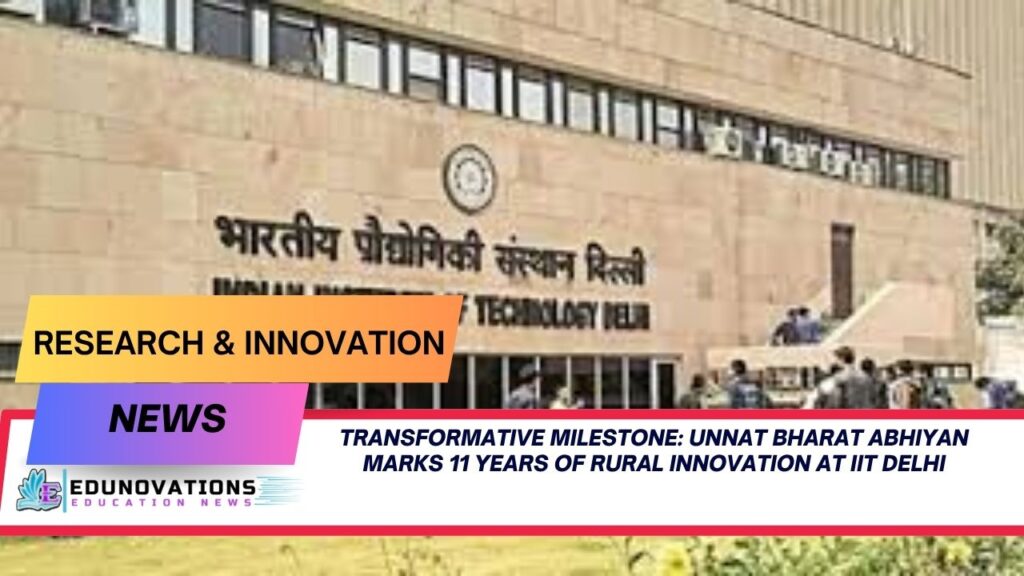
Celebrating 11 years of impact, IIT Delhi’s role in Unnat Bharat Abhiyan drives rural entrepreneurship and sustainable development — showcasing how higher education bridges technology and grassroots.
Unnat Bharat Abhiyan Completes 11 Years of Transforming Rural India Through Higher Education Institutions
New Delhi — The Indian Institute of Technology, Delhi (IIT Delhi) proudly marked the 11th anniversary of Unnat Bharat Abhiyan (UBA) on November 11, 2025. As the National Coordinating Institute for UBA, IIT Delhi has played a pivotal role in driving sustainable rural development by weaving together academic expertise, policy insight, and grassroots innovation. Over the last decade, the programme has uniquely demonstrated how a deep tech research collaboration at IIT Delhi can generate real-world impact in villages across the country.
Bridging Academia and Rural Communities
The IIT Delhi innovation and research open house on UBA Foundation Day drew a diverse audience, including over 1,100 participating institutions, more than 20,000 students, faculty members, and rural residents. The celebration highlighted how deep tech research collaboration at IIT Delhi has nurtured a generation of student-led initiatives in clean energy, sustainable agriculture, and rural entrepreneurship.
Prof. Virendra Kumar Vijay, National Coordinator of UBA, noted, “UBA’s success lies in connecting hearts before connecting technology — fostering a mindset where India’s villages are seen as living laboratories of innovation, not simply social problems to be fixed.”
Milestones of the Last 11 Years
Under IIT Delhi’s leadership, UBA has grown significantly:
- 4,600 Participating Institutions now span universities, colleges, and IITs across India. IIT Delhi
- 22,000 Villages engage with the programme, making it one of the most expansive rural-academia linkages in the nation. IIT Delhi
- Over 1,00,000 students and 25,000 faculty members have contributed to grassroots-driven projects. IIT Delhi
These numbers reflect not just scale but also sustainability — a model where HEIs act as catalysts for rural innovation.
Key Initiatives: From Solar Grids to Millets
During the anniversary event, several themes of UBA’s impact were spotlighted:
- Sustainable Energy Solutions
Villages supported by UBA cells have adopted solar microgrids and biogas units, cutting reliance on conventional fuel and enhancing energy access. - Entrepreneurship & Agri-Innovation
UBA has promoted millet-based enterprises, combining traditional wisdom with market-driven strategies to empower farmers and youth. - Skill Building & Knowledge Transfer
Through community immersion camps, youth–village dialogues, and rural exhibitions, IIT Delhi’s students have shared both technical and policy ideas — all driven by industry-university partnership initiatives at IITD campus. - Rural Innovation Labs
UBA has funded and spurred projects in water management, sanitation, health, and clean cooking solutions — turning villages into test beds for future-ready technologies.
Why UBA Matters: Expert Insights
From an expert standpoint, UBA is more than a social outreach programme — it’s a strategic platform for research translation. By aligning its mission with national priorities like Atmanirbhar Bharat and sustainable development, UBA helps IIT Delhi validate deep-tech prototypes, refine policy-relevant models, and train students on real-world design thinking.
Prof. Pooja Ghosh, Regional Coordinator (NCR), emphasized that UBA is not just about technology transfer but about nurturing a social innovation mindset. Meanwhile, Prof. Sangeeta Kohli, who leads the village cluster at Khurampur, argued that rural communities often surprise researchers with indigenous wisdom that complements modern engineering.
Looking Ahead: Vision for Year Twelve
As UBA enters its twelfth year, IIT Delhi is setting ambitious goals:
- Scaling rural entrepreneurship: Encouraging more student-run startups rooted in village contexts, especially around green technologies and livestock / millets.
- Strengthening policy linkages: Proposing frameworks to embed UBA’s successful models into state governance, ensuring sustainability beyond academic cycles.
- Deepening research: More deep tech research collaboration at IIT Delhi is planned — especially in renewable energy, precision agriculture, and clean water systems.
- Expanding capacity-building: Building on local innovation labs to host more immersion camps, rural hackathons, and technology showcases.
Prof. Ankesh Jain, NSS In-charge at IIT Delhi, noted, “Connecting students with villages has changed how they view development. UBA is not just about outreach; it is about co-creating futures.”
Impacts on Broader Development
- Social Transformation: Through UBA, IIT Delhi is leveraging its academic strength to promote inclusive growth, bringing higher education into direct contact with rural challenges.
- Sustainability: By promoting renewable energy, local entrepreneurship, and sustainable livelihoods, UBA aligns with global sustainable development goals.
- Innovation Pipeline: For IIT Delhi, UBA serves as a real-world innovation pipeline — projects conceived in villages can evolve into viable start-ups or policy frameworks.
- Student Engagement: Participating in UBA strengthens students’ capacity for empathy, problem-solving, and systems thinking — skills that benefit their academic and professional lives.
Linking UBA with Broader Education Content
To help students and researchers explore related topics, Edunovations offers a rich set of resources:
- Dive deeper into NCERT courses via our courses page.
- Prepare for exams with our MCQ practice.
- Stay current with national programmes through our Current Affairs section.
- Access free NCERT PDFs and mind maps for efficient learning.
- Explore structured notes and video lectures to build strong foundations.
External Collaboration & Authority
IIT Delhi’s UBA work also resonates beyond academia. For example, HEIs similar to IITD have been recognized by organizations like Mart India Infotech, which specializes in bridging academia and rural innovation. Their model supports scalable projects that combine industry-university partnership initiatives with social impact.
Conclusion
The 11-year journey of Unnat Bharat Abhiyan at IIT Delhi stands as a powerful case study of how innovation-driven social action can shape rural development. As IIT Delhi drives deeper into industry-university partnership initiatives, the future of UBA is not just promising — it’s poised to redefine how educational institutions contribute to India’s vision of sustainable, inclusive growth.
Toppers Use Mind Maps to score more than 95%
-
NCERT Class 11th Commerce Mind Maps
Add to cartOriginal price was: ₹999.00.₹199.00Current price is: ₹199.00. -
NCERT Class 12th Chemistry Mind Maps
Add to cartOriginal price was: ₹199.00.₹75.00Current price is: ₹75.00. -
NCERT Class 12th Commerce Mind Maps
Add to cartOriginal price was: ₹999.00.₹199.00Current price is: ₹199.00. -
NCERT Class 12th Science Mind Maps
Add to cartOriginal price was: ₹999.00.₹199.00Current price is: ₹199.00. -
NCERT Mind Maps For Class 10th
Add to cartOriginal price was: ₹999.00.₹199.00Current price is: ₹199.00.





Purchase Today
FAQs
- What is Unnat Bharat Abhiyan?
Unnat Bharat Abhiyan is a flagship national initiative of the Ministry of Education aimed at transforming rural India by engaging higher education institutions like IIT Delhi in grassroots development. - Why is IIT Delhi important in UBA?
IIT Delhi serves as the National Coordinating Institute for UBA, leading in project design, research, and implementation to foster sustainable rural innovation. - How does IIT Delhi promote rural entrepreneurship?
Through UBA, IIT Delhi supports village-level enterprises — such as millet-based micro-businesses — and encourages students to co-create solutions with rural communities. - What role does research play in UBA at IIT Delhi?
Deep tech research collaboration at IIT Delhi enables the development and testing of cutting-edge technologies like solar microgrids, clean water systems, and biogas units in rural settings. - How many institutions and villages are part of UBA?
Over 4,600 institutions participate in UBA, impacting more than 22,000 villages across India through collaborative projects. IIT Delhi - What are some key projects under UBA?
Projects include sustainable energy solutions (solar microgrids, biogas), agri-innovations (millet enterprises), skill training, and innovation labs in rural areas. - How are students involved in UBA?
Students participate in immersion camps, rural dialogues, technology showcases, and research, gaining hands-on experience in development and innovation. - What is the future vision for UBA at IIT Delhi?
IIT Delhi aims to scale up rural entrepreneurship, strengthen policy integration, and deepen its commitment to deep tech research in sustainability sectors. - How can other universities emulate IIT Delhi’s UBA success?
By adopting a similar model of combining academic research, student engagement, and village-level innovation — supported through industry-university partnership initiatives. - Where can I learn more about the resources related to UBA and IIT Delhi’s research?
You can explore related education and innovation content on Edunovations — including NCERT courses, current affairs, notes, MCQs, videos, and free PDFs.