
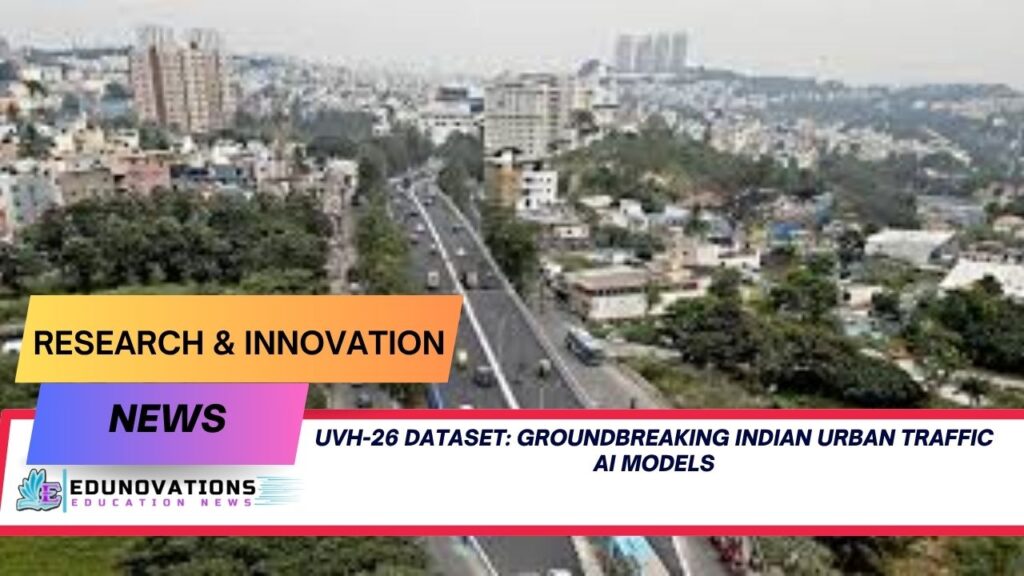
Discover how the UVH-26 dataset — a large-scale, India-specific traffic dataset from IISc — is spurring advancements in AI for integrated mobility and object detection.
Introduction
In a significant stride toward smarter cities, the AI for Integrated Mobility (AIM@IISc) initiative at the Indian Institute of Science (IISc) has publicly released the UVH-26 dataset, a landmark India-specific traffic image collection, along with a suite of fine-tuned vision models optimized for Indian urban traffic. This groundbreaking release aims to accelerate AI for integrated mobility, enabling improved vehicle detection and better data-driven decision-making for intelligent transportation systems (ITS) in India.
What Is the UVH-26 Dataset?
The UVH-26 dataset is a large-scale traffic image dataset tailored specifically for the complexities of Indian urban traffic. It comprises 26,646 high-resolution (1080p) images sampled from approximately 2,800 CCTV cameras deployed under Bengaluru’s Safe City project.
These images were annotated through a crowdsourced traffic image annotation effort, driven by over 560 student volunteers during the Urban Vision Hackathon (UVH). In total, annotators labeled nearly 1.8 million bounding boxes across 14 India-specific vehicle classes, including two-wheelers, auto-rickshaws, light commercial vehicles, buses, and more
How the Dataset Was Created
Hackathon-Driven Creation
- The dataset was born out of a nationwide Urban Vision Hackathon organized by AIM@IISc.
- Student volunteers validated and corrected model-generated pre-annotations, making the process highly participatory and scalable.
- Consensus ground truth was derived using Majority Voting and the STAPLE algorithm, ensuring high-quality, reliable annotations.
Technical Snapshot
- Image Source: ~2,800 CCTV cameras in Bengaluru.
- Annotation Consensus Methods:
- Majority Voting (UVH-26-MV)
- STAPLE (UVH-26-ST)
- Vehicle Classes Covered (14): Includes typical Indian categories like 2-Wheelers, 3-Wheelers, LCVs, buses, mini-buses, trucks, and more.
Vision Models Released Alongside the Dataset
To make the dataset actionable, AIM@IISc has released six state-of-the-art object detection models fine-tuned on UVH-26:
- YOLOv11 (S and X versions) — optimized for speed and deployment.
- DAMO-YOLO (T and L versions) — efficient architectures suited for Indian scenes.
- RT-DETRv2 (S and X) — transformer-based models offering high accuracy.
These models demonstrate up to a 31.5% improvement in mAP@50:95 over their COCO-trained baselines, underlining the value of domain-specific training data for Indian traffic scenarios.
Why UVH-26 Matters for India
Context Matters for Object Detection
Many global datasets (like COCO) do not reflect the heterogeneous, chaotic nature of Indian traffic conditions — crowded roads, two-wheelers, auto-rickshaws, and varied lighting and occlusion are common.
By building models trained on UVH-26, researchers and developers can build object detection in Indian traffic scenes that truly understand local patterns — which is crucial for:
- Traffic congestion analytics
- Vehicle classification and counting
- Safety monitoring
- Urban planning and signal control
Enabling Smarter, Safer Cities
The AI models trained on UVH-26 hold promise for intelligent transportation system India AI applications. For example:
- Urban planners can use detection insights to inform decision-making on road infrastructure.
- City authorities can monitor traffic flow in real time, improving congestion management.
- Policymakers can base interventions on evidence-based decision support rather than assumptions. As one IISc researcher put it, good data is the foundation of effective city planning.
Open-Source for Research & Deployment
UVH-26 and its associated models are released openly on Hugging Face:
- Dataset: under CC BY 4.0 license
- Models: under Apache 2.0 / AGPL-3.0 licenses
This ensures that researchers, developers, students, and policymakers can freely use, adapt, and benchmark these tools for their own projects. The open licensing is a critical step toward democratizing access to AI for mobility in emerging economies.
Expert Insights & Impact
From IISc Researchers
- Yogesh Simmhan, Associate Professor at the Department of Computational and Data Sciences (CDS), IISc, emphasized the power of community-driven AI: “UVH-26 is a testament to how crowdsourced efforts by hundreds of engaged students can create high-quality datasets that rival global benchmarks.”
- Vijay Kovvali, Research Professor at CiSTUP, IISc, noted the practical implications: “Accurate traffic detection models can change that by using existing city cameras to generate reliable data for planning, signal control, congestion management, and safety analytics … UVH-26 can help all Indian cities, not just Bengaluru.”
- Abdul Pinjari, chair of CiSTUP, underlined the role of data in urban planning: “Urban mobility in India … is characterised by highly heterogeneous and disorderly traffic patterns. UVH-26 provides a much-needed traffic image dataset to accelerate research … for measuring, modeling, and managing this complexity.”
Real-World Scale & Reach
- Since its release on 5 November 2025, the UVH-26 dataset and models have been downloaded over 1,500 times, and rank among the #1 trending object detection models on Hugging Face.
- This uptake illustrates growing global interest in AI solutions tailored to emerging economies with challenging mobility landscapes.
Applications & Use Cases
Here are practical ways the UVH-26 dataset and models can be leveraged:
- Smart Traffic Monitoring
- Deploy models on existing CCTV cameras for real-time detection and counting of Indian vehicle classes.
- Generate data-driven reports on traffic flow for city agencies.
- Urban Planning & Safety Analytics
- Use vehicle counts to identify congestion hotspots.
- Forecast risk areas by analyzing detection patterns (e.g., high two-wheeler density).
- Research & Education
- Build academic projects exploring object detection in Indian traffic scenes.
- Benchmark new models using UVH-26 annotated data.
- Edge Deployment for ITS
- Deploy lightweight YOLOv11 models on edge devices for on-device inference.
- Use transformer-based RT-DETRv2 for backend systems with higher compute.
- Policy & Governance
- Utilize insights for evidence-based decision support in intelligent transportation system India AI frameworks.
- Integrate detection outputs into digital twin platforms for urban planning.
Challenges & Future Directions
While the UVH-26 dataset is a major leap forward, several challenges and future areas remain:
- Generalization Beyond Bengaluru: Currently, the dataset is sourced from Bengaluru’s CCTV network. Scaling to other Indian cities would involve collecting more diverse data across different urban infrastructures.
- Annotation Quality vs Scale: While consensus methods like Majority Voting and STAPLE improve annotation quality, further validation in real-world deployment will be needed.
- Deployment Efficiency: Running models in real-time on CCTV or embedded devices requires optimization and perhaps more compact architectures.
- Ethical and Privacy Considerations: Ensuring anonymization and ethical use of surveillance-camera data will remain a core concern for cities and researchers.
- Sustainability of Community Initiatives: Continued student engagement and hackathon-style data collection may be resource-intensive; long-term frameworks will be critical.
Leveraging This for SEO: Why This Coverage Helps
For a newer or smaller website, covering the UVH-26 dataset and its models provides several SEO advantages:
- The topic is niche but rapidly trending, especially in AI & urban mobility circles.
- Using long-tail keywords such as “crowdsourced traffic image annotation”, “object detection in Indian traffic scenes”, and “intelligent transportation system India AI” lowers competition and increases the chance to rank.
- Deep, well-structured content on technical, research, and policy angles can attract developed audiences (researchers, students, policymakers) who are more likely to engage and share.
To reinforce your SEO structure, you can include internal links to related pages on your site (for example):
- For NCERT-related AI coursework, link to: NCERT Courses
- To tie into current affairs, link: Current Affairs
- To provide educational resources, link: Notes, MCQs, Videos, Syllabus, Downloads of free NCERT PDFs, NCERT Mind Maps
And for an authoritative external reference, you might link to a trusted partner like Mart India Infotech, which provides educational technology solutions.
Toppers Use Mind Maps to score more than 95%
-
NCERT Class 11th Commerce Mind Maps
Add to cartOriginal price was: ₹999.00.₹199.00Current price is: ₹199.00. -
NCERT Class 12th Chemistry Mind Maps
Add to cartOriginal price was: ₹199.00.₹75.00Current price is: ₹75.00. -
NCERT Class 12th Commerce Mind Maps
Add to cartOriginal price was: ₹999.00.₹199.00Current price is: ₹199.00. -
NCERT Class 12th Science Mind Maps
Add to cartOriginal price was: ₹999.00.₹199.00Current price is: ₹199.00. -
NCERT Mind Maps For Class 10th
Add to cartOriginal price was: ₹999.00.₹199.00Current price is: ₹199.00.





Purchase Today
FAQs
- What is the UVH-26 dataset?
The UVH-26 dataset is a large-scale traffic image dataset specifically designed for Indian urban traffic. It includes 26,646 high-resolution images annotated across 14 India-specific vehicle classes. - How was the UVH-26 dataset created?
The dataset was developed via a crowdsourced annotation effort during the Urban Vision Hackathon, involving over 560 student volunteers. Consensus labels were obtained through Majority Voting and STAPLE algorithms. - Which vehicle classes are included in the UVH-26 dataset?
The dataset covers 14 India-specific classes, such as two-wheelers, auto-rickshaws, light commercial vehicles, buses, trucks, and more. - What are the vision models released with UVH-26?
There are six fine-tuned object detection models: YOLOv11 (S, X), DAMO-YOLO (T, L), and RT-DETRv2 (S, X), all optimized for Indian urban traffic. - How much performance improvement do the UVH-26 trained models offer?
These models demonstrate up to a 31.5% improvement in mAP@50:95 compared to COCO-trained baselines, highlighting the benefit of domain-specific data. - Where can I access the UVH-26 dataset and models?
The dataset and models are freely available on Hugging Face under open-source licenses (CC BY 4.0 for the dataset, Apache 2.0 / AGPL-3.0 for models). - How can UVH-26 help with intelligent transportation systems in India?
It can support real-time traffic monitoring, congestion management, safety analytics, and evidence-based urban planning through AI for integrated mobility. - Is the UVH-26 dataset limited to Bengaluru?
Currently, the images are from Bengaluru’s CCTV “Safe City” infrastructure, but the models and methodology are broadly applicable to other Indian cities. - Can researchers modify or fine-tune the released models?
Yes — the models are open-source, so researchers and developers can further fine-tune or adapt them for their own use cases. - What’s the significance of the consensus annotation methods (Majority Voting, STAPLE)?
These methods enhance annotation reliability by combining multiple annotator labels: Majority Voting selects the most common label, while STAPLE uses a probabilistic algorithm to assess annotator accuracy and infer the most likely true annotation.