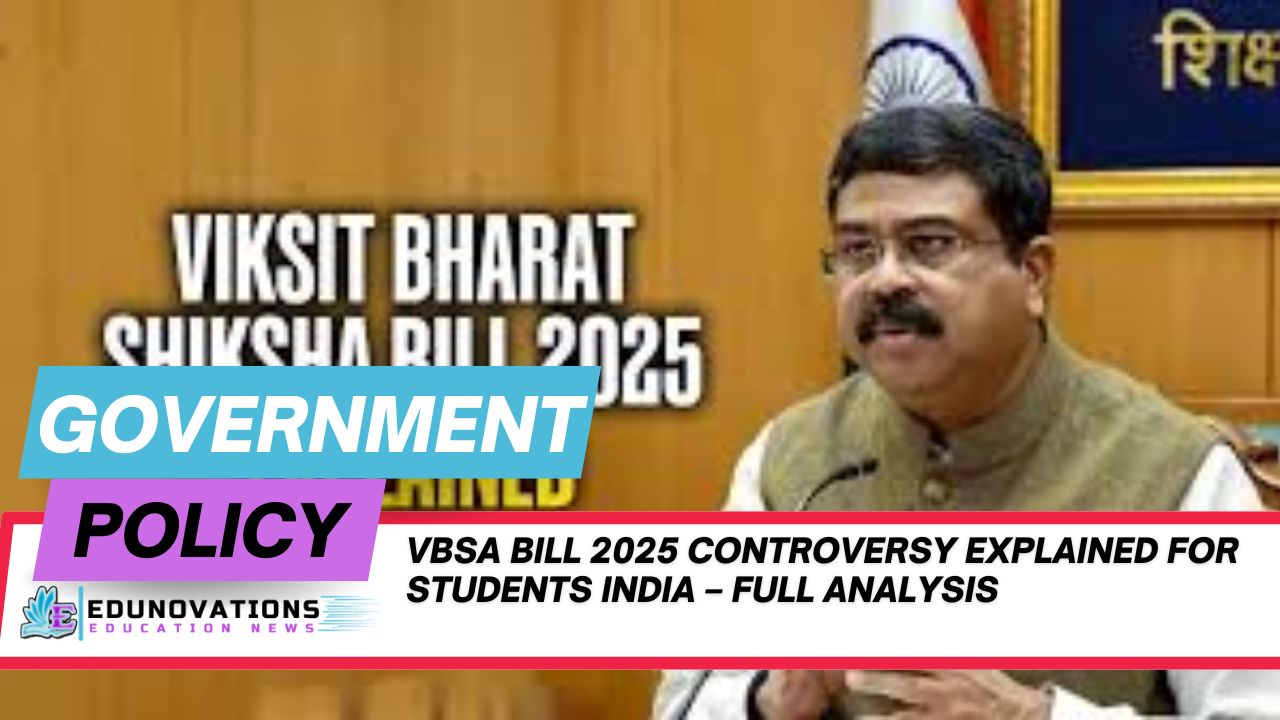
vbsa bill 2025 controversy explained for students india: understand UGC, AICTE, NCTE replacement, political debate, and impact on universities and students.
Introduction
The vbsa bill 2025 controversy explained for students india has become one of the most debated topics in the country’s education and political landscape. The proposed legislation, aimed at restructuring India’s higher education regulatory framework, has triggered strong reactions from political parties, academicians, and students alike.
At the heart of the issue lies a major structural change—the proposed replacement of key regulatory bodies such as the University Grants Commission (UGC), All India Council for Technical Education (AICTE), and National Council for Teacher Education (NCTE) with a single centralized authority. While the government views this as a step toward efficiency and modernization, opposition leaders, particularly from the Congress party, have raised concerns about federalism and institutional autonomy.
This detailed article provides a comprehensive breakdown of the issue, helping readers understand the vbsa bill 2025 controversy explained for students india, its implications, political reactions, and what it could mean for the future of higher education.
What is the VBSA Bill and Why It Matters
The Viksit Bharat Shiksha Adhishthan (VBSA) Bill aims to create a unified higher education regulatory body in India. The proposal aligns with the broader goals of the National Education Policy (NEP) 2020, which emphasizes simplification, transparency, and improved governance in education.
Currently, India’s higher education system is regulated by multiple bodies:
- UGC – Oversees universities and funding
- AICTE – Regulates technical education
- NCTE – Governs teacher education
The new bill proposes merging these institutions into a single entity. Supporters argue that this will eliminate redundancy, reduce bureaucratic delays, and ensure uniform standards.
However, the vbsa bill 2025 controversy explained for students india revolves around whether such centralization could compromise institutional independence and state authority.
Political Opposition and Key Concerns
The Congress party has strongly opposed the bill, raising several concerns:
1. Threat to Federal Structure
Education is a subject that falls under both central and state jurisdictions in India. Critics argue that replacing multiple regulatory bodies with one central authority could weaken the role of states.
2. Centralisation of Power
Opposition leaders believe the bill may concentrate excessive power in the hands of the central government, reducing institutional autonomy.
3. Impact on Diversity in Education
India’s higher education system is diverse, catering to regional needs. A single regulatory framework may not adequately address these variations.
4. Lack of Consultation
Another major point in the vbsa bill 2025 controversy explained for students india is the alleged lack of extensive consultation with stakeholders such as universities, teachers, and state governments.
Government’s Perspective on the Reform
The central government has defended the bill, stating that the reform is necessary to modernize the education system.
Key Arguments in Favor:
- Streamlined Governance: Reducing overlap among regulatory bodies
- Improved Transparency: Clear guidelines and accountability
- Global Competitiveness: Aligning Indian education with international standards
- Ease of Doing Education: Simplifying approvals for institutions
According to policymakers, the vbsa bill 2025 controversy explained for students india is largely driven by political differences rather than practical concerns.
Impact on Students and Universities
Understanding the vbsa bill 2025 controversy explained for students india requires examining its potential effects on students and institutions.
Positive Impacts (If Implemented Effectively):
- Faster approvals for courses and institutions
- Uniform academic standards across the country
- Improved quality assurance mechanisms
Negative Concerns:
- Reduced flexibility for state universities
- Risk of over-centralisation
- Possible delays during the transition phase
Students preparing for competitive exams can explore updated academic content through platforms like
👉 https://edunovations.com/currentaffairs/
👉 https://edunovations.com/notes/
Expert Insights on the Debate
Education experts remain divided on the issue.
Supportive View
Some experts believe that a single regulator can reduce corruption and improve efficiency. They argue that multiple bodies often create confusion and delays.
Critical View
Others warn that centralization could lead to uniform policies that may not suit all regions. They emphasize the need for autonomy and localized decision-making.
This dual perspective adds depth to the vbsa bill 2025 controversy explained for students india, making it a complex policy issue rather than a simple reform.
Comparison with Global Education Systems
Many countries have centralized education systems, but they also ensure strong institutional autonomy.
For example:
- The UK has centralized frameworks but independent universities
- The US follows a decentralized model with strong state control
India’s approach must strike a balance between efficiency and autonomy. The vbsa bill 2025 controversy explained for students india highlights the challenge of achieving this balance.
Role of NEP 2020 in Shaping the Bill
The National Education Policy (NEP) 2020 laid the foundation for structural reforms in higher education. It recommended:
- Establishing a single regulatory body
- Promoting multidisciplinary education
- Enhancing research and innovation
The VBSA Bill is seen as a step toward implementing these recommendations. However, critics argue that the execution must be carefully designed.
Students can access NCERT-based learning resources here:
👉 https://courses.edunovations.com/
👉 https://courses.edunovations.com/shop-2/
Challenges in Implementation
Even if the bill is passed, several challenges remain:
- Transition from existing bodies to a new system
- Managing institutional resistance
- Ensuring fair representation of states
- Maintaining transparency
These challenges are central to understanding the vbsa bill 2025 controversy explained for students india.
Digital and Infrastructure Implications
With increasing digitization in education, a unified regulatory body could improve:
- Online course approvals
- Digital learning frameworks
- National-level accreditation systems
Educational platforms offering structured content, MCQs, and syllabus support include:
👉 https://edunovations.com/mcq/
👉 https://edunovations.com/syllabus/
👉 https://edunovations.com/videos/
Industry and Institutional Perspective
Private institutions and ed-tech companies are closely watching the developments.
Some believe the reform could:
- Simplify compliance procedures
- Encourage innovation
- Attract foreign investment
Others worry about increased regulation and loss of flexibility.
For institutions looking to build digital infrastructure, services like
👉 https://www.martindiainfotech.com/
can provide technological support.
Future Outlook
The vbsa bill 2025 controversy explained for students india is likely to remain a key issue in policy discussions.
Possible scenarios include:
- Amendments to address concerns
- Delayed implementation
- Increased stakeholder consultations
The final outcome will shape the future of India’s higher education system for decades.
Conclusion
The vbsa bill 2025 controversy explained for students india reflects a broader debate about governance, autonomy, and the future of education in India. While the proposed reforms aim to simplify and modernize the system, concerns about centralization and federal balance cannot be ignored.
For students, educators, and policymakers, staying informed about these developments is crucial. The debate underscores the importance of inclusive policymaking that considers diverse perspectives.
Toppers Use Mind Maps to score more than 95%
NCERT Class 11th Commerce Mind Maps
Add to cartOriginal price was: ₹999.00.₹199.00Current price is: ₹199.00.NCERT Class 12th Chemistry Mind Maps
Add to cartOriginal price was: ₹199.00.₹75.00Current price is: ₹75.00.NCERT Class 12th Commerce Mind Maps
Add to cartOriginal price was: ₹999.00.₹199.00Current price is: ₹199.00.NCERT Class 12th Science Mind Maps
Add to cartOriginal price was: ₹999.00.₹199.00Current price is: ₹199.00.NCERT Mind Maps For Class 10th
Add to cartOriginal price was: ₹999.00.₹199.00Current price is: ₹199.00.





Purchase Today
FAQs (Frequently Asked Questions)
1. What is vbsa bill 2025 controversy explained for students india?
It refers to the debate over replacing UGC, AICTE, and NCTE with a single regulator.
2. Why is Congress opposing the VBSA Bill?
Due to concerns about centralization and weakening of state powers.
3. What changes will VBSA Bill bring?
It proposes a unified regulatory framework for higher education.
4. How will vbsa bill 2025 controversy explained for students india affect students?
It may impact course approvals, standards, and university autonomy.
5. What is the role of NEP 2020 in this bill?
It provides the policy framework supporting such reforms.
6. Will UGC, AICTE, and NCTE be abolished?
They may be replaced by a single regulatory authority.
7. Is centralization good for education?
It has both advantages (efficiency) and risks (loss of autonomy).
8. What are the pros and cons of vbsa bill 2025 controversy explained for students india?
Pros include efficiency; cons include reduced federal balance.
9. How can students stay updated on this issue?
By following current affairs platforms and official announcements.
10. What is the future of vbsa bill 2025 controversy explained for students india?
It depends on political consensus and policy revisions.