
Discover why are Samastipur college teachers protesting Bihar education bill. Read complete insights on the LNMU teachers’ black badge movement and university reforms.
Understanding the Uproar in Bihar’s Academic Landscape
The corridors of higher education in Bihar have transformed into sites of silent yet intense resistance. Across various institutions, a wave of profound anxiety has rippled through the teaching fraternity following legislative developments concerning state universities. Why are Samastipur college teachers protesting Bihar education bill has become the most debated question among academics, students, and policy analysts alike.
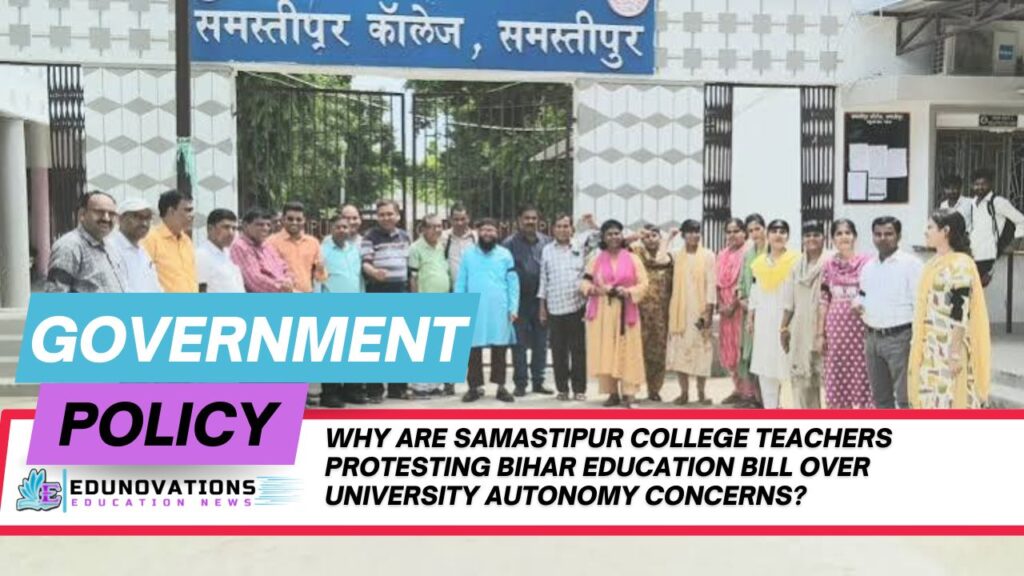
The core of this unprecedented movement traces back to a collective call to action issued by the Lalit Narayan Mithila University (LNMU) Teachers Association. Faculties from prominent institutions, including Samastipur College and Women’s College, stepped onto their campuses wearing black badges and black armbands. Rather than opting for disruptive strikes that stall academic calendars, these educators chose a path of disciplined, non-disruptive defiance. They conducted their regular lectures and administrative duties while pinned with black markers of protest, sending an unmissable message to policymakers.
For students preparing for competitive benchmarks or seeking structured academic paths through resources like NCERT Courses, sudden legislative shifts affecting institutional stability can inject unwanted uncertainty into the educational ecosystem. Academic stability relies heavily on administrative independence, a pillar that professors argue is currently under direct threat.
The Anatomy of the Protest: A Disciplined Approach
What sets the recent demonstrations apart from traditional political agitations is the absolute commitment to maintaining normalcy for students. Classrooms remained open, examinations proceeded without scheduled interruption, and library doors stayed unlocked. Yet, beneath the calm exterior, the dissent ran deep.
Professors and non-teaching staff voiced unified opposition against what they characterize as an erosion of academic freedom. Slogans echoing “Kala Kanoon Wapas Lo” (Withdraw the Black Law) reverberated through staff rooms and campus grounds as educators flagged potential systemic overhauls.
To build a comprehensive perspective on how legislative changes alter ground realities, educators and researchers frequently cross-verify updates via platforms dedicated to Current Affairs. Keeping track of policy modifications requires meticulous documentation, much like analyzing structural data found in standard Notes or evaluating institutional policies through targeted MCQ’s.
Key Grievances: Institutional Autonomy Under Scrutiny
The central argument presented by protesting faculty members revolves around the preservation of university autonomy. According to the associations leading the movement, proposed modifications to the university acts risk centralizing administrative power excessively within state bureaucratic apparatuses.
- Loss of Independent Decision-Making: Academic bodies fear losing their traditional authority over curriculum planning, resource allocation, and internal governance.
- Centralization Realities: Moving constituent undergraduate colleges directly under specialized state departments could strip universities of their historic administrative flexibility.
- Impact on Pedagogical Freedom: Teachers argue that true educational excellence requires a buffer from routine bureaucratic interference, enabling research-driven environments to thrive.
For students mapping out their higher education journey, understanding these structural shifts is vital. Utilizing updated tools such as official Syllabus trackers helps learners stay aligned with institutional frameworks, while multimedia lectures available through dedicated Videos offer clarity on shifting academic standards.
Expert Insights and Institutional Perspectives
Education analysts tracking the development note that institutional friction between state governance bodies and university syndicates is not entirely new, but the intensity of the current resistance marks a distinct escalation. Senior faculty members across Samastipur College—including notable academicians like Dr. Rahul Manhar, Dr. Mahesh Kumar Chaudhary, Dr. Dayanand Mehta, Dr. Devkant, and Dr. Rita Chauhan—have publicly emphasized that safeguarding university statutes is critical to protecting the future generations of scholars.
According to Dr. Sheo Sagar Prasad, President of the Patna University Teachers’ Association (PUTA), who has consistently advocated for institutional safeguards during similar legislative debates: “Any attempt to alter the fundamental character of state universities through excessive centralization undermines pedagogical independence and runs contrary to the decentralization objectives envisaged under modern educational frameworks.”
Furthermore, infrastructure and administrative modernization in educational hubs are increasingly being supported by specialized technology partners. Institutions looking to streamline digital administration often collaborate with firms like Mart Ind Infotech to optimize campus management systems without compromising academic integrity.
Looking Ahead: The Path Forward for Bihar’s Universities
As the standoff between university associations and the legislative framework continues to evolve, the primary focus remains on constructive dialogue. Educators have made it clear that their black-badge movement is an opening stance aimed at prompting a formal review of the contentious clauses within the higher education bill.
For learners and educators seeking supplemental study materials, foundational texts can be accessed seamlessly through portals offering Free NCERT PDFs Downloads, alongside conceptual learning aids like NCERT Mind Maps to simplify complex regulatory and academic topics.
The coming weeks will determine whether state policymakers address the core anxieties raised by university teachers or if the agitation will transition into a broader statewide movement. Until then, campuses across Samastipur and beyond remain vigilant, balancing their daily commitment to teaching with an unwavering defense of academic independence.
Toppers Use Mind Maps to score more than 95%
-
NCERT Class 11th Commerce Mind Maps
Add to cartOriginal price was: ₹999.00.₹199.00Current price is: ₹199.00. -
NCERT Class 12th Chemistry Mind Maps
Add to cartOriginal price was: ₹199.00.₹75.00Current price is: ₹75.00. -
NCERT Class 12th Commerce Mind Maps
Add to cartOriginal price was: ₹999.00.₹199.00Current price is: ₹199.00. -
NCERT Class 12th Science Mind Maps
Add to cartOriginal price was: ₹999.00.₹199.00Current price is: ₹199.00. -
NCERT Mind Maps For Class 10th
Add to cartOriginal price was: ₹999.00.₹199.00Current price is: ₹199.00.





Purchase Today
Frequently Asked Questions (FAQs)
- Why are Samastipur college teachers protesting Bihar education bill?Samastipur college teachers are protesting against the proposed higher education bill because they believe it severely compromises university autonomy and centralizes administrative power.
- What method did teachers use during the Samastipur university bill protest?Teachers adopted a peaceful, non-disruptive method by wearing black badges and black armbands while continuing to conduct their regular classes and duties.
- Which association called for the black badge protest in Samastipur?The protest was organized under the call of the Lalit Narayan Mithila University (LNMU) Teachers Association.
- What slogan was prominently raised during the college teachers’ protest?Protesting educators raised slogans such as “Kala Kanoon Wapas Lo” (Withdraw the Black Law) across campus grounds.
- How does the proposed bill affect university autonomy according to teachers?Faculty members argue that the bill strips universities of their independent governance, transforming historical academic institutions into rigid administrative units.
- Did the teachers’ protest disrupt student classes in Samastipur?No, the teachers deliberately chose not to boycott classes or lock college gates, ensuring that student education remained unaffected.
- Who are some of the prominent faculty members who supported the movement?Senior academics including Dr. Rahul Manhar, Dr. Mahesh Kumar Chaudhary, Dr. Dayanand Mehta, and Dr. Rita Chauhan actively participated in the demonstration.
- What are the broader implications of the Bihar higher education reforms?The reforms have triggered widespread debates regarding the centralization of undergraduate constituent colleges and the preservation of academic freedom.
- Are further demonstrations expected regarding the university bill?Yes, teacher associations have indicated that agitations and resistance will persist until their core concerns regarding institutional independence are addressed.
- Where can students find reliable updates on current educational policies in Bihar?Students can track verified developments through academic portals, current affairs trackers, and official university notification boards.