
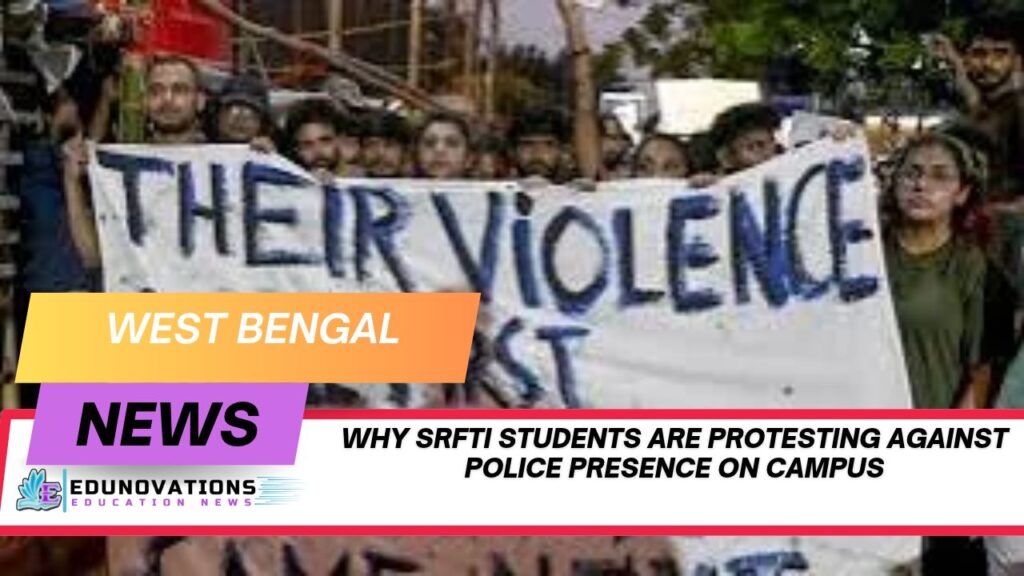
The serene environment of institutional learning has been deeply shaken as an intensifying crisis unfolds at the prestigious Satyajit Ray Film and Television Institute (SRFTI) in Kolkata.
The serene environment of institutional learning has been deeply shaken as an intensifying crisis unfolds at the prestigious Satyajit Ray Film and Television Institute (SRFTI) in Kolkata. What began as a dispute over security and campus clashes has now morphed into an all-out confrontation between the student body and the institute administration. Amid escalating tensions that have brought academic life to a grinding halt, students have raised alarm bells over what they describe as an intrusive security deployment. Specifically, why srfti students are protesting against police presence on campus has become the defining question of a month-long standoff that has caught the attention of national media, civil society, and prominent cultural figures alike.
The situation highlights a delicate balancing act that universities across India frequently face: maintaining public order and physical asset protection versus preserving institutional autonomy, democratic spaces, and student privacy. As stakeholders search for a viable resolution, understanding the historical background, the sequence of escalations, and the core grievances of the students provides critical insight into the broader discourse on student rights in contemporary higher education institutions.
The Anatomy of the Standoff: Tracing the Roots of the Agitation
To fully comprehend the gravity of the current situation at SRFTI, one must examine the timeline of events that transformed a routine administrative disagreement into a full-scale crisis. The unrest traces its origins back to late September, when an event organized on campus by an outside group led to heated exchanges and physical clashes. Students alleged that outsiders entered the premises and initiated violence, while organizers countered that students were responsible for the disruptions.
The friction multiplied exponentially following subsequent incidents in early October. Frustrated by what they perceived as administrative apathy and a failure to guarantee physical security against external aggressors, students launched a series of protests, including sit-ins outside the office of Vice-Chancellor Santosh Ajmera. Matters worsened when the administration invoked strict disciplinary actions, resulting in the rustication of six students for alleged vandalism and manhandling of officials during the protests.
With classes indefinitely suspended, hostels temporarily shut down, and holiday vacations extended, the campus atmosphere transformed into a pressure cooker. Students argue that rather than fostering a dialogue to resolve the core grievances, the administration opted for a heavy-handed approach by bringing law enforcement directly onto the institutional grounds.
Surveillance, Hostels, and the Core Privacy Debate
The most recent flashpoint centers on the continuous deployment of police personnel around critical administrative blocks and student residential zones. Representatives of the SRFTI Students’ Union, addressing a press conference at the Kolkata Press Club, voiced deep apprehensions regarding this ongoing deployment.
According to student leaders, police personnel were seen occupying the entrance of the administration building and actively monitoring hostel perimeters even on weekends when administrative offices remain closed. For students who live, study, and collaborate within these residential spaces, the presence of uniformed law enforcement officers creates an intimidating psychological environment.
This brings to light the multifaceted discussions surrounding srfti hostel police patrolling privacy concerns background details. Students argue that a university campus is fundamentally different from a public street or a commercial zone; it is a residential haven where young scholars must feel secure, autonomous, and free from constant observation. When security personnel begin recording movements or patrolling dormitory gates without clear institutional boundaries, it crosses the line from safety enforcement into direct surveillance.
Furthermore, individual student testimonies have added a disturbing layer to the crisis. Beyond physical patrolling on campus grounds, several female students have reported facing online harassment, targeted abuse, and severe safety threats on social media platforms. Some students recounted instances of being tracked or recognized outside the campus in public spaces across Kolkata. These compounding pressures have amplified the fear and isolation felt by the student community, making the demand for privacy not just a political stance, but a fundamental survival necessity.
Institutional Standpoint and Administrative Justifications
While the student union remains steadfast in its opposition, the institute’s leadership and administrative heads have robustly defended their decisions. SRFTI Registrar Deepak Kumar categorically rejected the allegations brought forward by the student body, dismissing claims of administrative failure or high-handedness as baseless.
From the administration’s perspective, the deployment of police forces was an unavoidable necessity born out of genuine security threats. School officials point to past instances of physical intimidation, aggressive marches, property vandalism inside the Vice-Chancellor’s office, and general breaches of institutional order as justifications for intervention. The administration maintains that keeping law enforcement present is essential to protect university property, safeguard faculty members, and prevent any escalation of violence between rival factions.
Regarding monitoring and recording practices, administrative representatives noted that security personnel were instructed to document public movements strictly for evidentiary and security management purposes. However, the gulf of trust between the governing body and the learners remains wide. While the administration views the police presence as a shield against chaos, the students experience it as an infringement on their basic freedoms and a punitive measure designed to suppress dissent.
Broader Solidarity, Public Discourse, and Expert Insights
As the impasse stretches past its fourth week, the ripples of the SRFTI controversy have extended far beyond West Bengal. Prominent cultural figures, alumni associations, and intellectuals have weighed in on the situation, urging both sides to step back from rigid postures.
Renowned actor Naseeruddin Shah and other notable members of the broader film and artistic fraternity have come out in verbal support of the student community, emphasizing that creative institutions thrive only when absolute freedom of expression and emotional security are guaranteed. The SRFTI Alumni Association has similarly issued formal statements calling for the immediate withdrawal of police forces from the campus and the revocation of punitive actions against the rusticated scholars.
Educational sociologists and governance experts note that campus crises of this scale often point toward a systemic communication breakdown. When administrators rely on policing rather than participatory conflict resolution, the foundational trust contract between a teaching institution and its pupils breaks down. Educational quality depends heavily on a stable psychological climate where learning materials, study resources, and academic syllabi can be engaged with peace of mind. Students who wish to supplement their academic preparation can explore structured resources like NCERT Courses and download reference materials via Downloads of Free NCERT PDFs, but such academic pursuits inevitably suffer when basic campus infrastructure is paralyzed by prolonged strikes and police blockades.
For students keeping track of national developments, staying updated through platforms like Current Affairs and practicing analytical skills using MCQ’s remain important, yet the disruption at SRFTI demonstrates how administrative friction can abruptly halt creative education. Educational bodies seeking to modernize their institutional frameworks often consult specialized service providers—such as Mart Ind Infotech—to build transparent digital communication channels that prevent such severe standoffs from erupting in the first place. Furthermore, students looking to structure their study paths can review official guidelines through Syllabus listings, utilize Notes for revision, and engage with visual aids like NCERT Mind Maps or educational videos via Videos.
Path Forward: Restoring Normalcy and Academic Harmony
Resolving the deep-seated deadlock at SRFTI requires a deliberate shift from confrontation to compromise. Both the institute leadership and the student representatives must acknowledge that a prolonged stalemate serves no one. Continued suspension of classes and locked hostel gates jeopardize the academic futures of scores of aspiring filmmakers and technicians.
To rebuild trust, a multi-step roadmap is essential:
- Gradual Decalibration of Police Presence: The administration must establish alternative, less intrusive security frameworks that do not rely on patrolling student residential corridors, thereby addressing legitimate privacy concerns.
- Open Dialogue Channels: Transparent, unconditional negotiations between Vice-Chancellor Santosh Ajmera, faculty panels, and elected student representatives can help reassess disciplinary actions fairly.
- Cyber Safety Interventions: Given the serious nature of online threats and doxing reported by female students, local cyber cell authorities must rigorously investigate complaints to ensure individual safety outside institutional boundaries.
Ultimately, the restoration of normalcy at SRFTI will serve as a crucial precedent for how creative and professional institutions across the country manage dissent, student welfare, and campus democracy in the years to come.
Toppers Use Mind Maps to score more than 95%
-
NCERT Class 11th Commerce Mind Maps
Add to cartOriginal price was: ₹999.00.₹199.00Current price is: ₹199.00. -
NCERT Class 12th Chemistry Mind Maps
Add to cartOriginal price was: ₹199.00.₹75.00Current price is: ₹75.00. -
NCERT Class 12th Commerce Mind Maps
Add to cartOriginal price was: ₹999.00.₹199.00Current price is: ₹199.00. -
NCERT Class 12th Science Mind Maps
Add to cartOriginal price was: ₹999.00.₹199.00Current price is: ₹199.00. -
NCERT Mind Maps For Class 10th
Add to cartOriginal price was: ₹999.00.₹199.00Current price is: ₹199.00.





Purchase Today
Frequently Asked Questions (FAQs)
1. Why are SRFTI students protesting against police presence on campus?
Students are protesting because the deployment of police personnel around administrative blocks and hostel zones creates an atmosphere of surveillance, restricting their freedom of movement and violating personal privacy.
2. What background details led to the SRFTI hostel police patrolling privacy concerns?
The tensions escalated following clashes between students and outsiders during campus events in late September and early October, leading the administration to bring in police forces for security, which students argue has infringed upon hostel privacy.
3. What are the key demands raised by the SRFTI students union at the Kolkata Press Club?
The union has demanded an immediate withdrawal of police personnel and patrolling units from hostel premises, accountability for campus attacks, and the withdrawal of punitive measures against students.
4. How has the ongoing protest impacted academic activities at SRFTI?
Classes have been suspended indefinitely, hostel facilities have faced restrictions, vacation periods have been extended, and normal academic and creative routines have been severely disrupted.
5. What is the administration’s stance on the police deployment?
The institute administration maintains that police personnel were brought in to protect public property, ensure staff safety, and prevent further vandalism or physical intimidation following earlier incidents of campus unrest.
6. Are there any external figures supporting the SRFTI student agitation?
Yes, notable film personalities, alumni associations, and public figures like actor Naseeruddin Shah have expressed solidarity with the student community, calling for an amicable resolution.
7. What specific privacy violations have students reported during the standoff?
Students have objected to being filmed or recorded without consent in public and residential areas, alongside separate complaints regarding online harassment, doxing, and safety threats received on social media.
8. What disciplinary actions have been taken by the SRFTI authorities?
The administration rusticated six students following allegations of manhandling officials and vandalizing the Vice-Chancellor’s office during earlier protests, a move strongly contested by the student body.
9. How are local authorities responding to safety complaints outside the campus?
Affected students have filed formal complaints with the cyber cell of the Kolkata police regarding online abuse and targeted threats, prompting active investigation into those incidents.
10. What measures are being proposed to restore normalcy at SRFTI?
Observers and alumni associations have suggested lifting heavy police surveillance, reopening channels of dialogue between the administration and students, and fairly reviewing disciplinary actions to resume regular classes.