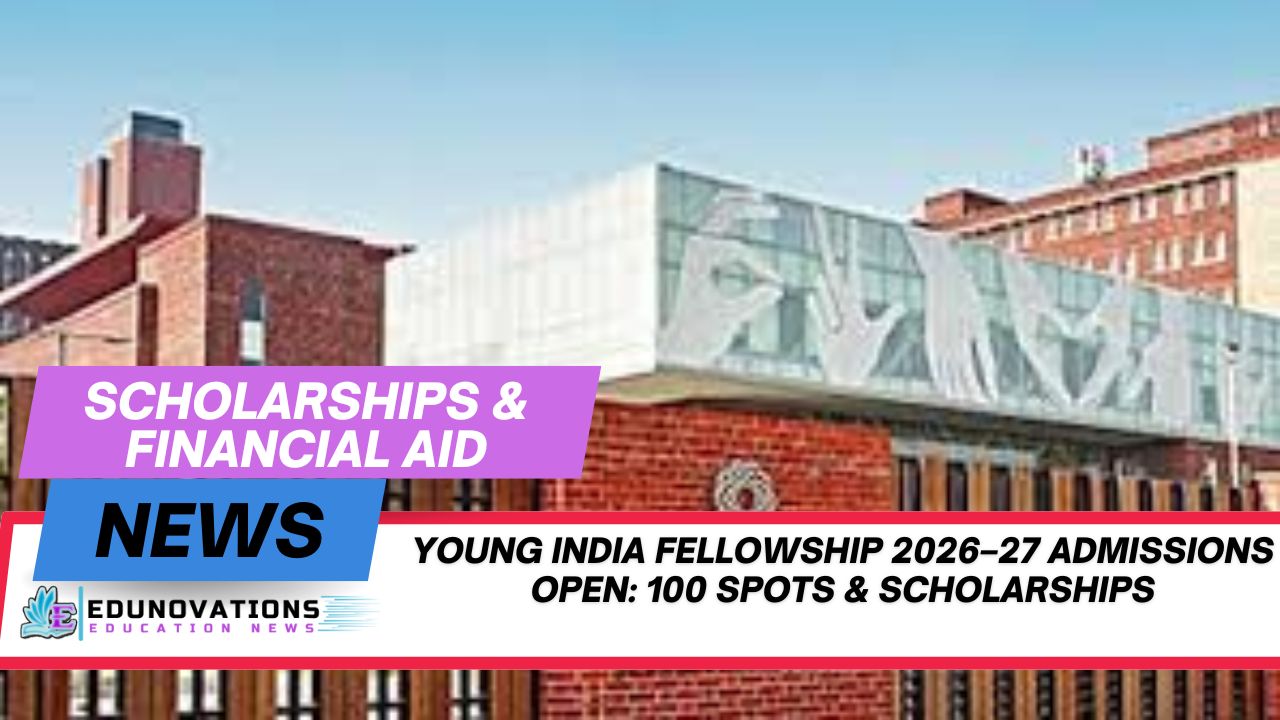
Young India Fellowship 2026–27 admissions open with 100 spots and full scholarships; new Postgraduate Diploma and accessible application process make this a top opportunity.
The renowned Ashoka University (AU) has once again opened its doors for the prestigious Young India Fellowship (YIF), launching admissions for the 2026–27 cohort. This milestone year marks 15 years since the Fellowship first began — and for the upcoming class, the university is offering 100 spots with scholarships for all selected Fellows.
In addition to continuing its legacy of excellence, this year’s YIF introduces a Postgraduate Diploma in Interdisciplinary Studies, reinforcing its commitment to holistic, cross-disciplinary education. All accepted Fellows will receive financial support — a significant move to make the programme more inclusive and accessible.
Why the Young India Fellowship 2026–27 Is a Big Opportunity
The Young India Fellowship has, over the past 15 years, emerged as one of India’s most respected programmes for interdisciplinary learning, leadership development, and experiential education.
Here’s what makes the 2026–27 cycle especially compelling:
- New academic credential: For the first time, successful candidates will receive a Postgraduate Diploma in Interdisciplinary Studies — rather than just a fellowship certificate.
- Commitment to inclusivity: All selected Fellows will benefit from scholarships, thanks to backing from HDFC Bank. This removes financial barriers for deserving applicants from diverse backgrounds.
- Limited cohort size: Approximately 100 spots will be filled, ensuring a tight-knit, selective batch of scholars.
- Holistic, multidisciplinary curriculum: Fellows will engage in a rigorous academic and experiential curriculum spanning roughly 18 courses across diverse disciplines, along with real-world projects, workshops, and mentorship.
For students seeking more than just a one-year certificate — those looking for deep intellectual immersion, exposure to multiple fields, mentorship from experts, and a supportive, scholarship-backed environment — this year’s YIF presents an excellent proposition.
Structure & Curriculum of the Programme
The updated structure underlines why this is now more than just a fellowship — it’s a full-fledged postgraduate-level learning track.
- Postgraduate Diploma in Interdisciplinary Studies: The diploma underscores the academic weight of the programme, giving Fellows a credential that holds value beyond the fellowship itself.
- Core + Elective Coursework: Fellows study around 18 courses covering multiple domains — humanities, social sciences, natural sciences, arts, and more.
- Critical Inquiry & Expression: Courses are designed to refine analytical thinking, writing, debate, public speaking, and intellectual engagement.
- Immersive Experiential Learning: Beyond classroom learning, Fellows undertake real-world projects, internships, and field-based immersive work — bridging academic learning with societal issues.
- Holistic Engagement & Mentorship: Fellows interact with faculty, guest lecturers, visiting experts and alumni — fostering a vibrant intellectual community committed to social impact.
Over its 15-year journey, almost 2,400 alumni of the Young India Fellowship have spread across sectors — government, academia, civil society, corporate, entrepreneurship, arts, sports, multilateral organisations, and more. Their success adds real-world validation to the programme’s impact.
Who Should Apply & Eligibility Criteria
The admissions criteria for YIF 2026–27 are intentionally broad — aiming to attract passionate, motivated individuals from diverse academic, professional, and social backgrounds.
✅ Eligibility Requirements
- Applicants must hold a recognised undergraduate degree in any discipline by July 2026 — or be in the final year of undergraduate study at the time of application.
- There is no age limit. Candidates may come from any age group.
- Candidates can be from any nationality, academic background, geographic or socioeconomic context.
🧠 Selection Criteria & Process
- The selection process is comprehensive and holistic — evaluating more than just academic scores. AU looks for intellectual curiosity, leadership potential, open-mindedness, empathy, critical thinking, and ability to contribute meaningfully to a diverse cohort.
- The application is free and done online. Shortlisted candidates are invited for a personal interview.
- Offers may come with either a standard admission or with a Chancellor’s Scholarship (full waiver of tuition and residence) for exceptional candidates.
This inclusive, holistic process ensures that YIF remains accessible to talented people irrespective of their prior background — making it more democratised than many traditional postgraduate programmes.
Scholarships & Financial Support — Access for All
One of the standout features of YIF 2026–27 is the financial support structure. The decision to offer scholarships to all selected Fellows underscores Ashoka’s commitment to equitable access.
- Scholarships range from 25% to 100% waiver, covering tuition, residence, meals — and in many cases, stipends.
- The elite Chancellor’s Scholarship — extended to a small set of exceptional candidates — grants full tuition and residence waiver.
- The financial backing from HDFC Bank has made this possible — making YIF accessible even to those from underprivileged or modest backgrounds.
Thanks to this, many candidates who otherwise may not afford graduate-level education can now receive high-quality postgraduate training, practical exposure, and a degree — opening doors to diverse career paths or further studies.
Why This Programme Matters: Broader Impact & Alumni Success
Over the past 15 years, YIF has built a robust reputation — not just as a one-year fellowship but as a transformative postgraduate-level experience. Here’s why it continues to matter:
- Alumni of YIF (nearly 2,400) are making substantial contributions worldwide across sectors — government, social development, research, academia, arts, entrepreneurship, corporate world.
- The interdisciplinary exposure, hands-on learning, and mentorship have equipped these individuals to tackle complex real-world challenges effectively.
- For many first-generation college goers — and individuals from non-traditional academic backgrounds — YIF offers a rare opportunity to access world-class education, rigorous training, and significant financial support. Ashoka University+1
- In a rapidly evolving job market that demands adaptability, cross-disciplinary thinking, and soft skills (leadership, communication, problem-solving), YIF’s design seems especially relevant.
According to the Vice Chancellor of Ashoka University, the Fellowship has “created leaders” whose alumni are “all across the world making a name for themselves. Many of them are at the top of their field.”
Application Timelines & Important Dates for 2026–27
If you are considering applying — here are the key deadlines and timelines for YIF 2026–27:
- Online applications now open (for Round 1).
- Priority Deadline (Round 1): December 8, 2025 — applications submitted by this date will be reviewed first for interviews.
- Final Deadline (Round 1): January 19, 2026.
- Personal interviews for shortlisted candidates will follow.
- Selected candidates will receive offer letters — with admission along with scholarship and (in some cases) need-based support.
Applicants may only apply once per cycle and in only one round.
Who Should Consider This — Ideal Aspirants for YIF 2026–27
The Young India Fellowship is not just for high-scoring academic aspirants; its holistic, interdisciplinary, and experience-driven model makes it ideal for a diverse spectrum of candidates. Consider applying if you:
- Hold or are about to complete an undergraduate degree in any discipline, irrespective of stream.
- Are curious, intellectually open, and keen to explore multiple fields — humanities, sciences, arts, social sciences, etc.
- Wish to enhance critical thinking, communication, leadership, and interdisciplinary skills rather than just technical expertise.
- Want access to scholarships or financial aid, without worrying about financial constraints.
- Aspire to apply education toward social impact, policy work, research, entrepreneurship, art, or cross-sectoral careers — not just conventional job tracks.
- Value mentorship, diverse peer groups, and real-world projects over standard classroom-only education.
Additional Context & What This Means for Higher Education in India
The revamping of YIF with a proper Postgraduate Diploma signals a shift in how Indian higher education institutions view fellowship programmes. Rather than limiting them to short-term certificates or add-ons, YIF demonstrates that fellowships — when structured with academic rigour, real-world exposure, and inclusive financial support — can stand alongside traditional postgraduate degrees.
In a time when interdisciplinary knowledge, adaptability, and cross-functional skills are increasingly valued by employers, think tanks, NGOs, and research institutions — programmes like YIF may set a benchmark. They offer an alternative to conventional master’s degrees, especially for students seeking flexibility, diversity, and social impact orientation.
Moreover, by offering scholarships to all accepted students, Ashoka University is setting a strong precedent for equity and access in higher education. For many students from underrepresented or economically weaker backgrounds, this could open life-changing opportunities — aligning with broader societal goals of democratizing quality education.
Expert Insight: Why the First-Year Postgraduate Diploma Move Matters
Education experts argue that the transition from a fellowship certificate to a full postgraduate diploma can significantly boost the perceived value of the programme. Here’s why:
- Legitimacy in academia and job markets: A postgraduate diploma carries more weight than a fellowship certificate, especially when applying abroad, for higher studies, or professional opportunities.
- Employability & recognition: Diploma holders — especially those from a reputed institution like Ashoka — are more likely to be considered for jobs, internships, research positions, or further studies.
- Bridging academic and practical worlds: Interdisciplinary diplomas encourage learners to gain exposure across fields — humanities, social sciences, sciences — providing flexibility to pivot between sectors.
- Encouraging diverse student backgrounds: Since eligibility isn’t restricted to any specific undergraduate discipline or age, the programme becomes inclusive — ideal for mid-career professionals, career-changers, and those with non-traditional backgrounds.
Given India’s evolving socio-economic context — a dynamic job market, demand for cross-functional skills, rising interest in social entrepreneurship and public policy — such a model may set new standards for postgraduate education in the country.
How to Apply & What to Prepare
If you plan to apply for YIF 2026–27, here’s a quick checklist to help you prepare:
- Check eligibility: Ensure your undergraduate degree is recognized and will be completed by July 2026 (or you are in final year). No age limit.
- Visit the official application portal: Fill out the free online application. Since the application is reflective in nature, take time to prepare thoughtful responses that reflect your background, passions, motivations, and worldview.
- Demonstrate holistic potential: YIF doesn’t just look for grades — highlight leadership, social awareness, extracurricular interests, cross-disciplinary experiences, and future goals.
- Submit before the priority deadline (December 8, 2025) for better chances of early review and interview scheduling — though final deadline is January 19, 2026.
- Be ready for personal interview: If shortlisted, you’ll be invited for a personal interview; expect questions about your background, motivations, aspirations, and societal vision.
- Prepare financial documentation (if needed): Although all Fellows receive scholarships or waivers, if you’re applying for need-based aid, prepare income proof or relevant documents as required.
For related resources, especially for exam preparation or general studies, you might explore content on our site — whether it’s NCERT Courses, Notes, or Current Affairs coverage. Internal links below could help:
- For NCERT foundational courses → NCERT Courses
- For Current Affairs updates → Current Affairs
- For MCQs, Syllabus and other study aids → MCQ / Syllabus / Notes
(Insert appropriate internal links where relevant.)
What Applicants & Observers Should Watch For
- Given that YIF 2026–27 marks a milestone 15th year, many prospective applicants and education watchers will view this batch as a “benchmark cohort.” The introduction of the Postgraduate Diploma may influence how future fellowship or diploma programmes are structured in India.
- The decision to grant scholarships to all selected Fellows could set a precedent, encouraging other institutions to reconsider access barriers.
- As global demand for interdisciplinary thinkers grows — especially in policy making, social entrepreneurship, sustainability, arts & media — YIF alumni could continue to shape India’s intellectual and professional landscape in new, diverse ways.
- For applicants — especially from underprivileged or first-generation-college backgrounds — this might be a rare chance to access transformative education at minimal cost.
Toppers Use Mind Maps to score more than 95%
NCERT Class 11th Commerce Mind Maps
Add to cartOriginal price was: ₹999.00.₹199.00Current price is: ₹199.00.NCERT Class 12th Chemistry Mind Maps
Add to cartOriginal price was: ₹199.00.₹75.00Current price is: ₹75.00.NCERT Class 12th Commerce Mind Maps
Add to cartOriginal price was: ₹999.00.₹199.00Current price is: ₹199.00.NCERT Class 12th Science Mind Maps
Add to cartOriginal price was: ₹999.00.₹199.00Current price is: ₹199.00.NCERT Mind Maps For Class 10th
Add to cartOriginal price was: ₹999.00.₹199.00Current price is: ₹199.00.



Purchase Today
10 FAQs — Young India Fellowship 2026–27 (Using Long-Tail Keywords)
Q1. What is Young India Fellowship 2026–27 admissions: 100 spots + full scholarships about?
A1. The admissions cycle for the Fellowship offering 100 spots and full scholarships aims to select around 100 talented and deserving students globally, providing them with financial support, a postgraduate diploma, and a structured interdisciplinary curriculum.
Q2. Who is eligible to apply for Postgraduate Diploma in Interdisciplinary Studies at Ashoka YIF 2026–27?
A2. Applicants with a recognised undergraduate degree (or final-year students likely to complete the degree by July 2026) in any discipline — regardless of age, academic background or nationality — are eligible.
Q3. How can I apply and what is the application deadline for YIF 2026–27 admissions?
A3. Interested candidates must fill the free online application before the priority deadline (December 8, 2025) or final deadline (January 19, 2026) for Round 1.
Q4. What kind of scholarships are available under YIF 2026–27?
A4. Scholarships range from 25% tuition waiver to a full 100% waiver covering tuition, residence, meals and — for exceptional candidates — possibly stipends or additional financial aid.
Q5. What does the curriculum include for Young India Fellowship 2026–27?
A5. The curriculum includes about 18 courses spanning multiple disciplines, core and elective coursework, experiential projects, mentorship, seminars, real-world engagement and exposure to diverse fields.
Q6. Why choose interdisciplinary postgraduate diploma over traditional masters in India?
A6. Because the interdisciplinary postgraduate diploma offers broad academic exposure, flexibility, cross-disciplinary skills, practical projects, and inclusive financial support — making it more adaptable than many traditional master’s programmes.
Q7. Does YIF 2026–27 consider applicants from non-science or non-arts background?
A7. Yes — YIF welcomes applicants from any discipline, whether sciences, humanities, commerce, arts or vocational backgrounds.
Q8. What is the selection process for Young India Fellowship 2026–27 admissions?
A8. Selection involves a holistic assessment of the application — academic records, extracurriculars, personal statement, background, motivations — followed by a personal interview for shortlisted candidates.
Q9. Is there an age limit for applying to YIF 2026–27?
A9. No — the Fellowship is open to all age groups, making it accessible to fresh graduates, mid-career professionals or non-traditional students alike.
Q10. How does scholarship funding work and who supports it for YIF 2026–27?
A10. Scholarships are funded primarily through support by HDFC Bank; they cover varying levels — from partial tuition waivers to full scholarships including residence, meals, and in some cases additional assistance for deserving candidates.