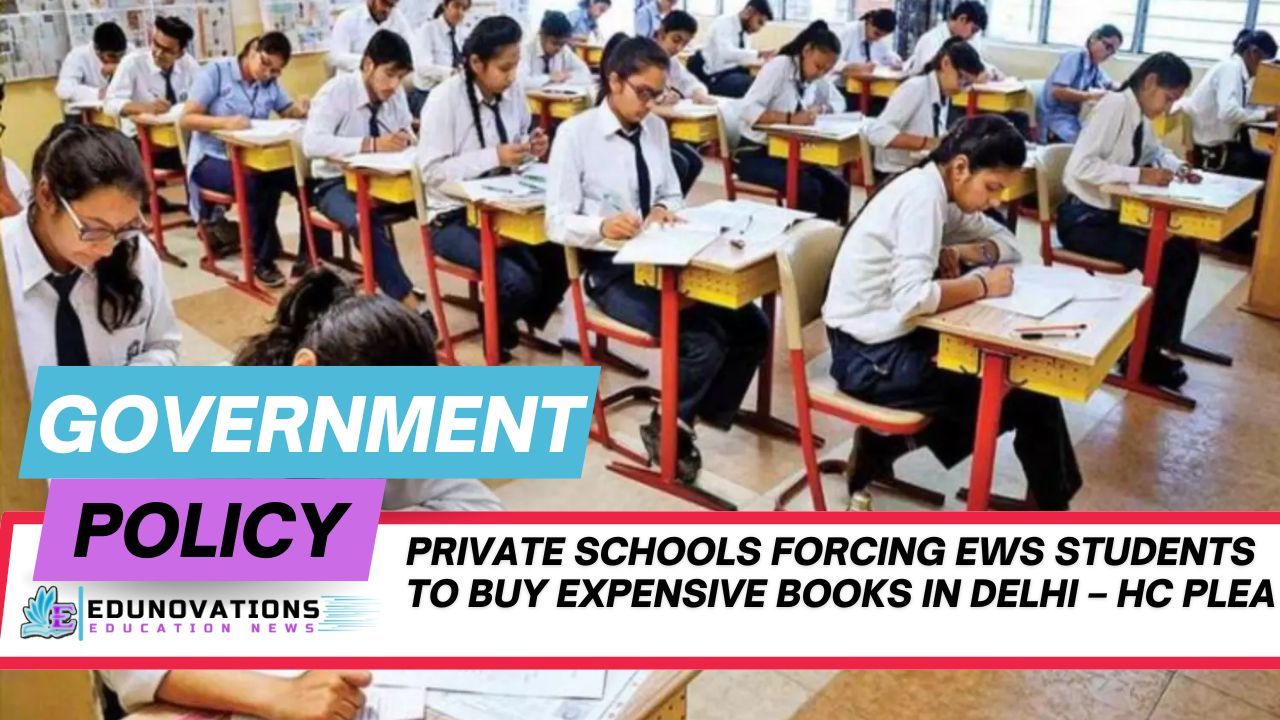
Delhi HC issues notice on plea alleging private schools forcing EWS students to buy expensive books in Delhi, raising concerns over exclusion and affordability gaps.
Introduction
The Delhi High Court has recently taken cognisance of a plea that highlights a troubling trend: private schools forcing EWS students to buy expensive books in Delhi. This petition has drawn attention to the growing disparity between the costs imposed by private publishers and the reimbursement provided by the Delhi government. The issue is not merely about textbooks; it represents a larger question of access to education, systemic exclusion, and the spirit of the Right to Education (RTE) Act.
The matter is of national importance, as the plea argues that compelling economically weaker section (EWS) students to purchase high-cost books undermines inclusivity in private schools. The court has sought responses from the Delhi government, the Central Board of Secondary Education (CBSE), and the National Council of Educational Research and Training (NCERT) within a defined timeframe.
The Background of the Plea
At the core of the case is the argument that EWS students, who are admitted into private schools under the RTE quota, face financial discrimination. The plea contends that these students are compelled to purchase books from private publishers costing up to ₹12,000 annually, while NCERT books covering the same curriculum are available at a fraction of the price—less than ₹700.
The Delhi government currently provides a reimbursement of ₹5,000 per year for these students. However, the reimbursement falls significantly short of the actual expenses, creating a wide affordability gap. This shortfall is resulting in systemic exclusion of EWS students due to high book costs, contradicting the principles of equity in education.
Judicial Intervention and Stakeholder Responses
The Delhi High Court, led by a division bench, issued notices to the Delhi government, CBSE, and NCERT, directing them to respond within four weeks. The petitioner has emphasised that unless regulatory mechanisms are introduced, the exploitation of families in the EWS category will continue unchecked.
The plea has also highlighted that despite the availability of NCERT textbooks, private schools prefer books by commercial publishers. This practice is viewed as a form of commercialisation of education in private CBSE schools, creating an unequal playing field for children from weaker backgrounds.
Financial Burden on EWS Families
The mismatch between government reimbursement and actual book costs is stark.
- Private publisher books: Up to ₹12,000 annually
- NCERT books: Approximately ₹700 annually
- Government reimbursement: ₹5,000 annually
This disparity leaves parents with an additional burden of at least ₹7,000 per year. For families already struggling to make ends meet, the expense is unsustainable and undermines the very purpose of the RTE framework.
Toppers Use Mind Maps to score more than 95%
NCERT Class 11th Commerce Mind Maps
Add to cartOriginal price was: ₹999.00.₹199.00Current price is: ₹199.00.NCERT Class 12th Chemistry Mind Maps
Add to cartOriginal price was: ₹199.00.₹75.00Current price is: ₹75.00.NCERT Class 12th Commerce Mind Maps
Add to cartOriginal price was: ₹999.00.₹199.00Current price is: ₹199.00.NCERT Class 12th Science Mind Maps
Add to cartOriginal price was: ₹999.00.₹199.00Current price is: ₹199.00.NCERT Mind Maps For Class 10th
Add to cartOriginal price was: ₹999.00.₹199.00Current price is: ₹199.00.


Purchase Today
The “Fixed Rate–Fixed Weight” Proposal
The petitioner has proposed a Fixed Rate Fixed Weight system for private publisher books in Delhi HC, which would cap both the price and weight of schoolbooks. The argument is twofold:
- To reduce financial exploitation of parents.
- To ensure compliance with child health guidelines, as heavy schoolbags have long been a matter of concern.
Education experts believe that introducing such a system would provide transparency and fairness, ensuring schools cannot arbitrarily inflate costs.
Voices from Experts and Civil Society
Education activist Ashok Agarwal, known for his work on education equity, commented that “forcing children from EWS backgrounds to buy expensive books is nothing less than systemic exclusion. It is a violation of the RTE Act and undermines the inclusivity that private schools are obliged to uphold.”
Policy experts further point out that while private schools argue about maintaining quality, NCERT textbooks have been widely accepted as comprehensive, cost-effective, and aligned with national curriculum frameworks.
The Larger Debate: Public vs Private Interests
The controversy raises a fundamental question: should private schools prioritise commercial interests over social responsibility? Advocates for education reform argue that unless regulated, EWS students reimburse Rs 5000 vs Rs 12000 cost of private textbooks will remain a recurring inequity.
By mandating NCERT books, the government can strike a balance between quality and affordability. Moreover, ensuring compliance with the RTE Act requires monitoring mechanisms and punitive measures for violations.
Policy Implications and Road Ahead
The Delhi High Court’s intervention signals an important step towards curbing exploitative practices. If implemented, reforms may include:
- Mandatory use of NCERT textbooks in all CBSE-affiliated schools.
- Revisions in the reimbursement policy to reflect actual costs.
- Introduction of a monitoring framework for compliance.
- Adoption of the Fixed Rate Fixed Weight system nationwide.
These measures would align India’s education system closer to the ideals of equity and accessibility.
Broader Context in Indian Education
This case is not isolated to Delhi. Across India, parents have voiced similar concerns about high costs of books, uniforms, and other school supplies. The systemic issue reflects an ongoing clash between the commercialisation of private schooling and the inclusive goals of education policy.
For students under the EWS quota, the affordability gap creates a two-tier system: one where wealthier students thrive while economically weaker peers struggle for access. Addressing these inequities is vital for maintaining social cohesion and fulfilling the promise of the RTE Act.
Useful Resources for Students and Parents
To support equitable education access, families can explore the following resources:
- NCERT Courses – affordable learning resources
- Current Affairs – updated news and exam prep material
- Notes – downloadable study notes
- MCQs – practice questions for exams
- Videos – visual learning content
- Syllabus – subject-wise curriculum details
- Free NCERT PDFs – cost-effective textbook access
- NCERT Mind Maps – simplified learning aids
- School Website Solutions – external provider for school tech needs
Conclusion
The Delhi High Court’s notice reflects an urgent need to protect the rights of underprivileged children in the education system. The practice of private schools forcing EWS students to buy expensive books in Delhi is not only a violation of the RTE Act but also a symbol of systemic exclusion. Unless strong regulatory frameworks and supportive policies are implemented, the gap between affordability and access will only widen.
The case highlights the importance of balancing quality education with equitable access and reaffirms that inclusivity must remain the cornerstone of India’s schooling system.
FAQs
1. Why are private schools forcing EWS students to buy expensive books in Delhi?
Private schools prefer private publisher textbooks over NCERT books, citing quality, but this increases costs for EWS students.
2. How much reimbursement does the Delhi government provide for EWS students’ books?
The Delhi government reimburses ₹5,000 annually, far less than the ₹12,000 average cost of private textbooks.
3. What is the systemic exclusion of EWS students due to high book costs?
It refers to the financial burden that makes education unaffordable, pushing weaker section students out of mainstream private schools.
4. What is the Delhi HC plea on commercialisation of education in private CBSE schools?
The plea argues that private schools are exploiting EWS students by forcing them to buy expensive books, violating the RTE Act.
5. How does the Fixed Rate Fixed Weight system for private publisher books work?
It proposes regulating the price and weight of books to ensure affordability and compliance with health guidelines.
6. Are NCERT books sufficient compared to private publisher books?
Yes, NCERT books are comprehensive, cost-effective, and aligned with the national curriculum, making them a viable alternative.
7. Why is there a gap between reimbursement and book costs?
The government reimbursement is capped at ₹5,000, but private schools mandate books costing up to ₹12,000.
8. What role does the Delhi High Court play in this case?
The HC has sought responses from Delhi govt, CBSE, and NCERT to examine whether regulatory changes are needed.
9. How can parents and students access affordable textbooks?
They can download Free NCERT PDFs and purchase low-cost editions to avoid private publisher costs.
10. What broader reforms could prevent exploitation of EWS students?
Mandatory NCERT adoption, better reimbursements, monitoring mechanisms, and a Fixed Rate Fixed Weight policy could ensure fairness.