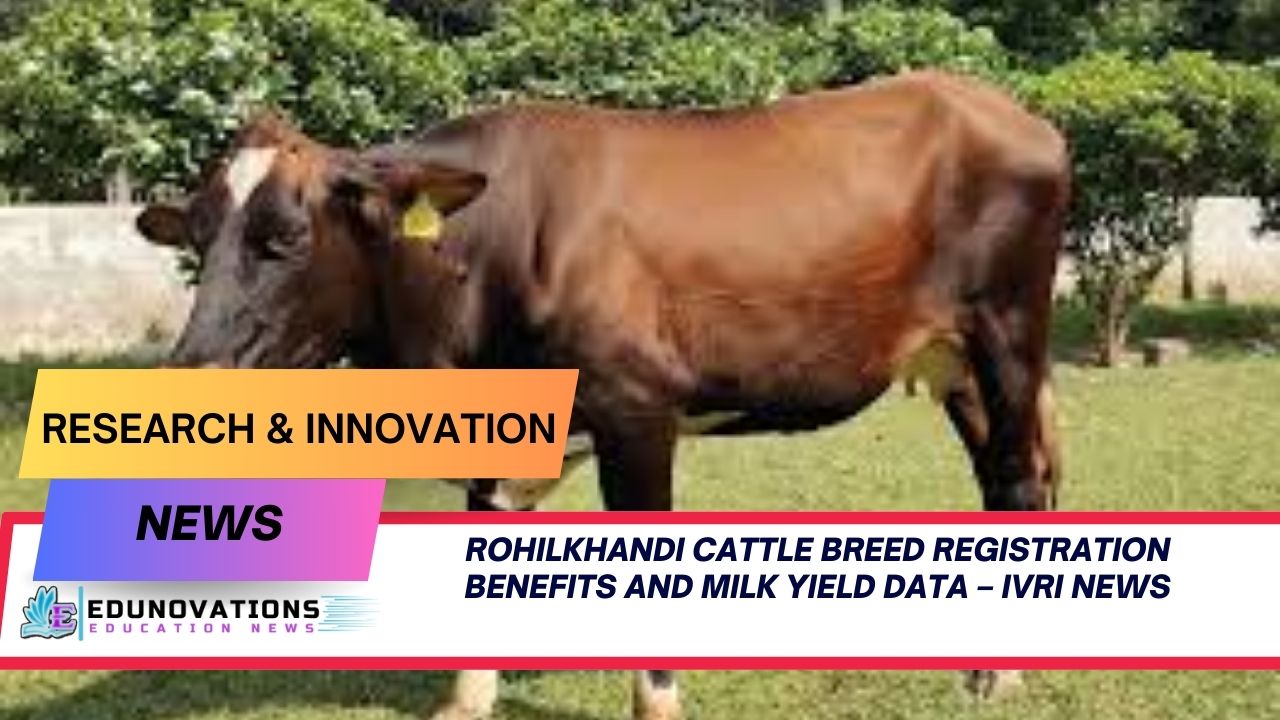
Discover how Rohilkhandi cattle breed registration improves milk yield, breed conservation, and boosts farmer income through IVRI’s initiative.
The Indian Veterinary Research Institute (IVRI), Izatnagar, has achieved a landmark milestone with the official registration of two important cattle breeds—Rohilkhandi and Vrindavani—under the National Bureau of Animal Genetic Resources (ICAR-NBAGR). This recognition not only ensures proper documentation and conservation of these indigenous breeds but also provides farmers with better access to government schemes and livestock improvement programs.
Importance of Rohilkhandi and Vrindavani Cattle Registration
The registration of Rohilkhandi cattle breed registration benefits and milk yield data has far-reaching implications for livestock management in India. Dr. Chaturverdi Dutt, leading the initiative at IVRI, highlighted that breed registration aids in:
- Genetic conservation of indigenous cattle
- Improved breeding strategies for milk and draught purposes
- Enhanced farmer income through access to government subsidies and schemes
During the registration ceremony held at NASC Complex, New Delhi, Union Minister of Agriculture and Farmers Welfare, Shri Chisvaraj Singh Chauhan, alongside Dr. Mangi Lal Jat, Secretary, Department of Animal Husbandry and Dairying (DAHD), formally acknowledged the registration. The ceremony also featured contributions from senior ICAR officials and livestock experts.
Rohilkhandi Cattle: Characteristics and Benefits
Rohilkhandi cattle are primarily found in the districts of Bareilly, Badaun, and Pilibhit in Uttar Pradesh. The breed is known for:
- Distinctive white color and medium build
- Average daily milk production of 4–5 liters
- Strong draught capacity, suitable for ploughing and load carrying
- High adaptability to hot and humid climates
- Disease resistance, reducing veterinary costs for farmers
Currently, the estimated population of Rohilkhandi cattle is around 300,000. With formal registration, structured improvement programs can enhance productivity and ensure sustainable growth in local dairy farming communities. Experts predict that these efforts will make Rohilkhandi one of the most successful breeds in the Bareilly division, positively impacting farmer livelihoods.
For further learning on livestock management and dairy farming techniques, explore NCERT courses and current affairs updates.
Vrindavani Crossbred Cattle: Features and Productivity
The Vrindavani crossbred cattle characteristics and production traits focus on maximizing milk yield while retaining indigenous adaptability. These cattle are a cross of Holstein Friesian and local breeds, optimized for:
- Higher milk production, averaging 6–7 liters per day
- Efficient feed conversion, making them suitable for small and medium farms
- Enhanced reproductive performance
- Adaptability to various agro-climatic conditions
By registering Vrindavani cattle, IVRI ensures the long-term conservation and strategic breeding of this valuable crossbreed, offering farmers opportunities to participate in productivity-enhancing programs.
Farmers can also access NCERT mind maps and study resources to better understand breeding programs and livestock science.
Government and Expert Involvement in Cattle Breed Registration
Dr. Raghavendra Bhatta, Deputy Director (Animal Science), ICAR, emphasized that breed registration strengthens policy-making for livestock development. Alongside him, Dr. G.N. Gaur and Dr. N.A. Mohan highlighted the importance of structured breeding and conservation plans. Dr. Dutt noted that both Rohilkhandi and Vrindavani breeds could significantly increase dairy productivity and support the rural economy in Uttar Pradesh.
Additionally, registration allows farmers to avail government subsidies, technical guidance, and training programs, enhancing their income and ensuring sustainable livestock practices. For guidance on livestock planning, consult Mart India Infotech for expert solutions and farm management tools.
Conservation and Breeding Strategies
Key Strategies for Breed Improvement:
- Population documentation and monitoring
- Artificial insemination programs for genetic improvement
- Health and nutrition management to boost productivity
- Training farmers on breed-specific care and milk production techniques
Experts at IVRI emphasize that proper documentation and breed registration help preserve genetic diversity while promoting economic development for local farmers. These strategies align with national initiatives under the ICAR-NBAGR, focusing on indigenous breed conservation.
Future Prospects for Rohilkhandi and Vrindavani Cattle
The official registration ensures:
- Better yield forecasting for dairy operations
- Enhanced policy interventions for sustainable farming
- Increased farmer adoption of improved breeds
- Higher regional productivity, contributing to India’s overall dairy output
Dr. Chaturverdi Dutt envisions a future where these breeds will be integral to Bareilly and neighboring divisions, supporting not only milk production but also rural livelihoods.
Students and enthusiasts can explore NCERT PDFs and video tutorials to gain deeper insights into cattle breeding and agricultural practices.
Key Takeaways
- Rohilkhandi cattle breed registration benefits and milk yield data are critical for regional dairy development
- Registration ensures genetic preservation and farmer empowerment
- Vrindavani cattle provide higher milk yields and adaptability for diverse climates
- Structured breeding strategies support sustainable livestock farming
- Government and expert participation strengthens policy and farmer outreach programs
Toppers Use Mind Maps to score more than 95%
-
NCERT Class 11th Commerce Mind Maps
Add to cartOriginal price was: ₹999.00.₹199.00Current price is: ₹199.00. -
NCERT Class 12th Chemistry Mind Maps
Add to cartOriginal price was: ₹199.00.₹75.00Current price is: ₹75.00. -
NCERT Class 12th Commerce Mind Maps
Add to cartOriginal price was: ₹999.00.₹199.00Current price is: ₹199.00. -
NCERT Class 12th Science Mind Maps
Add to cartOriginal price was: ₹999.00.₹199.00Current price is: ₹199.00. -
NCERT Mind Maps For Class 10th
Add to cartOriginal price was: ₹999.00.₹199.00Current price is: ₹199.00.





Purchase Today
FAQs
- What are the benefits of Rohilkhandi cattle breed registration?
Registration ensures genetic conservation, improved milk yield, and access to government schemes. - How much milk do Rohilkhandi cattle produce daily?
On average, 4–5 liters per day. - What are Vrindavani crossbred cattle characteristics and production traits?
They provide 6–7 liters daily, with good adaptability and reproductive performance. - How does registration help farmers financially?
It enables access to subsidies, technical training, and improved productivity. - Which Indian regions primarily host Rohilkhandi cattle?
Bareilly, Badaun, and Pilibhit districts in Uttar Pradesh. - What government bodies oversee breed registration?
ICAR-NBAGR and the Department of Animal Husbandry & Dairying (DAHD). - Can breed registration improve disease resistance?
Yes, systematic breeding enhances immunity and reduces veterinary costs. - What strategies are used for breed conservation?
Documentation, artificial insemination, nutrition management, and farmer training. - Why is Vrindavani cattle registration important?
It supports crossbred optimization for higher milk yield and adaptability. - Where can farmers learn more about livestock management?
Through NCERT courses, videos, mind maps, and external advisory sites like Mart India Infotech.