Education is the bedrock upon which the future of any developing nation stands, yet financial barriers often force brilliant, young minds to prematurely abandon their academic journeys.
Education is the bedrock upon which the future of any developing nation stands, yet financial barriers often force brilliant, young minds to prematurely abandon their academic journeys. To combat this pressing challenge and uplift deserving students from economically disadvantaged backgrounds, the Ministry of Education orchestrates the prestigious National Means-cum-Merit Scholarship (NMMS) scheme.
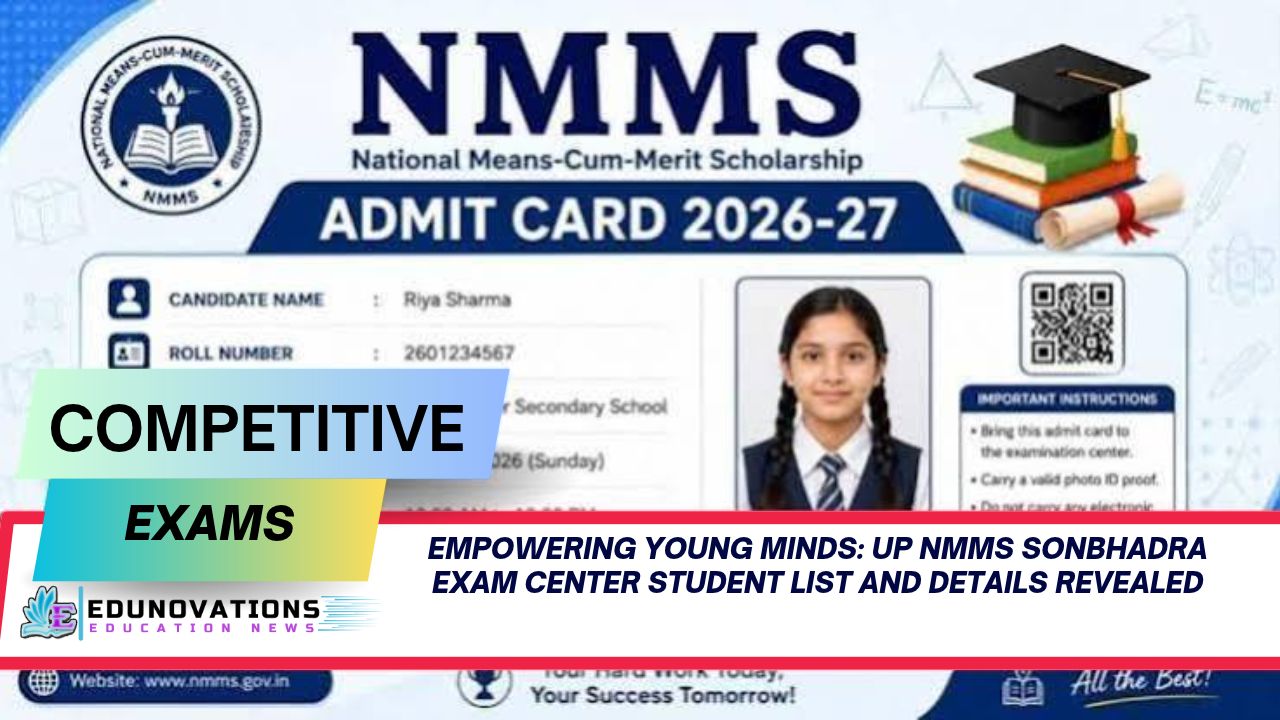
Reflecting this nationwide mission at the grassroots level, a vibrant display of academic enthusiasm was recently witnessed in the Sonbhadra district of Uttar Pradesh. Out of 1,175 registered young hopefuls, exactly 994 students in Sonbhadra appeared for the National Means-cum-Merit Scholarship Examination. This critical assessment serves as a gateway for talented eighth-grade scholars, offering them financial wings to soar higher into secondary education without letting monetary constraints clip their wings.
The Significance of the NMMS Scheme in Modern Education
The National Means-cum-Merit Scholarship scheme was originally conceptualized to arrest the alarming dropout rate among students after they complete their primary or upper-primary education, particularly encouraging them to continue learning through classes IX to XII. Selected candidates receive a scholarship amount of INR 12,000 per annum (calculated at INR 1,000 per month) directly credited into their verified bank accounts via the Public Financial Management System (PFMS).
For children growing up in rural or semi-urban belts like Sonbhadra, this financial safety net acts as a game-changer. It covers essential school expenses, textbook purchases, stationery costs, and ancillary learning tools. When viewed through a broader lens, initiatives like these bridge the equity gap, ensuring that raw talent is never stifled simply due to an empty pocket.
To maximize your child’s or student’s grasp of fundamental concepts, exploring reliable resources like NCERT Courses and downloading study materials from Downloads of Free NCERT PDFs can lay a robust foundation. Furthermore, incorporating visual learning techniques through NCERT Mind Maps helps young learners retain complex scientific and mathematical theorems with ease.
Inside the Sonbhadra Examination Centers: Structure and Execution
The examination in Sonbhadra was conducted under strict administrative supervision to maintain absolute transparency, fairness, and discipline. The evaluation structure of the NMMS test is scientifically designed to judge both innate cognitive capability and academic proficiency.
The test is systematically split into two distinct sections:
- Mental Ability Test (MAT): Comprising 90 multiple-choice questions over 90 minutes, this section tests verbal and non-verbal reasoning, including analogies, classification, numerical series, pattern perception, and hidden figures.
- Scholastic Aptitude Test (SAT): This component also consists of 90 multiple-choice questions for a duration of 90 minutes, evaluating comprehensive knowledge across Science, Social Studies, and Mathematics drawn from the curriculum of classes 7 and 8.
With a total of 180 questions carrying 180 marks, students had to demonstrate rigorous time management and conceptual clarity.
For systematic revision and self-assessment, students can practice regularly using Notes and test their understanding through interactive MCQ’s. Additionally, staying aligned with the official Syllabus ensures that no vital topic is left unread.
Student Experiences and Expert Perspectives
As young scholars walked out of the examination halls across Sonbhadra, a mixed wave of relief, excitement, and introspection filled the air.
- Ankit, a student from Chapail, shared his thoughts after completing the test: “The mathematics and science portions felt relatively straightforward because we practiced core problems beforehand. However, the general mental ability section required deep logical deduction. I managed my time well and hope for a strong merit score.”
- Arvind, coming from Kharhara, noted: “Social science and general awareness questions were balanced, though some multi-layered questions made me pause and think critically. Keeping an eye on the clock was crucial to finish everything.”
- Ishu from Ghatihta added: “The question paper thoroughly examined our analytical capabilities. While certain math calculations took extra minutes, the overall experience boosted my confidence for future competitive exams.”
Local guardians and educationists also voiced strong support for the examination structure. Vijay Bahadur Singh, a local guardian, remarked: “Conducting competitive evaluations at the middle-school level changes children’s attitudes toward learning. It encourages them to think beyond rote memorization and builds the competitive temperament necessary for future milestones.”
Educational administrators frequently stress that early exposure to national-level aptitude tests builds long-term resilience. To stay updated with broader educational trends, policy shifts, and general awareness updates that often mirror questions found in the SAT and MAT papers, students and educators frequently monitor portals dedicated to Current Affairs and educational video repositories like Videos.
Institutional Excellence and Educational Infrastructure
The seamless execution of district-wide competitive examinations requires robust logistical coordination, digital tracking, and secure communication channels. In regions like Sonbhadra, educational institutions and testing centers rely heavily on state-of-the-art administrative frameworks and secure digital infrastructure to handle candidate registrations, admit card generations, and result rollouts.
For schools and educational institutions seeking to upgrade their digital infrastructure, management portals, and administrative software solutions to support modern digital learning environments, partnering with specialized technology service providers like Mart Ind Infotech (“Mart Ind Infotech”) offers reliable pathways to institutional modernization.
Looking Ahead: Answer Keys, Evaluation, and Merit Generation
Following the successful conclusion of the test in Sonbhadra and across other districts of Uttar Pradesh, the examination board follows a structured timeline:
- Provisional Answer Keys: Released shortly after the exam conclusion, allowing candidates to review their answers and raise official objections if discrepancies are found.
- Final Answer Keys: Published following expert review of candidate feedback.
- Result Declaration: Scheduled for early next year, determining the final district-wise and state-wise merit lists based on combined aggregate scores in MAT and SAT.
Qualifying students enter a secure financial pipeline that guarantees them steady support through their crucial secondary school years, paving the path toward higher education excellence and professional success.
Toppers Use Mind Maps to score more than 95%
-
NCERT Class 11th Commerce Mind Maps
Add to cartOriginal price was: ₹999.00.₹199.00Current price is: ₹199.00. -
NCERT Class 12th Chemistry Mind Maps
Add to cartOriginal price was: ₹199.00.₹75.00Current price is: ₹75.00. -
NCERT Class 12th Commerce Mind Maps
Add to cartOriginal price was: ₹999.00.₹199.00Current price is: ₹199.00. -
NCERT Class 12th Science Mind Maps
Add to cartOriginal price was: ₹999.00.₹199.00Current price is: ₹199.00. -
NCERT Mind Maps For Class 10th
Add to cartOriginal price was: ₹999.00.₹199.00Current price is: ₹199.00.


Purchase Today
Frequently Asked Questions
1. What is the primary objective of the UP NMMS scholarship exam?
The primary goal is to award scholarships to meritorious students from economically weaker sections to arrest the dropout rate after class 8 and encourage them to continue their studies up to class 12.
2. How many students appeared for the exam in Sonbhadra recently?
A total of 994 students appeared for the National Means-cum-Merit Scholarship examination out of 1,175 registered candidates in Sonbhadra.
3. What are the key components of the NMMS written examination?
The examination consists of two main papers: the Mental Ability Test (MAT) and the Scholastic Aptitude Test (SAT), each carrying 90 multiple-choice questions.
4. What is the financial benefit awarded under the NMMS scheme?
Selected qualifying students receive an annual scholarship of INR 12,000, disbursed as INR 1,000 per month directly into their bank accounts.
5. What are the eligibility criteria regarding family income for this scholarship?
The total annual family income of the applicant from all sources must not exceed INR 3,50,000.
6. Are students studying in private schools eligible to apply for NMMS?
No, students enrolled in private schools, Kendriya Vidyalayas (KV), Jawahar Navodaya Vidyalayas (JNV), and Sainik schools are not eligible for this scheme.
7. What academic class must a student be studying in to appear for the test?
Students studying as regular students in Class 8 in government, government-aided, or local body schools are eligible to appear.
8. What minimum marks are required in Class 8 to qualify for the scholarship award?
Students must secure at least 55% marks (with a 5% relaxation for SC/ST categories) in their Class 8 final examination at the time of final selection.
9. How can students check the Sonbhadra NMMS district merit list?
Students can check the district merit lists and scorecards online through the official state examination regulatory authority portal once results are officially declared.
10. Where can aspirants find quality study materials and practice tests for MAT and SAT?
Aspirants can utilize dedicated educational platforms offering NCERT courses, practice MCQs, conceptual notes, and syllabus guides to prepare effectively.