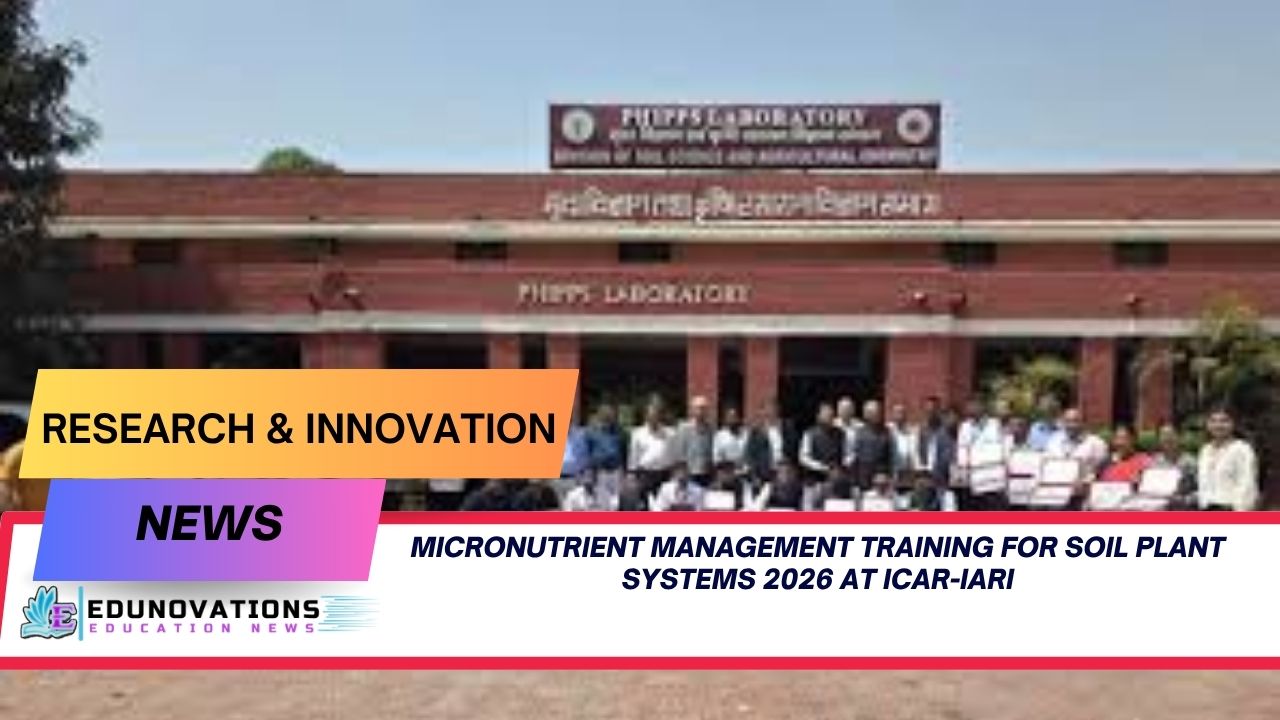
The micronutrient management training for soil plant systems 2026 organized by ICAR-IARI highlighted sustainable fertilizer technologies, soil testing innovations, and modern agricultural practices for Indian farmers and researchers.
Powerful ICAR Initiative Boosts Agricultural Innovation Through Specialized Training Programme
India’s agricultural sector is witnessing rapid transformation with the adoption of scientific nutrient management practices and sustainable farming technologies. In a major development, the Indian Agricultural Research Institute (IARI) organized a specialized training programme focused on improving micronutrient efficiency and soil health management for scientists, agricultural professionals, students, and extension workers.
The event has gained attention among researchers and farming communities because the micronutrient management training for soil plant systems 2026 focused on practical agricultural solutions that directly impact crop productivity, soil fertility, and sustainable food systems. The programme was conducted at the Division of Soil Science and Agricultural Chemistry (SSAC), one of the leading agricultural research divisions under ICAR-IARI.
Experts participating in the programme emphasized that nutrient deficiencies in Indian soils are becoming a major challenge for food security. According to agricultural studies, nearly 40–50% of cultivated land in India shows micronutrient imbalance, affecting crop yields and nutritional quality.
The micronutrient management training for soil plant systems 2026 therefore arrives at a crucial time when Indian agriculture is moving toward climate-resilient and precision-based farming methods.
Growing Importance of Scientific Nutrient Management
India remains one of the world’s largest agricultural economies. However, continuous cropping, excessive use of chemical fertilizers, and declining soil organic matter have created serious concerns regarding soil health.
Agricultural scientists participating in the programme noted that micronutrients such as zinc, iron, boron, manganese, and copper play a critical role in plant growth and crop productivity. Deficiency of these nutrients reduces crop quality and lowers farmers’ incomes.
The micronutrient management training for soil plant systems 2026 highlighted how balanced nutrient management can improve:
- Soil fertility
- Water-use efficiency
- Crop yield stability
- Resistance against plant diseases
- Nutritional value of food grains
Experts explained that micronutrients are required in smaller quantities compared to macronutrients, yet their absence can severely damage agricultural productivity.
Participants received detailed technical guidance regarding soil testing procedures, fertilizer application strategies, and sustainable nutrient management practices suitable for Indian agro-climatic conditions.
Major Focus Areas Covered During the Programme
The training programme included technical lectures, practical demonstrations, laboratory exposure, and interactive sessions with agricultural experts.
Key areas discussed during the event included:
Soil Testing Technologies
Scientists demonstrated advanced soil testing methods used for detecting micronutrient deficiencies in agricultural land. These technologies help farmers apply fertilizers more efficiently and reduce unnecessary agricultural expenditure.
Precision Farming Approaches
Participants were introduced to precision nutrient management systems designed to improve crop performance while minimizing environmental impact.
Biofortification Strategies
Agricultural researchers discussed methods to increase nutrient content in crops through scientific interventions. Biofortification has become increasingly important in addressing malnutrition challenges across rural India.
Fertilizer Innovation
The programme also highlighted advanced fertilizer formulations and nano-fertilizer technologies that improve nutrient absorption in crops.
The micronutrient management training for soil plant systems 2026 particularly emphasized sustainable fertilizer practices that reduce soil degradation while maintaining long-term productivity.
Why Soil Health Has Become a National Priority
India’s policymakers and agricultural institutions have increasingly focused on soil health due to declining productivity in many regions.
The Government of India’s Soil Health Card Scheme has already highlighted widespread nutrient deficiencies across multiple states. Agricultural experts participating in the programme stated that improper fertilizer use continues to create nutrient imbalance in soils.
According to experts, the following issues are becoming more common:
- Zinc deficiency in cereal crops
- Iron chlorosis in horticultural crops
- Boron deficiency in oilseeds
- Reduced nitrogen-use efficiency
- Declining soil microbial activity
The micronutrient management training for soil plant systems 2026 addressed these concerns through evidence-based scientific recommendations.
Agricultural professionals attending the event were encouraged to promote balanced fertilizer usage among farmers through awareness campaigns and field demonstrations.
Expert Insights on Sustainable Agriculture
Several senior scientists and soil experts shared insights during the programme regarding the future of sustainable agriculture in India.
Agricultural experts stressed that improving micronutrient efficiency is essential for achieving higher crop yields without increasing pressure on natural resources.
They explained that modern farming must focus on:
- Integrated nutrient management
- Organic matter restoration
- Climate-smart farming
- Efficient irrigation systems
- Precision fertilizer application
Experts also highlighted that excessive fertilizer use not only increases farming costs but also harms soil biodiversity and groundwater quality.
The micronutrient management training for soil plant systems 2026 therefore aimed to build scientific awareness among stakeholders involved in agricultural extension and research activities.
Role of ICAR-IARI in Agricultural Research
The Indian Agricultural Research Institute has played a pioneering role in agricultural innovation for decades. Widely known as the “Pusa Institute,” ICAR-IARI has contributed significantly to India’s Green Revolution and modern farming practices.
The institute continues to conduct advanced research in:
- Crop improvement
- Soil science
- Agricultural biotechnology
- Climate-resilient farming
- Sustainable nutrient management
The latest training initiative further strengthens ICAR-IARI’s role in promoting scientific agriculture across India.
Participants appreciated the institute’s efforts in organizing the micronutrient management training for soil plant systems 2026 because the sessions combined theoretical understanding with practical agricultural applications.
Benefits for Farmers and Agricultural Professionals
One of the biggest advantages of the programme was its practical orientation. Agricultural extension officers, scientists, and students gained valuable knowledge that can directly benefit farming communities.
Expected outcomes from such training initiatives include:
- Better nutrient-use efficiency
- Reduced fertilizer wastage
- Higher crop productivity
- Improved soil sustainability
- Increased farmer awareness
- Better crop quality
Experts noted that scientific nutrient management can significantly reduce cultivation costs while improving long-term agricultural profitability.
The micronutrient management training for soil plant systems 2026 also encouraged collaboration between researchers and field-level agricultural workers.
Advanced Fertilizer Technologies Explained
A major highlight of the event was the discussion on innovative fertilizer technologies being developed for Indian agriculture.
Participants learned about:
- Nano-fertilizers
- Controlled-release fertilizers
- Customized nutrient blends
- Biofertilizers
- Micronutrient-enriched formulations
These technologies are expected to improve nutrient absorption efficiency and reduce environmental pollution caused by excessive fertilizer application.
The advanced fertilizer technologies training for agriculture segment received strong interest from participants because India is rapidly adopting precision agriculture tools.
Agricultural experts stated that technology-driven nutrient management will become essential for future farming systems.
Importance of Training Programmes in Modern Agriculture
Agricultural training programmes play a critical role in bridging the gap between scientific research and field-level implementation.
Many farmers still rely on traditional fertilizer application practices without proper soil testing. As a result, crops often suffer from hidden hunger caused by micronutrient deficiencies.
The micronutrient management training for soil plant systems 2026 attempted to address this issue by promoting science-based decision-making.
Participants were trained to identify:
- Visual deficiency symptoms in crops
- Soil nutrient imbalance indicators
- Efficient fertilizer schedules
- Sustainable crop nutrition practices
Agricultural educators attending the programme emphasized that farmer awareness campaigns must be strengthened across rural India.
Climate Change and Nutrient Management
Climate change is increasingly affecting agricultural productivity across India. Rising temperatures, irregular rainfall, and soil degradation have created new challenges for farmers.
Experts explained that balanced nutrient management can improve crop resilience under stressful climatic conditions.
The programme discussed how sustainable micronutrient management in Indian agriculture can support:
- Drought tolerance
- Improved root development
- Better water retention
- Enhanced crop immunity
Scientists highlighted that future agricultural systems must integrate climate adaptation strategies with nutrient management solutions.
The micronutrient management training for soil plant systems 2026 therefore aligned closely with India’s long-term agricultural sustainability goals.
Digital Agriculture and Smart Farming Trends
Another important topic discussed during the programme was the growing role of digital agriculture.
Modern technologies such as:
- AI-driven soil analysis
- GPS-based nutrient mapping
- Drone-assisted fertilizer spraying
- Smart irrigation systems
- Data-driven crop monitoring
are changing the future of farming in India.
Participants learned how digital tools can improve fertilizer efficiency and reduce input costs.
The ICAR IARI micronutrient fertilizer training programme Delhi also encouraged participants to adopt data-based agricultural practices that support sustainable farming systems.
Educational Opportunities for Agricultural Students
The programme provided valuable learning exposure for students and young researchers interested in soil science and nutrient management.
Agricultural education experts stressed that future agronomists must understand modern soil fertility management techniques to address India’s food security challenges.
Students were encouraged to explore:
- Soil chemistry research
- Fertilizer technology innovation
- Precision agriculture systems
- Sustainable farming practices
For students seeking academic resources and preparation materials, platforms such as NCERT Courses, NCERT Notes, and MCQ Practice Resources provide useful educational support.
Similarly, aspirants can also access Current Affairs Updates and Educational Videos for competitive exam preparation.
Industry Collaboration and Agricultural Outreach
Experts participating in the programme stressed the importance of collaboration between agricultural institutions, industry stakeholders, and technology providers.
Agricultural technology companies are increasingly developing smart fertilizer solutions and soil testing tools for Indian farmers.
Industry outreach initiatives supported by organizations such as Mart Ind Infotech can help educational institutions and agricultural organizations improve communication and digital outreach.
The soil testing and micronutrient management workshop India initiative demonstrated how scientific collaboration can strengthen agricultural innovation and farmer education.
Future Outlook for Indian Agriculture
Experts believe that India’s agricultural future depends heavily on sustainable nutrient management and scientific farming practices.
The micronutrient management training for soil plant systems 2026 highlighted the urgent need for:
- Soil restoration initiatives
- Balanced fertilizer usage
- Scientific extension services
- Sustainable agricultural policies
- Farmer-centric technology adoption
Agricultural researchers concluded that improving soil health is essential for ensuring long-term food security and environmental sustainability.
The programme also reinforced the importance of continuous farmer education and institutional training in addressing emerging agricultural challenges.
Conclusion
The specialized agricultural training programme organized at ICAR-IARI has emerged as a significant initiative for promoting sustainable nutrient management and scientific agriculture in India.
By focusing on advanced soil testing methods, precision fertilizer application, and climate-smart nutrient management, the micronutrient management training for soil plant systems 2026 successfully addressed some of the most pressing concerns facing Indian agriculture today.
Experts believe such programmes will play a major role in improving agricultural productivity, restoring soil health, and supporting India’s long-term food security goals.
As climate change and resource limitations continue to challenge global agriculture, initiatives like these are expected to become increasingly important for building resilient and sustainable farming systems across the country.
Toppers Use Mind Maps to score more than 95%
NCERT Class 11th Commerce Mind Maps
Add to cartOriginal price was: ₹999.00.₹199.00Current price is: ₹199.00.NCERT Class 12th Chemistry Mind Maps
Add to cartOriginal price was: ₹199.00.₹75.00Current price is: ₹75.00.NCERT Class 12th Commerce Mind Maps
Add to cartOriginal price was: ₹999.00.₹199.00Current price is: ₹199.00.NCERT Class 12th Science Mind Maps
Add to cartOriginal price was: ₹999.00.₹199.00Current price is: ₹199.00.NCERT Mind Maps For Class 10th
Add to cartOriginal price was: ₹999.00.₹199.00Current price is: ₹199.00.





Purchase Today
FAQs
1. What is micronutrient management training for soil plant systems 2026?
It is a specialized agricultural training programme organized by ICAR-IARI focusing on soil fertility, micronutrient efficiency, and sustainable farming practices.
2. Where was the ICAR IARI micronutrient fertilizer training programme Delhi conducted?
The programme was conducted at the Division of Soil Science and Agricultural Chemistry under ICAR-IARI.
3. Why is sustainable micronutrient management in Indian agriculture important?
It helps improve soil fertility, crop productivity, and environmental sustainability while reducing fertilizer wastage.
4. What topics were covered in the soil testing and micronutrient management workshop India?
The programme covered soil testing, fertilizer technologies, nutrient deficiency management, and precision agriculture.
5. How does advanced fertilizer technologies training for agriculture help farmers?
It introduces modern fertilizers and nutrient management systems that improve crop productivity and reduce costs.
6. What are the major micronutrients required for crops?
Important micronutrients include zinc, iron, boron, copper, and manganese.
7. How can farmers identify micronutrient deficiency in crops?
Farmers can identify deficiencies through soil testing and visual crop symptoms such as yellowing leaves and poor growth.
8. What role does ICAR-IARI play in agricultural research?
ICAR-IARI conducts advanced agricultural research and develops scientific farming technologies for Indian agriculture.
9. How does precision farming improve nutrient management?
Precision farming uses data-driven tools and technologies to optimize fertilizer application and improve efficiency.
10. Why is soil health important for sustainable agriculture?
Healthy soil improves crop productivity, water retention, and long-term agricultural sustainability.