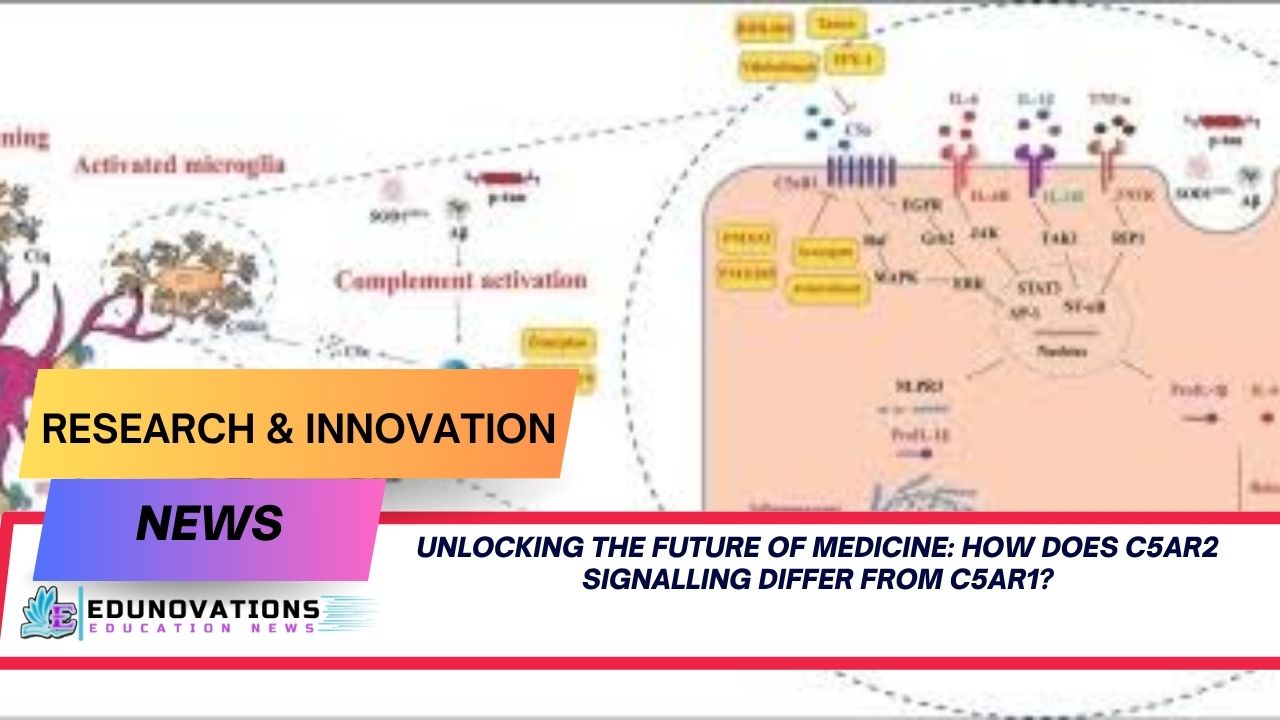
The landscape of modern pharmacology is undergoing a seismic shift, driven by breakthroughs in how we understand our body’s immune response.
The landscape of modern pharmacology is undergoing a seismic shift, driven by breakthroughs in how we understand our body’s immune response. For years, the scientific community has been captivated by the potential of the complement system—our body’s first line of defense against invading bacteria and viruses. Central to this system are specific membrane proteins known as complement anaphylatoxin receptors. While researchers have long understood the primary receptors, one particular protein has remained an elusive puzzle: the C5aR2 receptor.
A groundbreaking discovery by researchers at the Indian Institute of Technology (IIT) Kanpur, led by the renowned Professor Arun K. Shukla, has finally provided answers to how does C5aR2 signalling differ from C5aR1. This revelation is not just a triumph of academic curiosity; it is a fundamental shift in how we approach targeted drug design and the treatment of inflammatory diseases.
Understanding the Architecture of Immune Defence
To appreciate the significance of this discovery, one must first look at how our immune system operates. The complement system functions like a high-speed security network, identifying and neutralizing pathogens. When an infection or injury occurs, this system releases small proteins called anaphylatoxins. These proteins act as messengers, binding to specific receptors on our cells to trigger a controlled inflammatory response.
The receptors C5aR1 and C5aR2 are the key players in this mechanism. Historically, C5aR1 has been the “star,” as its structural pathways are well-documented and predictable. It follows a canonical signaling path, which scientists have successfully leveraged for drug development for decades. However, C5aR2 has long been considered an “atypical” player. Its behavior is non-canonical, meaning it ignores the traditional rules that guide its counterpart, C5aR1.
Students looking to grasp the basics of this mechanism can explore our detailed notes on cellular biology, which break down the complex interactions of the immune system into digestible segments.
The Breakthrough: Visualizing the Invisible
For years, the functional divergence between these two receptors remained a mystery because scientists simply could not “see” the atomic details of C5aR2. Traditional methods failed to capture the structural nuances of this receptor in a high-resolution format.
The turning point came with the application of cryogenic-electron microscopy (cryo-EM). By freezing biological samples at liquid nitrogen temperatures and using high-energy electron beams, Professor Arun K. Shukla’s team was able to map the molecular landscape of C5aR2. What they discovered was striking. While the exterior of the receptor—the part exposed to the cell environment—mimics C5aR1, the interior portion is structurally distinct. This structural “mismatch” is precisely why it fails to trigger the standard signaling pathways. Instead, it engages non-canonical partners, opening up entirely new avenues for therapeutic intervention.
For those preparing for competitive exams, staying updated on such scientific breakthroughs is vital. You can test your knowledge on these topics through our curated MCQs, designed to bridge the gap between academic theory and real-world scientific advancement.
The Role of Non-Canonical Signalling in Receptors
The discovery of how C5aR2 operates brings us to the broader topic: the explanation of non-canonical signalling in receptors. In biochemistry, “canonical” usually refers to the well-trodden paths that lead to expected cellular outcomes, such as inflammation. Non-canonical signalling, however, represents the “rebel” path.
When a receptor like C5aR2 bypasses these standard paths, it can act as a regulator, or a “brake,” on the inflammatory process. This is a massive opportunity for pharmaceutical research. If we can selectively control these receptors, we could theoretically treat inflammatory diseases without the side effects associated with blunt-force immune suppression.
Understanding these nuances is crucial for students of medicine and biotechnology. If you are struggling with the foundational concepts, our NCERT courses provide the necessary scaffolding to understand these advanced cellular processes. We also provide free NCERT PDF downloads to ensure all students have access to quality study material regardless of their resources.
R8Y: The New Frontier in Precision Medicine
Perhaps the most exciting outcome of the study is the development of a molecule dubbed “R8Y.” By utilizing the atomic map generated via cryo-EM, the team developed a compound that selectively binds to C5aR2 while ignoring C5aR1.
Why is this important? Because until now, drugs targeting these receptors often hit both, causing unintended side effects. With a selective molecule like R8Y, scientists can now study exactly what happens when you “switch on” C5aR2 without interfering with the canonical C5aR1 pathways. This level of precision is the cornerstone of modern, safer drug design.
We discuss the importance of research methodologies and experimental design in our current affairs portal, which keeps you updated on how such laboratory successes are translated into national-level policies and industrial applications.
Implications for Future Therapeutics
The implications of the study led by Professor Arun K. Shukla extend far beyond the laboratory at IIT Kanpur. Scientists are now preparing to transition these findings into animal models. The goal? To design novel therapeutics that can safely modulate the immune system in conditions ranging from severe infections to autoimmune disorders.
This research highlights why it is essential to stay grounded in the syllabus while keeping an eye on external developments. It is not enough to know the theory; one must understand how it applies to the future of healthcare. For school administrators and educational institutions looking to modernize their infrastructure to support such high-level scientific research, partnerships with firms like Mart Ind Infotech can help streamline the digital and technological requirements needed to host such advanced learning environments.
Visualizing Cellular Complexity
The visual nature of cryo-EM has fundamentally changed how we represent cellular biology. If you find the concept of structural divergence difficult to visualize, our mind maps are a perfect tool to consolidate this information. They map out the relationship between receptor structure and function, helping you retain complex information with ease.
Furthermore, our video library features experts explaining how receptors interact with their ligands, providing a visual aid to the written text provided here. As researchers continue to unlock the secrets of the human body, the bridge between classroom learning and the cutting edge of science becomes easier to traverse.
Toppers Use Mind Maps to score more than 95%
NCERT Class 11th Commerce Mind Maps
Add to cartOriginal price was: ₹999.00.₹199.00Current price is: ₹199.00.NCERT Class 12th Chemistry Mind Maps
Add to cartOriginal price was: ₹199.00.₹75.00Current price is: ₹75.00.NCERT Class 12th Commerce Mind Maps
Add to cartOriginal price was: ₹999.00.₹199.00Current price is: ₹199.00.NCERT Class 12th Science Mind Maps
Add to cartOriginal price was: ₹999.00.₹199.00Current price is: ₹199.00.NCERT Mind Maps For Class 10th
Add to cartOriginal price was: ₹999.00.₹199.00Current price is: ₹199.00.




Purchase Today
Frequently Asked Questions (FAQs)
- How does C5aR2 signalling differ from C5aR1 in terms of structure? While their exterior parts are similar, the intracellular part of C5aR2 is structurally distinct, preventing it from using the canonical signaling mechanisms used by C5aR1.
- What is an atypical drug target receptor explained for students? An atypical drug target receptor is a protein that does not follow standard, well-known pathways, allowing for more specific drug design that minimizes side effects.
- Why is the discovery of the R8Y molecule significant? R8Y is significant because it is selective; it binds only to C5aR2, allowing scientists to study its specific role in the immune system without triggering the C5aR1 pathway.
- What are the practical applications of cryo-EM in drug target research? Cryo-EM allows scientists to view the atomic structure of complex receptors that were previously impossible to map, facilitating the creation of custom molecules for disease treatment.
- How does the body’s complement system protect against pathogens? The complement system uses proteins and enzymes to identify pathogens and trigger an inflammatory response to clear them from the body.
- Are there risks associated with targeting C5aR1? Yes, because C5aR1 is involved in canonical pathways, indiscriminate targeting can cause unwanted inflammatory side effects, which is why selective targeting is better.
- How can students learn more about immune signalling? Students can use comprehensive notes and mind maps found in educational resources to simplify the complex relationships between receptors and signaling pathways.
- What role did Professor Arun K. Shukla play in this research? Professor Arun K. Shukla led the IIT Kanpur research team that successfully visualized the C5aR2 structure and developed the R8Y molecule.
- What is the future goal of the IIT Kanpur study? The goal is to test the R8Y molecule in animal models to develop safer, more effective therapeutics for inflammatory and immune-related conditions.
- How does the immune system use anaphylatoxins? Anaphylatoxins are small proteins that bind to specific receptors to initiate a controlled inflammatory response at the site of infection.