
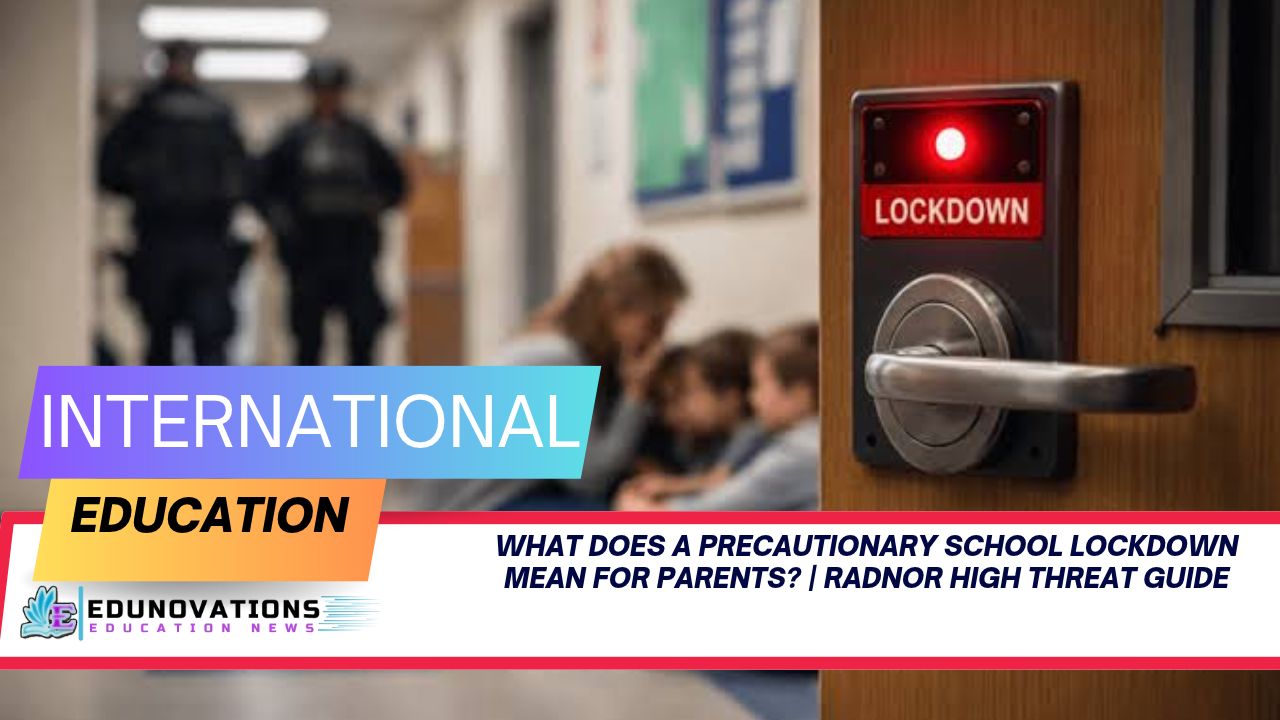
Understand what does a precautionary school lockdown mean for parents after Radnor High School’s unfounded threat, plus police swatting response and safety steps.
Critical Lockdown Alert: What Does a Precautionary School Lockdown Mean for Parents After Radnor High Threat?
When emergency alerts flash across a school district, fear spreads almost as fast as the news itself. On Monday, November 23, 2026, families and residents in Delaware County, Pennsylvania, faced that exact tension when Radnor High School in Radnor Township was placed under a precautionary lockdown following a reported threat inside the building. Law enforcement sources indicated the alert stemmed from a suspected swatting call—a hoax report engineered to provoke an urgent, heavy armed police response—while school officials confirmed that students and staff were safe and following established emergency protocols. By roughly 1:45 p.m., after officers completed a building search and found no injuries and no shots fired, officials determined the threat was unfounded and lifted the lockdown.
For many parents watching from home or work, headlines containing words like “threat,” “shots fired,” and “lockdown” create immediate confusion. Understanding what does a precautionary school lockdown mean for parents helps families separate rapid emergency containment from confirmed danger, know how law enforcement investigates hoax reports, and support students once normal routines resume.
Timeline and Sequence of Events at Radnor High School
Monday’s response at Radnor High School unfolded rapidly across late morning and early afternoon, drawing significant local attention and law enforcement resources. According to local reporting and official advisories, emergency responders arrived at the campus in force, taped off the front entrance, and began systematic interior checks while students and staff sheltered in place.
- Initial Threat Report and Lockdown Initiation: School administrators enacted a precautionary lockdown after a threat was reported involving the building. An early advisory posted on the school’s website reassured families that students and staff were safe and adhering to established safety procedures while updates were gathered.
- Heavy Law Enforcement and Aerial Presence: Multiple police vehicles converged outside the school, police tape blocked the front entrance, and overhead news coverage captured the scale of the response. Police sources noted the incident was treated as a suspected swatting call.
- Secondary Reports and Room-by-Room Checks: Reports noted a subsequent call claiming shots had been fired inside the school, though officers already on scene reported no gunfire had occurred. Officers conducted room-to-room checks alongside a K-9 search, and students were checked in the gymnasium as part of security measures. Nearby, Upper Merion police also investigated a separate shots-fired report around 12:42 p.m. at the Brandywine Radnor Hotel on King of Prussia Road, with no confirmed connection established to the school incident.
- All-Clear and Lifting of the Lockdown: Following the thorough search, officials concluded the threat was unfounded, confirmed there were no injuries and no gunshots fired, and lifted the lockdown around 1:45 p.m.
For students, educators, and parents tracking current events or civic safety topics, keeping up with verified updates is essential; readers following broader news can explore Current Affairs and structured study resources such as Notes and MCQ’s.
Clarifying Key Terms During a School Security Alert
During fast-moving campus emergencies, official advisories use precise terms that can sound alarming or ambiguous to someone reading a push notification on their phone. Knowing the distinction between these terms makes emergency updates much easier to interpret.
Precautionary Lockdowns Versus Confirmed Emergencies
A precautionary lockdown is a protective measure taken when a credible-sounding report or unverified risk requires securing the building while authorities verify facts. It does not automatically mean an active attacker is on campus or that an injury has occurred. Instead, it buys time for trained officers to clear rooms, check potential vulnerabilities, and confirm whether danger actually exists.
What “Unfounded” Means in Official Reporting
When officials label a threat “unfounded,” they are reporting that investigation and physical checks found no evidence supporting the reported danger—such as no weapon, no shots fired, and no credible threat inside the facility. That distinction matters because an “unfounded” call is not necessarily a harmless prank; it is a serious false alarm that still triggers real sirens, tactical sweeps, and emotional strain across the school community.
Swatting and Hoax Threat Calls in Context
A swatting call is a deliberate, false emergency report—often involving fabricated claims of an active shooter, gunman, or violent crime—intended to draw an immediate, heavy police response to a specific location. Law enforcement agencies treat initial reports seriously because they cannot afford to gamble on a hoax when lives could be at stake, even when investigators suspect deception.
Broader Context, National Data, and Federal Guidance
The Radnor High School incident reflects a wider national pattern affecting K-12 campuses, emergency dispatchers, and local school boards. Even when a threat turns out to be a hoax, the operational and human costs are substantial.
| Metric or Guidance Area | Key Finding / Detail | Operational & Community Impact |
| K-12 Swatting Trend (2022–23 to 2024–25) | Recorded incidents dropped from 446 in 2022–23 to 158 in 2023–24 and 124 in 2024–25 (down 72% over two years). | Shows declining frequency in tracked data, yet single hoaxes still disrupt entire communities. |
| Federal Guidance (September 2026) | Education and Justice departments issued joint guidance urging structured preparation and threat assessment. | Highlights trauma, lost instructional time, and taxpayer costs from false alarms. |
| FBI Advisory Indicators (August 2026) | Notes spoofed numbers, internet-based calling, single uncorroborated reports, or inconsistent details. | Helps agencies assess hoax risks while maintaining cautious response standards. |
| Primary Preparedness Pillars | Multidisciplinary threat assessment teams, staff drills, security measures, and crisis communication. | Reduces panic, counters rumors, and speeds safe resolution during alerts. |
Federal guidance released on September 25, 2026, by the U.S. Department of Education and the Department of Justice emphasized that school swatting causes real trauma, lost classroom instruction, and significant public resource strain. At the same time, data from the Educator’s School Safety Network cited in that coverage showed a notable downward trend in documented K-12 swatting incidents—from 446 in the 2022–23 school year to 158 in 2023–24 and 124 in 2024–25, a 72% decline from the peak year.
Even with lower tracked totals in recent school years, federal officials and security analysts stress that every incoming threat must be evaluated carefully. Perpetrators frequently use internet-based calling systems or spoofed numbers—sometimes originating far outside the local community—to mask their location and create confusion.
Voices on Campus Safety and Emergency Preparedness
Because no single public figure or national official was named as a central participant in the Radnor High School incident itself, federal policy leaders who addressed school swatting in late September 2026 offer helpful perspective on why preparedness matters. In their joint federal guidance on addressing school swatting, Nicholas Kent, Under Secretary at the U.S. Department of Education, and Stanley Woodward Jr., Associate Attorney General at the U.S. Department of Justice, stated:
“We are committed to the safety of students, teachers, and staff across the country and take all incidents of swatting and violence seriously. We welcome further conversations with educational institutions to determine how best to solve this crisis, which increasingly affects people and organizations across the country.”
Both officials oversee major federal portfolios—Kent within federal education policy and Woodward within the Justice Department—and their remarks underscore a core takeaway for schools and families alike: preventing harm and minimizing disruption requires coordination between educators, law enforcement, and clear communication channels.
Practical Steps for Families and Schools After a Hoax Alert
Understanding what does a precautionary school lockdown mean for parents is only the first step; how families respond during and after an alert shapes both immediate safety and long-term emotional recovery.
During a Lockdown Alert
- Rely on Official Channels: Check verified district or school messages and official law enforcement updates rather than unverified social media posts.
- Keep Access Lanes Clear: Avoid driving to the school unless explicitly instructed to do so, as congested roads can slow emergency vehicles and complicate reunification.
- Wait for Official Reunification Instructions: Let officers complete building sweeps and clearance checks before expecting students to be released.
After the Lockdown Is Lifted
- Validate Feelings Without Dismissing Them: Even when a threat proves unfounded, students who heard sirens, saw police tape, or waited quietly during a search can feel anxious or exhausted.
- Talk Through What Happened: Ask open questions about how your child felt during the alert and let them know that taking precautions is standard practice.
- Return Gradually to Routine: Once safety is confirmed, steady daily habits help restore a sense of normalcy for both children and adults.
Students and educators balancing daily school schedules alongside civic awareness can also explore NCERT Courses, Videos, Syllabus, Downloads of Free NCERT PDFs, and NCERT Mind Maps. School administrators and institutions looking for digital communication tools can also connect through Need Website for Schools Contact Mart Ind Infotech.
Toppers Use Mind Maps to score more than 95%
-
NCERT Class 11th Commerce Mind Maps
Add to cartOriginal price was: ₹999.00.₹199.00Current price is: ₹199.00. -
NCERT Class 12th Chemistry Mind Maps
Add to cartOriginal price was: ₹199.00.₹75.00Current price is: ₹75.00. -
NCERT Class 12th Commerce Mind Maps
Add to cartOriginal price was: ₹999.00.₹199.00Current price is: ₹199.00. -
NCERT Class 12th Science Mind Maps
Add to cartOriginal price was: ₹999.00.₹199.00Current price is: ₹199.00. -
NCERT Mind Maps For Class 10th
Add to cartOriginal price was: ₹999.00.₹199.00Current price is: ₹199.00.





Purchase Today
Frequently Asked Questions About School Lockdowns and Hoax Threats
1. What does a precautionary school lockdown mean for parents during an active alert?
It means the school has secured doors and restricted movement as a proactive safety measure while police investigate a reported concern, even if no confirmed attacker or injury has been verified.
2. How police respond to suspected swatting calls at schools in a typical incident?
Officers typically treat the report with urgency, establish a perimeter, coordinate with school staff, clear rooms systematically, and use specialized resources such as K-9 units when needed to confirm whether any real danger exists.
3. What are standard school lockdown safety procedures for students and staff?
Standard procedures generally involve moving into secure areas out of sight, locking or securing entry points, remaining quiet, following staff or law enforcement directions, and waiting for official clearance before leaving shelter.
4. What happens when a school threat is called unfounded by officials?
It means law enforcement searches and investigation did not substantiate the reported threat—such as finding no gunshots or injuries—allowing officials to lift the lockdown and update families.
5. How hoax threat calls affect school campus security and daily operations?
Hoax calls can trigger heavy police deployments, room-by-room searches, halted classes, lost instructional time, heightened anxiety, and strain on emergency dispatchers and families.
6. Why do authorities still deploy heavily if a call is suspected to be swatting?
Because emergency responders cannot assume a report is fake until they verify the scene safely, making thorough checks essential to protect students and staff.
7. Should parents drive to the school immediately when a precautionary lockdown begins?
Generally no; rushing to campus can create traffic bottlenecks for responding police and emergency units and delay organized reunification procedures.
8. How can families tell accurate updates apart from rumors during a lockdown?
Families should prioritize official statements from the school district and police agencies and treat unverified social posts or rumors with caution until confirmed.
9. Can swatting calls originate outside the local town or state?
Yes; callers sometimes use internet-based services or spoofed numbers from outside the local area or even outside the country, which can add investigative complexity.
10. How can parents support students emotionally after an unfounded school threat?
Listening calmly, acknowledging that the alert felt stressful even without physical harm, answering questions honestly, and encouraging normal routines can help students decompress.


