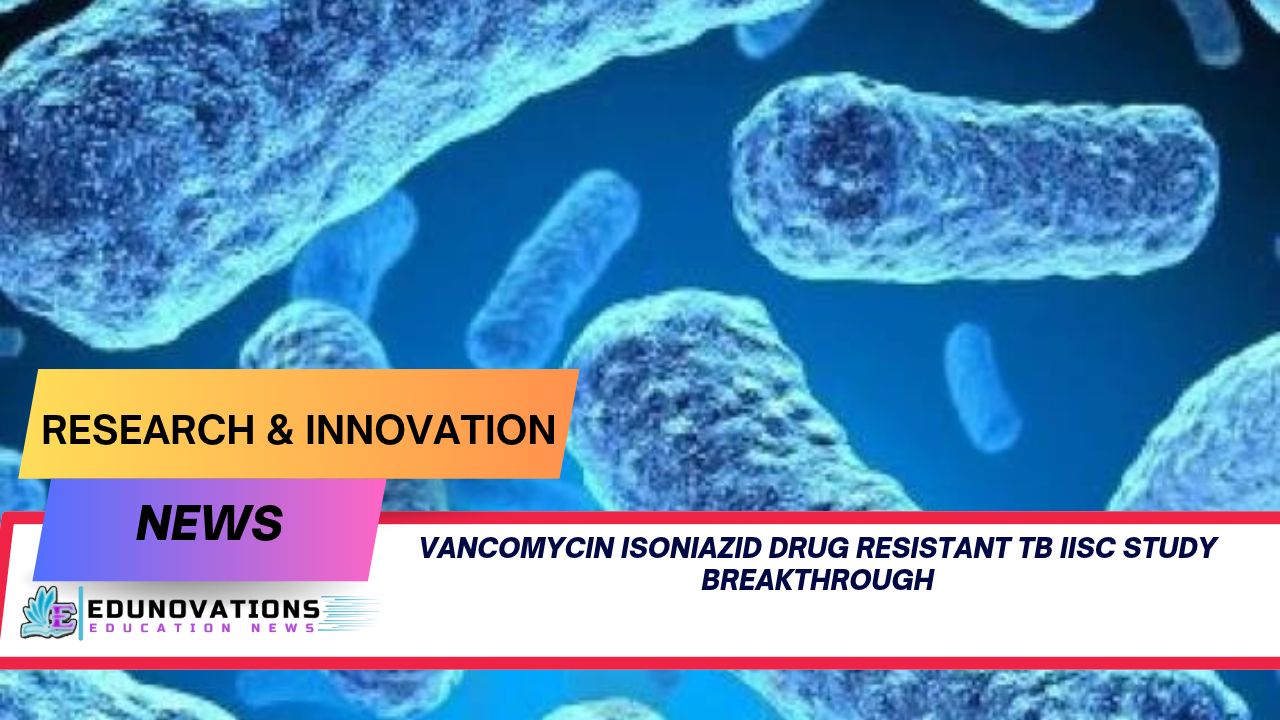
Explore the vancomycin isoniazid drug resistant tb iisc study revealing how pairing antibiotics restores frontline TB drug sensitivity in clinical isolates and mice.
Tuberculosis remains one of humanity’s deadliest infectious diseases, and its growing resistance to frontline medications threatens global public health gains. In a major scientific development reported in November 2026, researchers at the Indian Institute of Science (IISc) in Bengaluru demonstrated a promising strategy to restore the effectiveness of a cornerstone anti-tuberculosis drug. By pairing isoniazid with vancomycin, the team showed that it is possible to reverse drug resistance in clinical bacterial strains isolated from patients and significantly lower bacterial loads in animal models.
The vancomycin isoniazid drug resistant tb iisc study brings fresh momentum to tuberculosis therapeutics at a time when drug-resistant strains complicate treatment regimens worldwide. Published in Microbiology Spectrum, the research was led by Professor Nagasuma Chandra of the Department of Biochemistry at IISc and Sukriti Pal, a doctoral researcher in the same department, working alongside Professor Amit Singh from the Centre for Infectious Disease Research (CIDR) and the Department of Microbiology and Cell Biology (MCB), as well as collaborators from the National Tuberculosis Institute (NTI) in Bengaluru and Kristu Jayanti (Deemed to be University).
Students, medical aspirants, and researchers tracking biomedical breakthroughs and public health updates can also explore structured learning materials on NCERT Courses and stay updated with daily developments through Current Affairs.
The Growing Threat of Drug-Resistant Tuberculosis
For decades, isoniazid has served as one of the primary first-line antibiotics used to treat infections caused by Mycobacterium tuberculosis. Because it is potent, widely available, and central to standard treatment protocols, losing its efficacy creates an immediate clinical setback. Over time, however, Mycobacterium tuberculosis has evolved resistance mechanisms that blunt isoniazid’s antibacterial action, contributing to drug-resistant tuberculosis and multidrug-resistant tuberculosis (MDR-TB).
According to global surveillance data from the World Health Organization (WHO) covering 2024 and 2025, hundreds of thousands of people develop multidrug-resistant or rifampicin-resistant tuberculosis each year—estimated at roughly 390,000 incident MDR/RR-TB cases in 2024 and around 370,000 cases globally in 2025. India accounts for a substantial share of the global drug-resistant tuberculosis burden, and treatment initiation gaps remain a major hurdle, with fewer than half of estimated drug-resistant cases starting appropriate therapy in recent reporting periods.
While all-oral and shorter six-month or nine-month regimens have expanded access and improved outcomes in many settings, treatment success rates for drug-resistant tuberculosis still lag behind the roughly 90 percent cure rate seen in drug-susceptible tuberculosis. Long courses, pill burden, adverse effects, and limited drug pipelines mean scientists must continually find ways to make existing medicines work harder and smarter. That urgency makes the vancomycin isoniazid drug resistant tb iisc study particularly relevant for infectious disease researchers and healthcare policy watchers.
“Isoniazid resistance poses a major challenge in the treatment of TB. To tackle this problem, we started exploring ways to rescue the drug by reversing resistance,” said Professor Nagasuma Chandra, corresponding author of the study at IISc’s Department of Biochemistry.
Complementing that perspective, first author Sukriti Pal noted that even with multiple antibiotic combinations in use today, resistance continues to undermine patient care. Finding a practical way to revive a proven drug like isoniazid offers an attractive path because it leverages established pharmacological knowledge rather than starting entirely from scratch.
How Isoniazid Works and Why Resistance Happens
To appreciate why combining isoniazid and vancomycin matters, it helps to look closely at the biology of Mycobacterium tuberculosis. Isoniazid is classified as a prodrug. Rather than attacking the bacterium directly in its administered chemical form, it must first be activated inside the bacterial cell by a specific bacterial enzyme system. Once activated, it interferes with critical components needed to build the bacterium’s protective outer envelope, ultimately killing the pathogen.
Resistance emerges when mutations occur in specific genes involved in this activation pathway or drug targets. When the bacterial machinery that activates isoniazid is impaired or altered, the drug cannot exert its full lethal effect. In clinical practice, patients infected with isoniazid-resistant or multidrug-resistant strains face narrower treatment choices, longer timelines, and greater risk of treatment failure.
The Role of the Bacterial Cell Wall
Mycobacterium tuberculosis is notorious for its thick, lipid-rich, and complex cell wall. This cell envelope acts like a biological fortress, shielding the microbe from environmental stress, host immune defenses, and many conventional antibiotics. Vancomycin is a well-known glycopeptide antibiotic that targets cell wall synthesis in certain Gram-positive bacteria, yet on its own it struggles to cross the formidable, impermeable cell envelope of Mycobacterium tuberculosis efficiently.
When researchers at IISc tested the two drugs together, they observed a synergistic interaction. Exposure to the combination disrupts cell wall integrity and alters cell wall lipid biosynthesis pathways, allowing vancomycin to penetrate the bacterial cell more effectively and contribute to killing the pathogen. Through systems-level modeling and molecular analysis, the investigators examined how stress responses and cell wall remodeling interact when Mycobacterium tuberculosis encounters the combined regimen.
Learners preparing for biology, biotechnology, or competitive exams can review foundational concepts through Notes, practice objective questions on MCQ’s, and reinforce visual topics with Videos.
Key Findings from Clinical Isolates and Mouse Models
The research team did not rely on a single laboratory strain. Working in partnership with the National Tuberculosis Institute in Bengaluru, the scientists evaluated the vancomycin isoniazid drug resistant tb iisc study protocol across clinical isolates of Mycobacterium tuberculosis obtained from sputum samples of patients with drug-resistant tuberculosis.
These clinical isolates exhibited diverse patterns of resistance to isoniazid, giving the investigators a realistic testbed to check whether the combination could overcome varied resistance mechanisms. Key experimental takeaways included:
- Substantial bacterial growth reduction: Most tested clinical isolates—spanning isoniazid-resistant and multidrug-resistant strains—showed a reduction of more than 90 percent in bacterial growth when exposed to the combined treatment compared with individual agents.
- Stronger activity than single drugs: Neither isoniazid alone nor vancomycin alone matched the suppression achieved when the two antibiotics were paired.
- In vivo efficacy in mice: In experiments conducted with Professor Amit Singh using a mouse model infected with multidrug-resistant Mycobacterium tuberculosis, 10 days of treatment with either drug alone did not produce a significant drop in bacterial burden. By contrast, the combination yielded roughly a 10-fold reduction in bacterial load in both the lungs and the spleen.
- Reduced lung tissue pathology: Microscopic examination of lung tissue showed fewer granulomas—the characteristic clusters of immune and inflammatory cells formed during tuberculosis infection—in animals receiving the combined therapy.
Those animal and ex vivo results are encouraging, yet scientists emphasize a crucial boundary in biomedical research: laboratory and rodent findings are preclinical milestones, not immediate clinical prescriptions.
What Comes Next: Clinical Trials and Safety Evaluation
Translating a promising laboratory combination into an approved human therapy requires rigorous, step-by-step clinical validation. Sukriti Pal emphasized that while the team is actively working to advance the combination toward clinical trials, much more work is needed before patients can be treated with it outside an experimental setting.
Specifically, researchers and regulators must evaluate:
- Human safety and dosing: Determining optimal doses, administration routes, and potential side effects when vancomycin and isoniazid are given together in humans.
- Pharmacokinetics and tolerability: Checking how both drugs behave in the human body over multi-week or multi-month treatment courses.
- Efficacy across diverse patient groups: Testing whether the combination improves cure rates and prevents relapse in people with isoniazid-resistant or multidrug-resistant tuberculosis, either on its own or alongside established regimens.
- Cost and feasibility in high-burden areas: Assessing practical delivery in public health programs where tuberculosis is most common.
For aspiring researchers, medical students, and educators following how scientific discoveries progress from bench to bedside, checking Syllabus outlines and downloading study aids via Free NCERT PDFs and NCERT Mind Maps can help build strong conceptual grounding in microbiology and biochemistry. Educational institutions looking to build or upgrade their digital presence can also explore web solutions through Mart Ind Infotech.
Broader Context for Tuberculosis Research in India
India has long been at the forefront of both the challenge and the scientific response to tuberculosis. From public health screening and diagnostic expansion to academic research at premier institutions like IISc and the National Tuberculosis Institute, tackling antimicrobial resistance requires coordinated progress across basic science, clinical medicine, and healthcare delivery.
Strategies that rescue drug sensitivity or repurpose existing antibiotics hold special appeal because they address an immediate bottleneck: novel anti-TB drugs take years and substantial capital to discover and clear regulatory hurdles. By uncovering how cell envelope stress and permeability can be leveraged to restore susceptibility to an established first-line medicine, the vancomycin isoniazid drug resistant tb iisc study adds a compelling mechanistic chapter to modern infectious disease research.
At the same time, public health experts remind communities that preventing drug resistance starts with early diagnosis, completing prescribed treatment courses accurately, improving indoor ventilation, and supporting patients throughout therapy. Scientific breakthroughs work best when paired with strong health systems.
Toppers Use Mind Maps to score more than 95%
-
NCERT Class 11th Commerce Mind Maps
Add to cartOriginal price was: ₹999.00.₹199.00Current price is: ₹199.00. -
NCERT Class 12th Chemistry Mind Maps
Add to cartOriginal price was: ₹199.00.₹75.00Current price is: ₹75.00. -
NCERT Class 12th Commerce Mind Maps
Add to cartOriginal price was: ₹999.00.₹199.00Current price is: ₹199.00. -
NCERT Class 12th Science Mind Maps
Add to cartOriginal price was: ₹999.00.₹199.00Current price is: ₹199.00. -
NCERT Mind Maps For Class 10th
Add to cartOriginal price was: ₹999.00.₹199.00Current price is: ₹199.00.




Purchase Today
Frequently Asked Questions (FAQs)
- What did the vancomycin isoniazid drug resistant tb iisc study find?Researchers at the Indian Institute of Science found that combining vancomycin with isoniazid restored sensitivity to isoniazid in drug-resistant Mycobacterium tuberculosis clinical isolates, reduced bacterial growth by over 90 percent in most tested isolates, and cut bacterial loads roughly 10-fold in the lungs and spleen of infected mice over 10 days.
- How does vancomycin help overcome isoniazid resistance in tuberculosis?Isoniazid is a prodrug that relies on bacterial activation and can be blunted by mutations, while vancomycin normally has trouble crossing the thick cell wall of Mycobacterium tuberculosis. Together, cell envelope disruption and stress responses increase access and antibacterial activity against resistant bacteria.
- Which IISc departments and researchers led this tuberculosis study?The study was led by Professor Nagasuma Chandra and PhD student Sukriti Pal at IISc’s Department of Biochemistry, in collaboration with Professor Amit Singh at the Centre for Infectious Disease Research and Department of Microbiology and Cell Biology, along with partners including the National Tuberculosis Institute in Bengaluru.
- Is the vancomycin and isoniazid combination ready for patients right now?No. The findings come from clinical bacterial isolates and mouse models, and researchers stress that extensive safety, dosage, and efficacy studies in formal clinical trials are required before use in patients.
- Why is isoniazid resistance a serious problem for TB treatment?Isoniazid is a core first-line drug against tuberculosis, so resistance limits standard treatment options, increases reliance on more complex regimens, and raises the risk of poor outcomes if not properly managed.
- What happened in the mouse model tested by the IISc researchers?In mice infected with multidrug-resistant Mycobacterium tuberculosis, single-drug treatment with either isoniazid or vancomycin for 10 days did not significantly lower bacterial burden, whereas the combined treatment reduced bacterial load about 10-fold in the lungs and spleen and lowered lung granuloma counts.
- Where was the IISc research on combining vancomycin and isoniazid published?The research findings were published in the scientific journal Microbiology Spectrum in 2026 and highlighted by the Indian Institute of Science in November 2026.
- Can vancomycin alone treat drug-resistant Mycobacterium tuberculosis effectively?In the reported study, vancomycin alone did not produce a significant reduction in bacterial load in the mouse model over the 10-day test window because Mycobacterium tuberculosis has a protective cell envelope that limits entry on its own.
- How do clinical isolates help scientists test new TB drug combinations?Clinical isolates collected from patient sputum samples reflect real-world bacterial strains and varied resistance mutations, allowing researchers to test whether a combination works across diverse drug-resistant profiles.
- What are the next steps for advancing this antibiotic combination?The research team is working toward clinical trial readiness while emphasizing further evaluation of safety, dosing, and effectiveness in drug-resistant tuberculosis cases before clinical adoption.