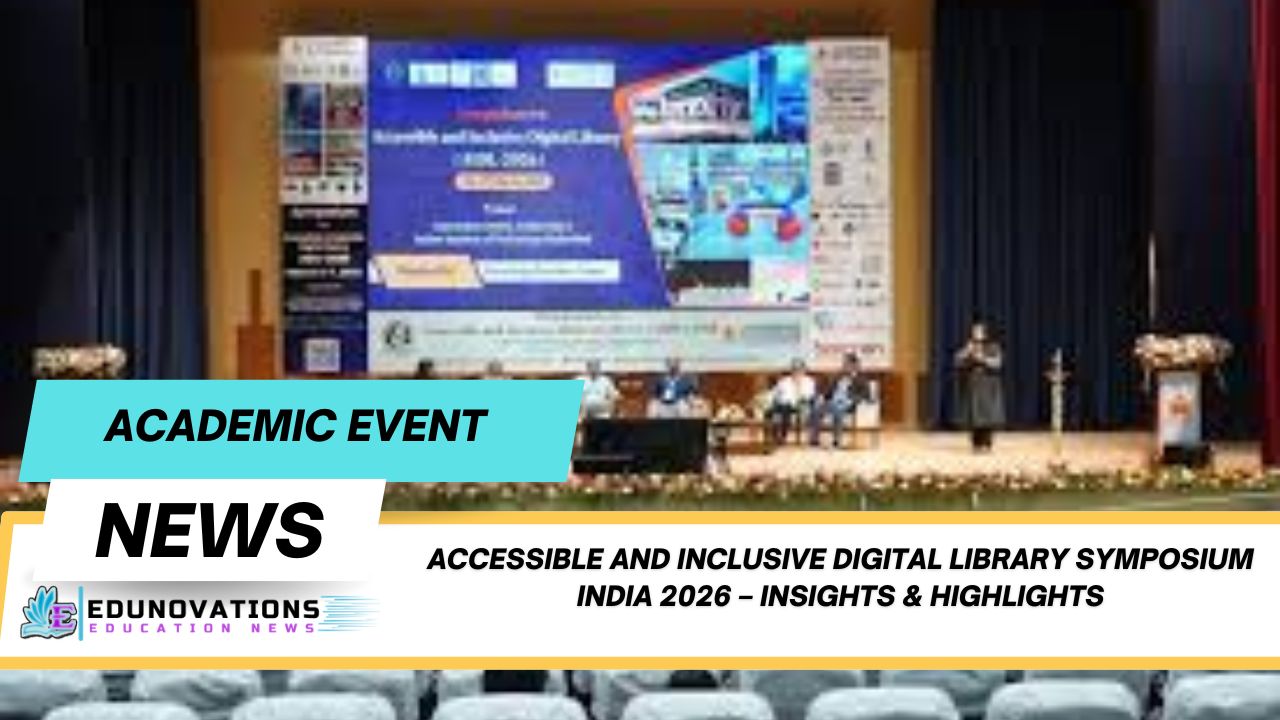
Explore the Accessible and Inclusive Digital Library Symposium India 2026, focusing on accessibility frameworks, AI-enabled technologies, and inclusive knowledge systems.
Introduction
The Accessible and Inclusive Digital Library symposium India 2026 marked a major milestone in enhancing digital knowledge ecosystems for diverse learners. Hosted by the Knowledge Resource Centre (KRC) at the Indian Institute of Technology Hyderabad, AIDL–2026 brought together experts, academicians, librarians, and technology developers from across India to deliberate on accessibility, inclusivity, and AI-enabled assistive technologies in higher education libraries. This landmark event emphasized structured governance, inclusive design, and collaborative approaches to foster equitable access to information.
A National Platform for Inclusive Digital Knowledge
Over two days, the symposium showcased over 60 research contributions, keynote addresses, and assistive technology demonstrations, highlighting emerging accessibility solutions. Experts from academic, policy, publishing, and technology sectors converged to share insights on building inclusive library services and AI-integrated systems. The event focused on practical strategies, moving beyond theoretical discussions, to ensure measurable progress in accessibility and inclusive digital transformation.
Inaugural Highlights
The symposium commenced with a traditional Lighting of the Lamp and an inauguration ceremony. Prof. B. S. Murty, Director of IIT Hyderabad, addressed participants via a video message, emphasizing the importance of embedding accessibility into knowledge systems. He noted that libraries serve as gateways to information and underlined the growing role of AI-enabled assistive technologies in providing equitable access to individuals with physical and cognitive challenges.
Guest of Honour Dr. Dipendra Manocha, Director of Developing Countries Program at the DAISY Consortium, highlighted technological challenges faced by differently-abled individuals. He stressed the need for inclusive frameworks beginning at the school level and called for leveraging AI and assistive technologies to bridge accessibility gaps in India.
Key Sessions and Expert Deliberations
The AIDL–2026 agenda included six thematic sessions, covering a wide range of topics in accessibility, technology integration, and inclusive library services:
Assistive Tools and Technologies
Dr. Manocha’s keynote addressed AI-powered assistive frameworks, multimodal technologies, and scalable solutions for academic libraries. Research papers explored personalized library services for Divyangjan users, smart library ecosystems, and computer vision-enabled access. Attendees experienced live demonstrations of AI-enabled adaptive tools, further underlining the potential of innovative technology in transforming library accessibility.
Designing Inclusive Library Spaces
Speakers like Ms. Parul Kumtha and Ms. T.V. Aishwarya emphasized universal design principles in digital and physical library environments. Topics included accessibility audits, culturally responsive digital interfaces, infrastructure planning, and support mechanisms for visually impaired and deaf users. These insights are crucial for institutions seeking to implement inclusive library frameworks that meet WCAG standards.
Community Engagement and Collaboration
This session focused on partnerships between academic and public libraries, community organizations, and rural outreach initiatives. Case studies highlighted digital learning interventions and structured collaborations aimed at increasing accessibility for diverse learners, particularly in underserved regions.
Accessible Media and Digital Platforms
Panelists explored WCAG compliance, AI-enabled institutional repositories, and voice-activated systems for visually impaired users. Discussions emphasized integrating sign language translation systems, accessible publishing frameworks, and adaptive digital tools to support inclusive knowledge access.
Policy, Legal Compliance, and Governance
Experts addressed governance under the RPwD Act, copyright challenges, and ethical considerations in AI implementation. Structured institutional strategies and accountability mechanisms were discussed to ensure inclusive digital library adoption across higher education institutions.
Exhibition and Networking Opportunities
The assistive technology exhibition offered participants hands-on experience with adaptive furniture, accessibility software, and AI-enabled platforms. Cultural programs, guided library tours, and networking sessions encouraged professional collaboration and knowledge sharing among participants. This created opportunities for capacity-building initiatives and partnerships promoting inclusive digital transformation in libraries.
Valedictory Session and Recommendations
The symposium concluded with a reaffirmation that accessibility must be embedded within institutional policies and service frameworks, rather than treated as a compliance requirement. Key recommendations included:
- Developing collections that cater to Divyangjan users and meet WCAG standards.
- Integrating AI-enabled assistive technologies across library systems.
- Establishing structured accessibility governance mechanisms in higher education.
- Initiating continuous professional development for library staff to support inclusive library services.
Way Forward
AIDL–2026 has set a national precedent for building a structured discourse on accessible and inclusive digital libraries in India. The symposium demonstrated the significance of inclusive infrastructure, AI-enabled assistive technologies, and collaborative governance in enhancing knowledge accessibility. IIT Hyderabad intends to continue AIDL as a recurring platform to advance inclusive library practices across academic institutions.
Expert Insights
Prof. Saket Asthana, Symposium Chair, emphasized that inclusive libraries are not merely a regulatory obligation but a social imperative. Dr. Bhojaraju Gunjal, Chief Library Officer, highlighted the importance of measurable outcomes in digital accessibility programs, stressing that innovative frameworks should be adopted with accountability and sustained monitoring.
Additional Context and Statistics
- IIT Hyderabad hosts over 5,760 students, with 60% enrolled in postgraduate and PhD programs.
- The institute secured a 7th rank in NIRF 2025 and achieved top positions in innovation and citations per faculty.
- More than 60 research contributions and 50 product demonstrations were presented during the symposium.
- Over 340 faculty members actively contribute to research, supporting inclusive academic initiatives.
Internal and External Linking Strategy
For readers seeking more information on related topics, visit NCERT Courses, Current Affairs, and Notes. Explore MCQs and Videos to complement your learning. For syllabus and downloadable NCERT PDFs, access Syllabus and Free NCERT PDFs. Check out NCERT Mind Maps at Mind Maps. For authoritative external references, connect with Mart India Infotech.
Toppers Use Mind Maps to score more than 95%
NCERT Class 11th Commerce Mind Maps
Add to cartOriginal price was: ₹999.00.₹199.00Current price is: ₹199.00.NCERT Class 12th Chemistry Mind Maps
Add to cartOriginal price was: ₹199.00.₹75.00Current price is: ₹75.00.NCERT Class 12th Commerce Mind Maps
Add to cartOriginal price was: ₹999.00.₹199.00Current price is: ₹199.00.NCERT Class 12th Science Mind Maps
Add to cartOriginal price was: ₹999.00.₹199.00Current price is: ₹199.00.NCERT Mind Maps For Class 10th
Add to cartOriginal price was: ₹999.00.₹199.00Current price is: ₹199.00.
Purchase Today
FAQs
- What is the Accessible and Inclusive Digital Library symposium India 2026?
- How can AI-enabled assistive technologies improve inclusive library services and accessibility?
- What are the key recommendations from the AIDL 2026 symposium on digital accessibility?
- Which experts spoke on universal design principles in inclusive digital libraries?
- How do WCAG-compliant platforms support accessibility frameworks in higher education?
- What role does community collaboration play in inclusive library outreach programs?
- How can academic libraries implement AI-powered assistive systems for Divyangjan users?
- What are the legal and governance considerations in inclusive digital library adoption?
- How does IIT Hyderabad contribute to national accessible digital library initiatives?
- What are the emerging trends in assistive technology demonstrations at AIDL 2026?