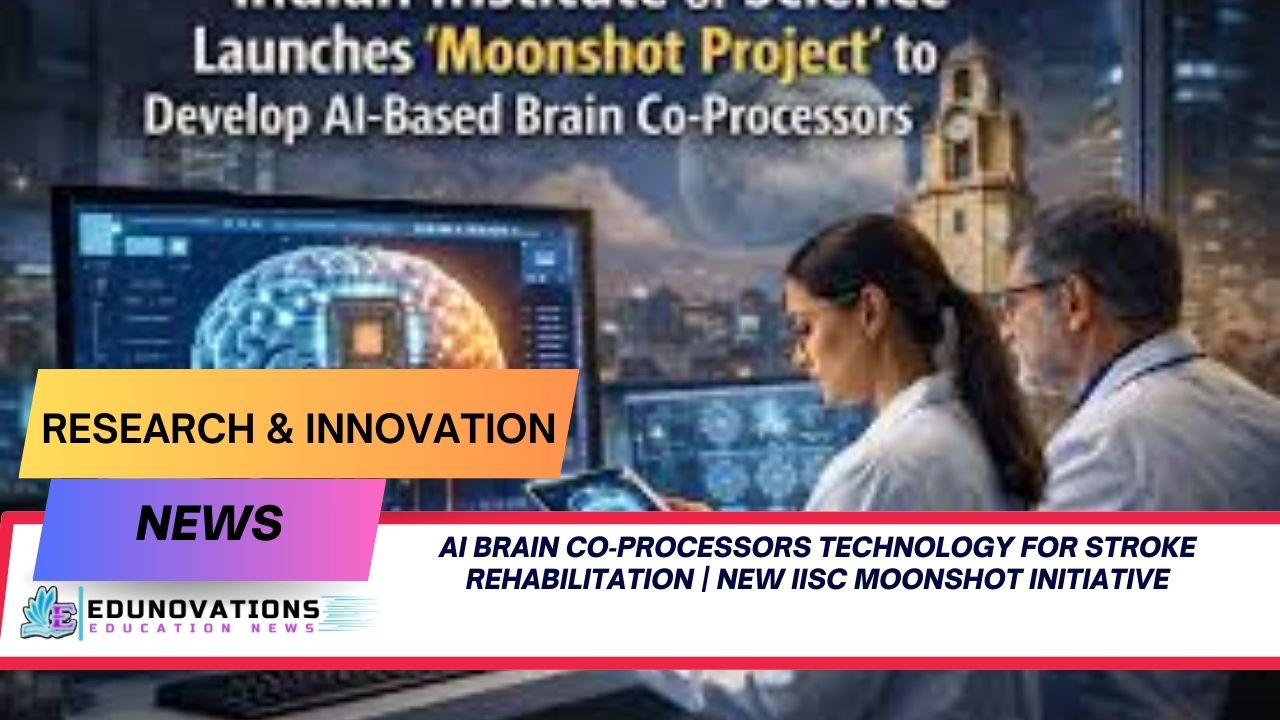
Discover how AI brain co‑processors technology for stroke rehabilitation launched by IISc with Pratiksha Trust support aims to transform neurological treatment. Learn the science, future outlook, and implications.
India’s Bold Leap in Neurotechnology: A New Moonshot for Brain Innovation
In a landmark development for Indian science and global neurotechnology research, the Indian Institute of Science (IISc) in Bengaluru has officially launched a pioneering initiative focused on AI brain co‑processors technology for stroke rehabilitation, funded generously by the Pratiksha Trust. This ambitious “moonshot” project is set to push the boundaries of brain‑machine interfaces and transform rehabilitation therapies for neurological disorders, particularly stroke survivors, by combining advanced artificial intelligence (AI) with neuromorphic hardware.
At the official launch event on 4 March 2026, senior leaders, including representatives of the Pratiksha Trust and IISc faculty, reaffirmed the project’s potential to move India toward the forefront of neuroscience innovation. The roadmap ahead involves developing both implantable and non‑invasive neural co‑processors that decode brain activity, process neural signals using AI, and re‑encode patterns to assist cognitive and motor restoration.
This initiative represents one of the most high‑profile research thrusts in contemporary Indian science. Beyond stroke care, the implications expand to broader areas of cognitive enhancement, motor skill restoration, and ultimately, a future where AI‑enhanced neural technologies become a core part of medical diagnostics and rehabilitation worldwide.
Understanding Brain Co‑Processors: The Fusion of AI and Neuroscience
At its core, a brain co‑processor is an advanced device that bridges neuroscience and computing through a closed‑loop AI system. These co‑processors are designed to monitor neural signals from the brain, interpret them via AI algorithms, and translate them into precise stimulation signals to re‑engage brain circuits responsible for motor and cognitive functions.
How Brain Co‑Processors Work
- Neural Recording: Sensors take real‑time readings of brain activity using techniques such as EEG (electroencephalography) or ECoG (electrocorticography).
- AI Interpretation: Advanced algorithms — some implemented on low‑power neuromorphic chips — interpret the neural data, identifying patterns related to motor intent, perception, or cognitive intent.
- Feedback/Stimulus: Once processed, the AI system sends back tailored stimulation or feedback signals to the brain, helping restore or augment specific functions.
This seamless integration of neural decoding and AI‑based encoding forms the backbone of next‑generation therapeutic tools that make the vision of AI‑powered rehabilitation a reality.
A Multi‑Phase Mission: From Non‑Invasive Devices to Clinical Impact
The project’s development plan is structured into two strategic phases:
Phase 1 — Non‑Invasive Neural Co‑Processors
The first phase focuses on designing, building, and validating non‑invasive co‑processors that can safely provide sensorimotor feedback. These external tools are expected to help stroke survivors regain coordinated movement in daily tasks, such as reaching for and grasping objects — essential functions often lost after stroke events.
Phase 2 — Invasive and Embedded Systems
Following successful validation of external devices, researchers will develop more advanced systems including minimally invasive implants that can restore complex motor coordination and cognitive synergy with greater precision and real‑world effectiveness.
Why This Matters: A New Era of Stroke Rehabilitation
Stroke remains one of the leading causes of long‑term disability worldwide, with survivors frequently facing challenges in motor coordination and cognitive function. Traditional rehabilitation — although beneficial — can be slow, resource‑intensive, and often yields inconsistent outcomes across patients.
That’s where AI brain co‑processors technology for stroke rehabilitation stands to redefine recovery:
- Reduced rehabilitation duration through AI‑guided feedback loops
- Personalized treatment paths driven by brain signal interpretation
- Enhanced recovery outcomes for sensorimotor tasks
- Potential accessibility in low‑resource settings supported by scalable hardware
This project, supported by the Pratiksha Trust’s multimillion‑rupee funding, aligns with a broader vision of making advanced neurotechnologies both affordable and scalable within and beyond India’s healthcare infrastructure.
What India Brings to the Table: Indigenous Innovation and Global Collaboration
A key feature of this initiative is its commitment to indigenous development of neurotechnology, including the creation of India‑specific datasets from neural recordings, open‑source AI tools, and hardware designs that can be integrated into clinical practice.
IISc’s research team — comprising experts in neuroscience, electrical engineering, machine learning, and bioelectronics — is also collaborating with clinicians and international partners to validate these tools against global medical and ethical standards.
This cross‑institutional alliance underscores how rigorous science, coupled with visionary funding, can produce innovations with profound implications for patient care — especially in countries where access to specialized rehabilitation remains limited.
Voices from the Frontlines: Leadership Insight
During the launch event, key figures highlighted how AI brain co‑processors technology for stroke rehabilitation could potentially transform neurological treatment:
“This project accelerates the development of transformative medical technologies that could benefit millions,” said a senior representative of the Pratiksha Trust, emphasizing the importance of merging academic excellence with clinical applicability.
Prof. Govindan Rangarajan, Director of IISc, echoed this sentiment, noting the interdisciplinary nature of the initiative — one that unites engineering, computational sciences, and clinical expertise to address one of the most critical health challenges facing India today.
Looking Ahead: Beyond Stroke — Future Possibilities
While the immediate focus remains on stroke rehabilitation, the broader goals of the moonshot project stretch into other domains:
- Enhancement of cognitive functions such as memory and attention
- Applications in neurodegenerative diseases like Parkinson’s and Alzheimer’s
- Integration with assistive technologies and prosthetics
- Expanded global research collaborations
Researchers also aim to share open datasets and visualization tools as digital public goods — catalyzing innovation in academic and technology communities worldwide.
Linking to Related Educational Resources
For learners and professionals seeking deeper insights into connected fields:
- Explore structured programs on AI and neuroscience in our NCERT Courses
- Stay updated with the latest developments in science in Current Affairs sections
- Access foundational material linking AI and brain science in Notes
- Test your knowledge with MCQ’s on related topics
- Watch explanatory sessions and expert discussions in Videos
- Review curriculum intersections in Syllabus resources
- Download free related educational resources in NCERT PDFs
- Visualise complex concepts using NCERT Mind Maps
External Reference
For collaborative opportunities and institutional partnerships in education and technology development, visit Mart Ind Infotech, a trusted resource for school and academic contact information.
Toppers Use Mind Maps to score more than 95%
NCERT Class 11th Commerce Mind Maps
Add to cartOriginal price was: ₹999.00.₹199.00Current price is: ₹199.00.NCERT Class 12th Chemistry Mind Maps
Add to cartOriginal price was: ₹199.00.₹75.00Current price is: ₹75.00.NCERT Class 12th Commerce Mind Maps
Add to cartOriginal price was: ₹999.00.₹199.00Current price is: ₹199.00.NCERT Class 12th Science Mind Maps
Add to cartOriginal price was: ₹999.00.₹199.00Current price is: ₹199.00.NCERT Mind Maps For Class 10th
Add to cartOriginal price was: ₹999.00.₹199.00Current price is: ₹199.00.



Purchase Today
10 Frequently Asked Questions (FAQs)
- What is AI brain co‑processors technology for stroke rehabilitation?
It refers to closed‑loop systems that decode and process neural signals using AI to help restore motor and cognitive function in stroke survivors. - How does a brain co‑processor work with AI algorithms?
It captures brain activity, interprets it via AI, and re‑encodes signals to enhance rehabilitation. - Who is funding the brain co‑processors moonshot project?
The Pratiksha Trust, founded by Kris and Sudha Gopalakrishnan, is the primary funder. - What are the main objectives of the moonshot project?
To create both non‑invasive and implantable co‑processors for rehabilitation and cognitive enhancement. - What phase focuses on non‑invasive neural co‑processors?
Phase 1 involves designing and validating external devices. - What medical conditions could benefit besides stroke?
Potential applications include Parkinson’s, Alzheimer’s, and impaired motor coordination disorders. - Are these devices clinically validated?
Clinical validation with neurologists and therapists is part of the project’s development plan. - Why is indigenous neurotechnology development important?
It ensures scalability and accessibility in low‑resource healthcare settings. - How does this project benefit India’s science ecosystem?
It strengthens interdisciplinary research and fosters innovation in AI and neuroscience. - Where can students learn more about related science fields?
Courses, notes, and videos on AI, computation, and neuroscience are available through our educational resources.