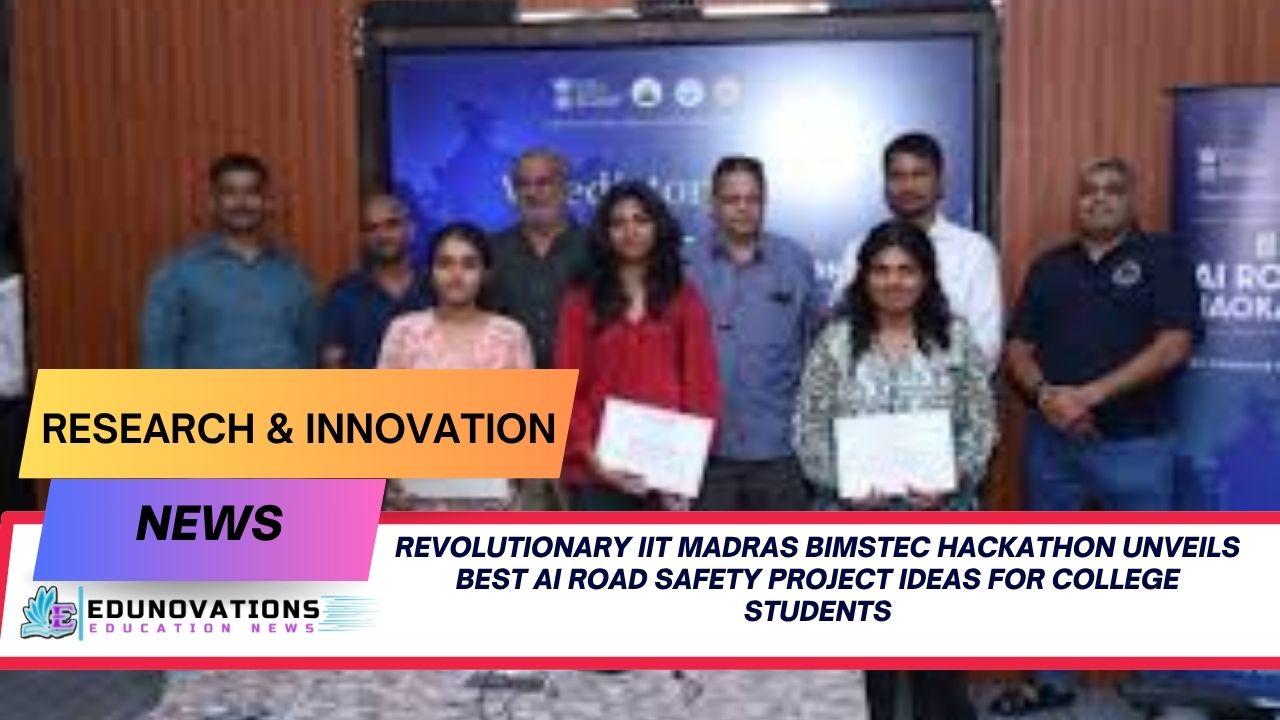
Discover how IIT Madras united BIMSTEC nations for an AI road safety hackathon. Explore the best ai road safety project ideas for college students driving innovation.
The intersection of artificial intelligence, youth innovation, and public infrastructure recently reached a historic milestone at the Indian Institute of Technology Madras (IIT Madras). In a groundbreaking initiative aimed at reducing traffic fatalities across South and Southeast Asia, the Centre of Excellence for Road Safety (CoERS) at IIT Madras organized its first-ever international hackathon focused on artificial intelligence. Gathering talent from seven South Asian and Southeast Asian countries, the event served as a launching pad for students and young developers to tackle critical traffic safety challenges. For educators, researchers, and young innovators searching for the best ai road safety project ideas for college students, this landmark regional gathering provided a high-impact template for how technology can directly serve human lives.
Road safety remains one of the most pressing socio-economic challenges in the Global South. The Bay of Bengal Initiative for Multi-Sectoral Technical and Economic Cooperation (BIMSTEC) region—encompassing Bangladesh, Bhutan, India, Myanmar, Nepal, Sri Lanka, and Thailand—is home to nearly 1.8 billion people. Alarmingly, the region suffers approximately 200,000 road fatalities each year. Addressing this staggering loss of life demands data-driven, technology-enabled interventions. By hosting the BIMSTEC AI Road Safety Hackathon under the aegis of the Ministry of Road Transport and Highways (MoRTH), Government of India, IIT Madras demonstrated how academic institutions can lead global cross-border problem-solving. Furthermore, for engineering institutions looking to guide their scholars toward meaningful academic research, reviewing the best ai road safety project ideas for college students showcased during this event provides invaluable real-world inspiration.
A Regional Call to Action: The BIMSTEC AI Road Safety Hackathon
Held on July 16 on the IIT Madras campus—a date officially recognized as AI Appreciation Day—the international event was conceived as the largest road safety hackathon for the Global South. The initial seed for this initiative was sown during the India AI Impact Summit in Delhi, where CoERS announced its intention to build a collaborative regional network around road safety engineering.
The hackathon brought together multidisciplinary teams of students, software engineers, policy researchers, and data scientists across the seven member nations. Rather than focusing on purely theoretical artificial intelligence models, the event challenged participants to build practical, deployable, human-centered applications. Scholars examining the best ai road safety project ideas for college students often notice that projects ground themselves in real-world feasibility. The BIMSTEC hackathon proved that when students are provided with structured domain knowledge and clear problem statements, they can engineer software prototypes capable of saving thousands of lives.
To stay updated on important national and international developments like the BIMSTEC summit and technological advancements across India, students can follow curated Current Affairs resources to sharpen their general awareness and competitive exam preparation.
Core Problem Statements: Translating AI into Real-World Road Solutions
The hackathon challenged young developers to build AI-powered interactive chatbot solutions and mobile platforms across three critical functional areas. These three domains represent some of the best ai road safety project ideas for college students who wish to build portfolio-defining engineering projects:
| Track Name | Core Focus Area | Key Technical Challenge |
| DriveLegal | Legal Literacy & Traffic Compliance | Building localized AI conversational bots for traffic laws, fine schedules, and citizen rights. |
| RoadWatch | Infrastructure & Contractor Accountability | Computer vision and crowdsourced reporting of potholes, missing signs, and unsafe roads. |
| RoadSoS | Emergency Response & Trauma Care | Automated crash detection using mobile sensors and real-time emergency routing without cell network dependencies. |
1. DriveLegal: Simplifying Complex Traffic Regulations
Navigating legal frameworks, traffic rules, and penalty structures can be daunting for everyday citizens. Under the DriveLegal challenge, teams were tasked with designing intelligent conversational assistants capable of interpreting location-specific motor vehicle laws. By understanding how to build an ai chatbot for traffic laws and fines, participating teams developed interactive natural language processing (NLP) models that allow drivers to query rules in regional languages, review fine schedules, and take interactive educational quizzes to improve road awareness.
2. RoadWatch: Enhancing Municipal Infrastructure and Transparency
Unsafe road infrastructure—such as unlit hazards, deteriorating asphalt, and missing signs—contributes significantly to accidents. The RoadWatch problem statement focused on developing ai tools for reporting road infrastructure and pothole issues. Participants created computer vision models and mobile reporting portals that empower citizens to capture photos of hazardous road conditions. These platforms automatically tag geospatial coordinates, categorize the severity of the road defect, and track local government repair budgets to hold contractors accountable.
3. RoadSoS: Next-Generation Emergency Response Networks
The immediate aftermath of a vehicular crash—often referred to as the “Golden Hour”—is crucial for saving lives. The RoadSoS track tasked students with creating seamless, location-aware emergency dispatch mechanisms. The standout solutions focused on how offline motion sensors detect road accident in mobile app environments. By tapping into smartphone accelerometers and gyroscopes, these applications detect impact forces typical of a collision and dispatch emergency alerts to nearby trauma centers, even in remote locations with poor internet connectivity.
Official Leadership Insights: Engineering Research for Societal Impact
The hackathon highlighted the vital role that higher education plays in shaping public policy and societal wellbeing. Key leaders from government bodies and academic institutions shared powerful insights regarding the event’s broader mission.
Prof. V. Kamakoti, Director of IIT Madras, emphasized the institute’s commitment to creating technology that directly serves humanity:
“Our institute, IIT Madras, has always believed that research must serve society. Road safety is one of the clearest examples of this responsibility. Through the Centre of Excellence for Road Safety, our institute has been able to bring research, technology, and policy together to attend to one of the most pressing challenges in India, as well as the world. The AI Road Safety Hackathon, bringing together young minds from across the seven BIMSTEC nations, represents the kind of collaborative spirit IIT Madras stands for.”
Prof. Kamakoti added that providing a platform where students apply artificial intelligence to save human lives sets a benchmark for engineering curriculum design worldwide. For academic mentors reviewing the best ai road safety project ideas for college students, incorporating social utility into software engineering assignments is paramount.
Addressing the holistic nature of traffic management, Prof. Venkatesh Balasubramanian, Head of CoERS at IIT Madras, noted:
“Road safety cannot be solved by any one intervention alone and it requires a systems approach, where infrastructure, technology, behaviour, and policy work together. At CoERS, our Data Driven Smart Enforcement programs have shown the value of this approach… We believe this same systems thinking can be extended to our BIMSTEC neighbours.”
Representatives from India’s Ministry of External Affairs (MEA) also commended the initiative, noting that meeting global road safety challenges requires nations to pool their capabilities. The Ministry of Road Transport and Highways (MoRTH) suggested that shortlisted platform concepts undergo incubation and mentorship through CoERS to scale up their real-world implementation across Indian cities and neighboring states.
Students preparing for technical competitive exams or pursuing higher studies in engineering can access structured Syllabus guides to align their academic preparation with modern technological requirements.
Top Winners and Standout Innovations from across BIMSTEC
Out of hundreds of competitive entries submitted across South Asia, top honors were awarded to student teams that demonstrated exceptional technical feasibility, user experience design, and algorithmic accuracy.
       [ BIMSTEC AI Road Safety Hackathon ]
                         │
     ┌───────────────────┴───────────────────┐
     ▼                                       ▼
 Top Winners (India)             Special Recognition
 ├── 1st: Team 'Cipher'          ├── Road Legal (Thailand)
 ├── 2nd: Team 'Civics Forge'    └── Qreators (Nepal)
 └── 3rd: Team 'Tejas'
The Winning Teams
- First Place – Team ‘Cipher’ (India): Developed an advanced multi-lingual conversational AI interface that simplifies local traffic regulations while offering gamified learning modules for young drivers.
- Second Place – Team ‘Civics Forge’ (India): Engineered a public accountability dashboard using machine learning to verify road repair photos and cross-reference public infrastructure expenditure data.
- Third Place – Team ‘Tejas’ (India): Created an offline-first mobile emergency alert system that utilizes device telemetry to detect vehicular rollovers and sudden deceleration.
Together, the top three teams received a cumulative prize pool of ₹1,00,000, along with direct incubation opportunities supported by CoERS IIT Madras.
International Special Recognitions
The hackathon also celebrated outstanding innovations from neighboring BIMSTEC partners:
- Road Legal (Thailand): Recognized for building an AI law assistant capable of instantly converting complex traffic statutes into simple, digestible legal advisories for foreign motorists and local drivers alike.
- Qreators (Nepal): Earned special praise for developing a lightweight mobile algorithm designed to operate in mountainous terrain, alerting rescue teams to off-grid road accidents.
The success of these young developers highlights why educators actively look for the best ai road safety project ideas for college students. These projects demonstrate that computer science students do not need massive corporate budgets to create meaningful, life-saving software solutions.
School administrators and educational institutions looking to build state-of-the-art digital infrastructure, online learning portals, or institutional web platforms can consult experienced technology experts at Mart Ind Infotech to build modern educational web systems.
Why Road Safety is the Ideal Domain for College Computer Science Projects
For computer science, data science, and robotics students, selecting a capstone senior project or hackathon theme can be challenging. Academic advisors frequently recommend that scholars explore the best ai road safety project ideas for college students due to several distinct educational benefits:
- Rich Multi-Modal Data: Road safety projects allow students to work with diverse data types, including computer vision video streams, smartphone sensor time-series data, geospatial GPS maps, and natural language text datasets.
- High Social Value: Projects directly align with the United Nations Sustainable Development Goals (SDG Target 3.6: Halving global road deaths and injuries).
- Interdisciplinary Skill Building: Students must integrate software development with physics, human factors engineering, urban planning, and law.
- Feasibility on Edge Devices: Modern smartphones possess built-in gyroscopes, accelerometers, camera arrays, and neural processing units, making low-cost prototyping accessible to every university student.
+-----------------------------------------------------------------------+
|            Key Components of a Student AI Road Safety Project         |
+-----------------------------------------------------------------------+
|  1. Data Collection   --> Mobile Sensors, Cameras, Open GPS Data       |
|  2. AI/ML Processing  --> Edge Computer Vision, Motion Pattern Models |
|  3. User Interface    --> Natural Language Chatbots, Emergency UI     |
|  4. Cloud/Backend     --> Spatial Mapping, Incident Logging           |
+-----------------------------------------------------------------------+
Students aiming to build foundational knowledge across science, physics, and mathematics to support their engineering projects can access comprehensive NCERT Courses to strengthen their academic fundamentals.
Technical Deep-Dive: How Students Can Replicate These Breakthroughs
To help engineering candidates implement the best ai road safety project ideas for college students, let us examine the technical architecture behind the three primary hackathon tracks.
Building an AI Traffic Law Chatbot
To create a legal assistant chatbot, students can utilize Retrieval-Augmented Generation (RAG) frameworks paired with lightweight Large Language Models (LLMs). The system ingests local motor vehicle acts, fine tables, and traffic management guidelines into a vector database. When a driver asks a question, the RAG system retrieves the exact legal clause and summarizes it into simple terms.
[ User Query ] ──► [ Intent Classification ] ──► [ Vector Database Search ]
                                                        │
[ Simplified Response ] ◄── [ LLM Summarization ] ◄─────┘
For students looking to master core concepts before building complex RAG architectures, reviewing structured study materials and conceptual Notes can accelerate foundational learning.
Deploying Vision Models for Infrastructure Quality
For pothole and hazard detection systems, students can train object detection networks (such as YOLOv8 or EfficientDet) on open-source road damage datasets. Once trained, the model runs directly inside a mobile browser or native app, scanning video feeds from a dash-mounted smartphone to flag road hazards in real time.
[ Camera Feed ] ──► [ YOLOv8 Object Detection ] ──► [ Bounding Box Tagging ]
                                                           │
[ Pothole Map Alert ] ◄── [ GPS Coordinate Stamp ] ◄───────┘
Students seeking to test their knowledge on computer vision concepts, algorithms, and data science fundamentals can practice with topic-wise practice questions and MCQs to test their proficiency.
Motion Sensor Accident Detection Algorithms
Mobile collision detection relies on tri-axial accelerometer data. When a vehicle undergoes a sudden deceleration exceeding a specific G-force threshold combined with rapid angular orientation changes, the application triggers a confirmation prompt. If the user does not respond within 30 seconds, the app uses SMS or local mesh networking to transmit coordinates to emergency responders.
[ Tri-Axial Accelerometer ] ──► [ G-Force Threshold Check (> 4.5G) ]
                                                │
[ Alert Emergency Contacts ] ◄── [ 30s Countdown Unanswered ] ◄─┘
To visualize complex algorithmic processes, data structures, and physics concepts visually, students can explore interactive educational Videos designed to simplify complex STEM subjects.
Regional Policy and Strategic Importance: The BIMSTEC Vision
The initiative taken by IIT Madras goes beyond software coding. It represents a diplomatic and policy framework known as “Tech Diplomacy for Public Good.” By bringing together bimstec regional road safety initiatives and technology solutions, India is fostering cross-border collaboration among South Asian neighbors.
Historically, road safety strategies were imported from high-income Western nations. However, traffic conditions, road user behavior, vehicle density, and infrastructure constraints in the Global South are vastly different. Solutions that work in Western Europe may fail in congested urban centers across South Asia.
By hosting regional developers, CoERS IIT Madras is encouraging the creation of road safety technologies tailored specifically to the unique traffic dynamics of South and Southeast Asia. Sharing open-source road safety tools, training datasets, and policy frameworks creates a unified defense against traffic casualties across member states.
+--------------------------------------------------------------------+
|                 BIMSTEC Road Safety Ecosystem                      |
+--------------------------------------------------------------------+
|  • Unified Traffic Hazard Reporting Standards                       |
|  • Shared Cross-Border Emergency SOS Protocols                     |
|  • Collaborative AI Dataset Training for Asian Road Conditions     |
|  • Student & Researcher Exchange Programs Across Universities       |
+--------------------------------------------------------------------+
For students preparing for board exams, university admissions, or competitive entrances, downloading revision guides and Free NCERT PDFs offers a convenient way to study essential subjects anywhere, anytime.
The Role of CoERS IIT Madras in Driving Evidence-Based Safety
The Centre of Excellence for Road Safety (CoERS) at IIT Madras was established with funding from the Ministry of Road Transport and Highways (MoRTH), Government of India. The primary mission of CoERS is to perform evidence-based, integrated road safety research combining three core branches of engineering:
- Human Factors Engineering: Analyzing driver psychology, reaction times, fatigue patterns, and distraction factors.
- Road Engineering: Designing safer intersections, intelligent traffic signaling, hazard signage, and durable road surfaces.
- Vehicle Engineering: Evaluating crashworthiness, active safety features, telemetry systems, and driver-assistance technologies.
CoERS acts as an advisory body to state governments and national ministries, promoting a “systems approach” to traffic safety. The center advocates for Data Driven Smart Enforcement (DDSE) programs that use automated cameras, predictive AI analytics, and targeted police deployment to prevent traffic violations before accidents occur.
                 ┌────────────────────────────────┐
                 │    CoERS Systems Approach      │
                 └───────────────┬────────────────┘
                                 │
         ┌───────────────────────┼───────────────────────┐
         ▼                       ▼                       ▼
┌──────────────────┐   ┌──────────────────┐   ┌──────────────────┐
│  Human Factors   │   │ Road Engineering │   │ Vehicle Safety   │
│ Driver Psychology│   │ Safe Intersection│   │ Telemetry & Active│
│ & Reaction Time  │   │ Design & Signage │   │ Crash Avoidance  │
└──────────────────┘   └──────────────────┘   └──────────────────┘
To assist students in connecting interrelated scientific principles, complex policy concepts, and technical disciplines, utilizing visual NCERT Mind Maps can significantly improve memory retention and holistic understanding.
Guiding the Next Generation of Innovators
As universities look for ways to make computer science education more impactful, integrating social engineering challenges into standard curricula is essential. The BIMSTEC AI Road Safety Hackathon proved that when students are presented with clear guidelines and real datasets, they can build viable solutions in a matter of days.
For faculty members, project leads, and student researchers searching for the best ai road safety project ideas for college students, the event highlighted several high-priority project themes:
- Pedestrian Safety Predictors: AI systems that analyze pedestrian movement at high-density crossings and alert approaching drivers.
- Two-Wheeler Helmet & Vest Compliance: Edge-AI computer vision algorithms deployed on traffic light cameras to monitor helmet usage and high-visibility apparel.
- Drowsiness & Distraction Detectors: Low-cost, driver-facing infrared camera software that detects eye closures and smartphone usage.
- Drunk Driving Prevention Interlocks: IoT-enabled breathalyzer sensors connected to vehicle ignition systems with automated cloud logging.
By encouraging engineering students to focus their technical talents on these high-impact areas, academic institutions can cultivate a generation of socially conscious developers who build software that protects human life.
Toppers Use Mind Maps to score more than 95%
NCERT Class 11th Commerce Mind Maps
Add to cartOriginal price was: ₹999.00.₹199.00Current price is: ₹199.00.NCERT Class 12th Chemistry Mind Maps
Add to cartOriginal price was: ₹199.00.₹75.00Current price is: ₹75.00.NCERT Class 12th Commerce Mind Maps
Add to cartOriginal price was: ₹999.00.₹199.00Current price is: ₹199.00.NCERT Class 12th Science Mind Maps
Add to cartOriginal price was: ₹999.00.₹199.00Current price is: ₹199.00.NCERT Mind Maps For Class 10th
Add to cartOriginal price was: ₹999.00.₹199.00Current price is: ₹199.00.


Purchase Today
Frequently Asked Questions (FAQs)
1. What are the best ai road safety project ideas for college students entering hackathons?
The best project ideas focus on high-impact, practical challenges such as building offline emergency crash detection applications, creating multi-lingual legal compliance chatbots, designing automated pothole detectors using computer vision, and developing driver drowsiness monitoring systems.
2. How was the BIMSTEC AI Road Safety Hackathon organized?
The hackathon was organized by the Centre of Excellence for Road Safety (CoERS) at IIT Madras under the aegis of the Ministry of Road Transport and Highways (MoRTH), Government of India. It featured participation from seven BIMSTEC member nations.
3. What technical stack is recommended for learning how to build an ai chatbot for traffic laws and fines?
Developers typically use Python, LangChain, or LlamaIndex frameworks paired with vector databases (such as ChromaDB or Pinecone) and open-source Large Language Models (LLMs). Retrieval-Augmented Generation (RAG) is used to index official traffic regulations accurately.
4. How offline motion sensors detect road accident in mobile app systems without internet?
Mobile apps utilize raw accelerometer and gyroscope sensor data sampled at high frequencies. When sudden deceleration (G-force spike) combined with angular rotation exceeds calibrated crash thresholds, the app triggers a emergency SMS payload containing last-known GPS coordinates without requiring cellular internet.
5. What are the most effective ai tools for reporting road infrastructure and pothole issues?
Effective tools combine mobile camera feeds with object detection computer vision models (such as YOLOv8). These tools auto-detect road damage, geotag the location, classify hazard severity, and upload the report to a public dashboard for municipal maintenance tracking.
6. Which nations belong to the BIMSTEC regional group?
BIMSTEC includes seven member nations in South and Southeast Asia: Bangladesh, Bhutan, India, Myanmar, Nepal, Sri Lanka, and Thailand.
7. What was the theme of the IIT Madras BIMSTEC Hackathon?
The theme was “AI in Road Safety,” organized on July 16, 2026 (AI Appreciation Day), focusing on three primary tracks: DriveLegal, RoadWatch, and RoadSoS.
8. Who won the top prizes at the IIT Madras BIMSTEC AI Road Safety Hackathon?
Indian teams swept the top three overall positions: Team ‘Cipher’ placed first, Team ‘Civics Forge’ came second, and Team ‘Tejas’ took third place. Special international appreciation was awarded to teams from Thailand (Road Legal) and Nepal (Qreators).
9. Why is a systems approach important for road safety engineering?
As highlighted by CoERS IIT Madras, road safety cannot be solved by a single intervention. A systems approach combines human behavioral analysis, safer road infrastructure, vehicle safety technology, and data-driven law enforcement policy working in unison.
10. How can college students get involved in CoERS IIT Madras initiatives?
Students can participate in open national and international hackathons, apply for research internships at CoERS, access published road safety reports, and build capstone engineering projects aligned with CoERS problem statements.