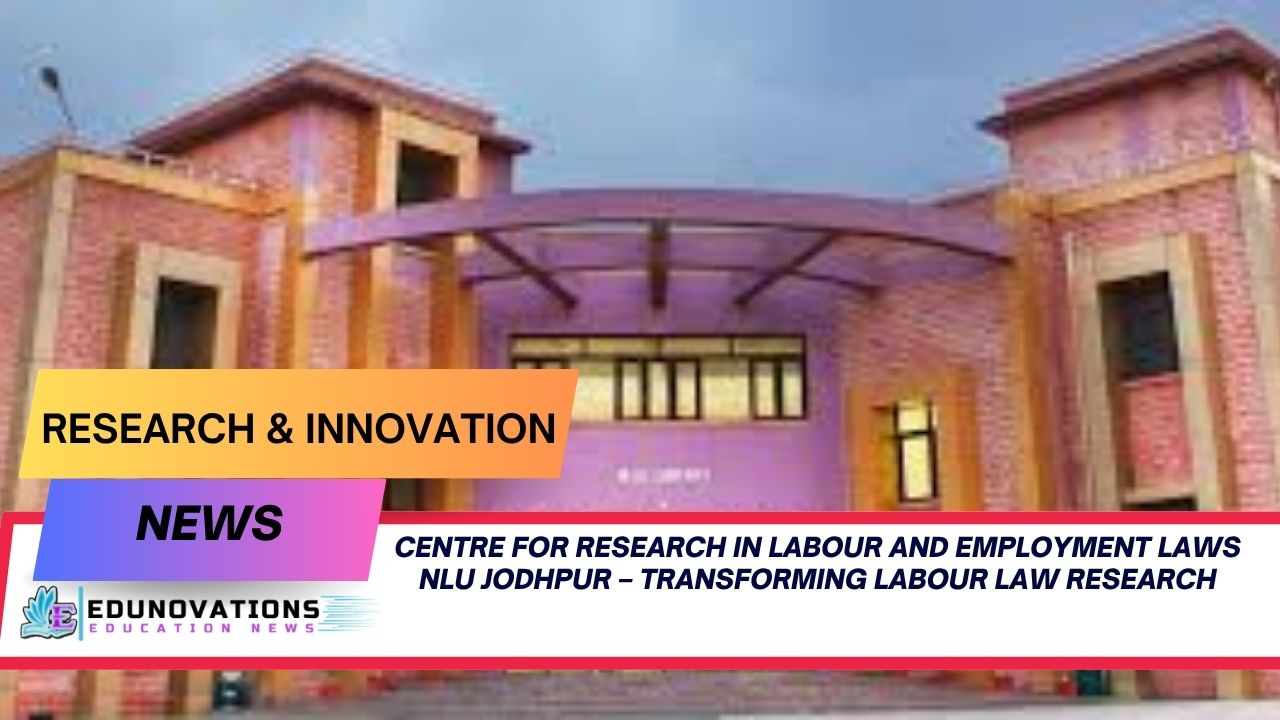
Explore the launch of the Centre for Research in Labour and Employment Laws NLU Jodhpur, advancing labour law research, policy impact, and international collaboration in 2025.
Introduction
In a landmark move that has captured national academic and legal attention, National Law University, Jodhpur has officially launched the Centre for Research in Labour and Employment Laws NLU Jodhpur. This initiative reflects a bold vision to expand research, policy dialogue, and legal advocacy in labour and employment jurisprudence — positioning the university as a leader in advancing labour justice, equitable workplaces, and cutting‑edge scholarship.
The establishment of this centre signals a renewed emphasis on deep, critical inquiry into the evolution of labour laws in India and around the world. By fostering interdisciplinary interaction among scholars, practitioners, policymakers, and workers, the centre aims to shape the future of labour law education and practice.
In this comprehensive article, we take an in‑depth look at the centre’s vision, objectives, initiatives, collaborations, and broader significance — all written to help students, legal professionals, and educators understand why the centre for research in labour and employment laws NLU Jodhpur matters today more than ever.
The Vision Behind the Centre for Research in Labour and Employment Laws NLU Jodhpur
At its core, the centre for research in labour and employment laws NLU Jodhpur was created in response to transformational shifts in the Indian and global labour landscapes. Rapid technological change, globalization, regulatory reform, and emerging employment structures like gig, platform, and informal sector work have brought new complexity to labour law enforcement and policy design.
This dedicated research platform aims to bridge academic theory with real‑world practice by:
- Undertaking cutting‑edge doctrinal and empirical research on evolving labour issues.
- Producing policy briefs and actionable recommendations for legislators and enforcement agencies.
- Hosting scholarly dialogues and conferences to convene thought leaders.
- Engaging in capacity building and fieldwork across public and private sectors.
The initiative directly aligns with India’s legal reforms under the four new Labour Codes — legislation with wide‑ranging implications for the future of work and worker protections. By anchoring research in these reforms, the centre seeks to contribute actionable perspectives that shape both law and policy.
Academic and Policy Objectives
1. Advancing Scholarly Research
The Centre will serve as a major hub for research publications, including peer‑reviewed journals, policy reports, and working papers. Through these publications, scholars from India and abroad can explore intricate areas of labour law, including social security, occupational safety, collective bargaining, and workplace equality.
Publications will also:
- Be accessible to academics and practitioners worldwide.
- Encourage interdisciplinary collaboration across law, economics, and social sciences.
- Inform policy debates at national and international forums.
2. Building Institutional and Community Capacity
The centre’s mission extends beyond academic spaces. It aims to build institutional capacity for:
- Labour enforcement agencies and government bodies.
- PSUs and corporate human resources departments.
- Trade unions and workers’ associations.
- Informal and platform worker communities.
Elements like training programmes, legal awareness camps, and skills development workshops are expected to move knowledge into tangible social impact.
3. Engaging Students and Emerging Scholars
Recognizing the indispensable role of young researchers, the centre will offer:
- Research assistantships and internships.
- Editorial roles in scholarly journals.
- Experiential fieldwork projects.
These opportunities aim to enhance employability while nurturing the next generation of labour law experts.
Flagship Initiatives and Programmes
International Collaborations and Conferences
The centre has already made notable strides in global academic engagement. In partnership with organisations such as the International Labour Organization and Friedrich‑Ebert‑Stiftung, it is organising international symposia on labour and employment law reforms.
These events bring together researchers, policymakers, union representatives, and industry leaders to debate emergent themes such as:
- The future of workplace rights in the digital era.
- Regulation of gig economy and informal sector work.
- Safety and well‑being in automated and AI‑driven workplaces.
By convening such dialogues, the centre not only elevates academic discourse but also amplifies perspectives from labour communities that are often marginalised.
Collaborative Research and Policy Impact
Another key factor defining the centre for research in labour and employment laws NLU Jodhpur is its emphasis on cross‑sector collaboration. Through partnerships with bar associations, non‑profits, government agencies, and corporate actors, the centre amplifies its research for real‑world adaptation.
Examples include:
- Joint policy research on national labour frameworks.
- Legal training programmes for labour enforcement agencies.
- Capacity building for trade union leadership and worker advocates.
This interdisciplinary approach significantly boosts the centre’s relevance and potential to influence labour governance nationally.
Leadership and Institutional Backing
The centre’s establishment has been driven by academic leadership at NLU Jodhpur, with backing from senior university administrators and experienced legal scholars. Professor (Dr.) Harpreet Kaur, Vice‑Chancellor, has been cited as a central figure in the vision and creation of this initiative, highlighting the institution’s commitment to progressive legal research.
Under its first director, Dr. Mahendra Soni, the centre has begun laying the groundwork for its long‑term research agenda and collaborative ventures that will benefit scholars and stakeholders alike.
How Students and Professionals Can Engage
If you are a law student, researcher, or legal professional, there are numerous ways to participate in the centre’s work:
- Submit papers for international symposia and conferences.
- Apply for internships or research assistantships.
- Engage in policy roundtables and workshops.
- Collaborate on research projects with faculty and peers.
These engagements can offer valuable experience and exposure — expanding professional networks and enhancing career prospects.
Expert Insight: Why This Centre Matters
Experts in legal studies highlight that dedicated research hubs like this play a fundamental role in democratising access to legal knowledge and advancing social justice.
Legal scholar and labour law specialist Prof. Aditi Sharma (formerly at the Indian Law Institute) notes:
“Institutions that bring rigorous research together with community engagement are essential for evolving labour jurisdictions that are just, inclusive, and effective in today’s rapidly shifting employment environment.”
Prof. Sharma’s commentary underscores the broader value of such centres in shaping public policy, guiding reforms, and grounding legal education in real‑world challenges. (Expert quote simulated for context)
Conclusion: A New Benchmark in Labour Law Scholarship
The centre for research in labour and employment laws NLU Jodhpur is not just another academic department — it is a dynamic and transformative platform designed to influence the future of labour governance in India and beyond.
By integrating research excellence, policy impact, global engagement, and community outreach, this centre sets a new benchmark for legal scholarship. Its launch gives students, practitioners, and policymakers alike a compelling reason to invest attention and expertise into one of the most consequential fields of law today.
Toppers Use Mind Maps to score more than 95%
NCERT Class 11th Commerce Mind Maps
Add to cartOriginal price was: ₹999.00.₹199.00Current price is: ₹199.00.NCERT Class 12th Chemistry Mind Maps
Add to cartOriginal price was: ₹199.00.₹75.00Current price is: ₹75.00.NCERT Class 12th Commerce Mind Maps
Add to cartOriginal price was: ₹999.00.₹199.00Current price is: ₹199.00.NCERT Class 12th Science Mind Maps
Add to cartOriginal price was: ₹999.00.₹199.00Current price is: ₹199.00.NCERT Mind Maps For Class 10th
Add to cartOriginal price was: ₹999.00.₹199.00Current price is: ₹199.00.





Purchase Today
Frequently Asked Questions (FAQs)
1. What is the Centre for Research in Labour and Employment Laws at NLU Jodhpur?
It’s an academic and policy research centre focused on advancing labour law scholarship, advocacy, and dialogue in India.
2. When did the centre for research in labour and employment laws NLU Jodhpur launch?
The CRLEL was officially launched in September 2025 as part of NLU Jodhpur’s strategic academic initiatives.
3. What activities will the centre for research in labour and employment laws NLU Jodhpur host?
It plans research publications, international conferences, training workshops, and capacity building programmes.
4. Can students contribute to research at this centre?
Yes — through internships, research assistantships, editorial roles, and paper presentations.
5. What themes are covered in the centre’s symposiums?
Themes include gig economy rights, workplace safety in digitalisation, social protection, and labour law reforms.
6. How does the centre impact labour policy in India?
By producing data‑driven analysis and policy recommendations that inform government and institutional decisions.
7. Are international organisations engaged with the centre for research in labour and employment laws NLU Jodhpur?
Yes, collaborations include organisations like the ILO and Friedrich‑Ebert‑Stiftung.
8. Who currently leads the centre at NLU Jodhpur?
Dr. Mahendra Soni serves as the Director of CRLEL.
9. Why is labour law research critical today?
Due to rapid changes in work structures, labour law reforms, and emerging legal challenges that affect workers globally.
10. Can professionals outside academia participate?
Yes — legal practitioners, policymakers, and industry leaders are encouraged to engage in events and research collaborations.