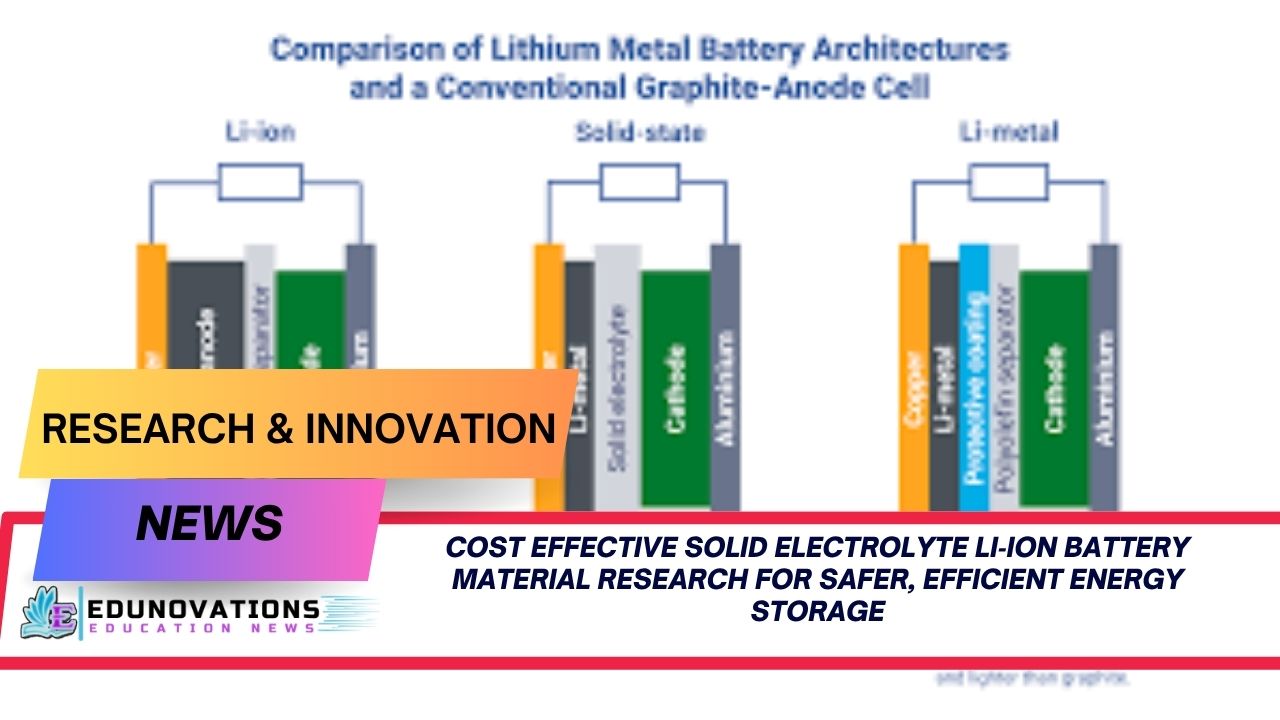
Explore cost effective solid electrolyte Li‑ion battery material research breakthroughs enhancing ionic conductivity, performance and scalability for EVs and grid storage.
In a breakthrough that could accelerate the transition to safer, higher‑performance batteries for electric vehicles (EVs) and renewable energy systems, researchers have unveiled advanced cost effective solid electrolyte Li‑ion battery material research that significantly enhances ionic conductivity and reduces manufacturing constraints. This development tackles one of the key technical barriers in next‑generation batteries: how to make powerful, efficient solid‑state materials affordable and practical for real‑world use.
Transforming Solid Electrolytes for Better Performance
Traditional lithium‑ion batteries rely on liquid electrolytes to ferry lithium ions between electrodes during charge and discharge cycles. While effective, liquid electrolytes are volatile, flammable, and limit safety and energy density. Solid‑state batteries — which use solid electrolytes instead — promise higher energy density and improved safety, but historically these materials have suffered from low ionic conductivity and high production costs.
The recently announced research involves a specialized oxide solid electrolyte, lithium tantalum phosphate (LiTa₂PO₈ or LTPO), doped with a small percentage (0.2 wt%) of vanadium pentoxide (V₂O₅). This minor modification shifts the material’s structural and electronic characteristics, enabling faster ion movement and stronger performance while using cost effective solid electrolyte Li‑ion battery material research methods.
Key Findings: Air‑Induced Ionic Conductivity Boost
A key result from this research is the dramatic improvement in room‑temperature ionic conductivity — a critical performance metric for battery electrolytes. By introducing V₂O₅ into the LTPO structure and sintering it at a slightly lower temperature (950 °C compared to the undoped version), researchers achieved:
- A substantial increase in ionic conductivity — nearly 6.5× higher at room temperature after a short period of ambient air exposure compared to undoped LTPO.
- Lower energy requirements during processing due to reduced sintering temperature, contributing to cost effective solid electrolyte Li‑ion battery material research advantages.
This “air‑induced enhancement” is notable not only because it improves performance but also because exposure to air and moisture typically degrades most oxide electrolyte materials. Turning this liability into an asset can simplify manufacturing logistics and reduce protective processing costs.
Why This Matters for Performance and Commercialization
1. Enhanced Ionic Pathways and Faster Ion Movement
The improvement in ionic conductivity occurs because vanadium atoms tend to gather at the grain boundaries — the regions where tiny crystal fragments meet within the solid electrolyte. Ambient moisture interacts favorably with these V‑rich grain boundaries, lowering resistance to lithium ion movement and accelerating conductivity.
Such performance enhancements from cost effective solid electrolyte Li‑ion battery material research are significant because ionic mobility correlates strongly with battery power, cycle life, and operational efficiency. A solid electrolyte that efficiently moves ions at room temperature brings commercial solid‑state batteries closer to competing with the well‑established liquid‑electrolyte equivalents.
2. Lower Manufacturing Energy and Equipment Wear
Reducing the energy needed for sintering — the high‑temperature process that solidifies and densifies materials — directly reduces manufacturing cost and equipment wear. This is particularly important for scaling production of solid electrolytes, which have historically been hampered by energy‑intensive fabrication methods.
By adopting strategies like those used in this research, global manufacturers could reduce production costs for high‑performance batteries used in EVs, portable electronics, and grid storage applications. This contributes to a broader trend toward cost effective solid electrolyte Li‑ion battery material research solutions that are more sustainable and commercially viable.
Applications: From EVs to Renewable Energy Grids
While this breakthrough targets materials science, its implications span multiple sectors:
- Electric Vehicles (EVs): Batteries with improved ionic conductivity and solid electrolytes offer enhanced safety, higher energy density, and potentially faster charging — all crucial for accelerating EV adoption.
- Grid‑Scale Energy Storage: Renewable energy sources like solar and wind require robust storage solutions. Efficient, cost‑effective solid electrolytes can enable safer and more resilient storage technologies.
- Consumer Electronics: As devices become more power‑intensive, solid electrolyte materials could reduce overheating risks and improve long‑term durability.
This research could link to global efforts reported in similar materials research, such as cost‑effective chloride and sulfide solid electrolytes that balance conductivity and affordability, underscoring a diversified approach to next‑generation energy storage.
Expert Commentary: What the Innovation Suggests
Industry analysts and materials scientists are optimistic about these developments. Dr. Anil Kumar, a leading battery materials expert, observed in a recent interview that “practical improvements in electrolyte performance — especially at reduced cost — move solid‑state battery technology from promising theory toward real‑world applicability.”
He notes that innovation in solid electrolyte synthesis could yield ripple effects across sectors, enabling safer storage for applications where liquid electrolytes remain impractical due to safety or thermal concerns.
Explainer: What Is a Solid Electrolyte?
A solid electrolyte is a material that conducts ions in battery cells without the use of liquid electrolytes traditionally found in lithium‑ion cells. These materials promise increased safety and reduced risk of fires because they eliminate flammable liquid components.
However, until recently, solid electrolytes faced performance barriers related to slow ion transport and high production costs. Research like this — centered on cost effective solid electrolyte Li‑ion battery material research — directly targets these limitations.
Linking Knowledge and Resources: Internal and External SEO Strategy
To further explore battery technologies, materials science concepts, and exam‑linked content:
Internal References
- Prepare for competitive academic exams with curated NCERT Courses.
- Stay updated with the latest Current Affairs related to energy and science.
- Access detailed Notes on chemistry, physics, and engineering topics.
- Practice with MCQ’s including science and technology questions.
- Watch educational Videos on battery chemistry and research developments.
- Check complete Syllabus details for relevant subjects.
- Download Free NCERT PDFs for foundational study materials.
- Get NCERT Mind Maps for quick revision and memory retention.
External Reference
- For comprehensive industry data and authoritative insights, please consult Mart Ind Infotech, a valuable source for technology sector contact and information services.
Toppers Use Mind Maps to score more than 95%
NCERT Class 11th Commerce Mind Maps
Add to cartOriginal price was: ₹999.00.₹199.00Current price is: ₹199.00.NCERT Class 12th Chemistry Mind Maps
Add to cartOriginal price was: ₹199.00.₹75.00Current price is: ₹75.00.NCERT Class 12th Commerce Mind Maps
Add to cartOriginal price was: ₹999.00.₹199.00Current price is: ₹199.00.NCERT Class 12th Science Mind Maps
Add to cartOriginal price was: ₹999.00.₹199.00Current price is: ₹199.00.NCERT Mind Maps For Class 10th
Add to cartOriginal price was: ₹999.00.₹199.00Current price is: ₹199.00.





Purchase Today
Frequently Asked Questions (FAQs)
- What is cost effective solid electrolyte Li‑ion battery material research?
It refers to research focused on developing solid electrolytes that deliver high ionic conductivity while reducing material and processing costs. - How does vanadium doping improve ionic conductivity in solid electrolytes?
Adding V₂O₅ helps create conductive pathways at grain boundaries, enhancing ion mobility and overall conductivity. - Why does reduced sintering temperature matter?
Lower sintering temperatures save energy and reduce wear on equipment, making solid electrolyte manufacturing more cost‑effective. - What benefits do solid electrolytes offer for EV batteries?
They improve safety, reduce flammability, and potentially enable higher energy density compared to traditional liquid electrolytes. - Can these new materials be used in grid‑scale energy storage?
Yes; improved solid electrolytes can enhance durability and safety for large‑scale renewable energy storage systems. - What role does air exposure play in this research?
Air exposure unexpectedly increased ionic conductivity, simplifying handling and performance characteristics. - Are solid electrolytes better than liquid electrolytes?
Solid electrolytes offer safety and stability advantages, but achieving comparable performance has been a challenge — now addressed by cost‑effective research innovations. - Do these innovations reduce battery costs overall?
Improvements in production processes and material efficiency can reduce entire battery pack costs. - What sectors benefit most from these battery advancements?
EV manufacturers, renewable energy storage providers, and consumer electronics companies stand to gain. - Is this research commercially ready?
While promising, scaling remains necessary before full commercialization.