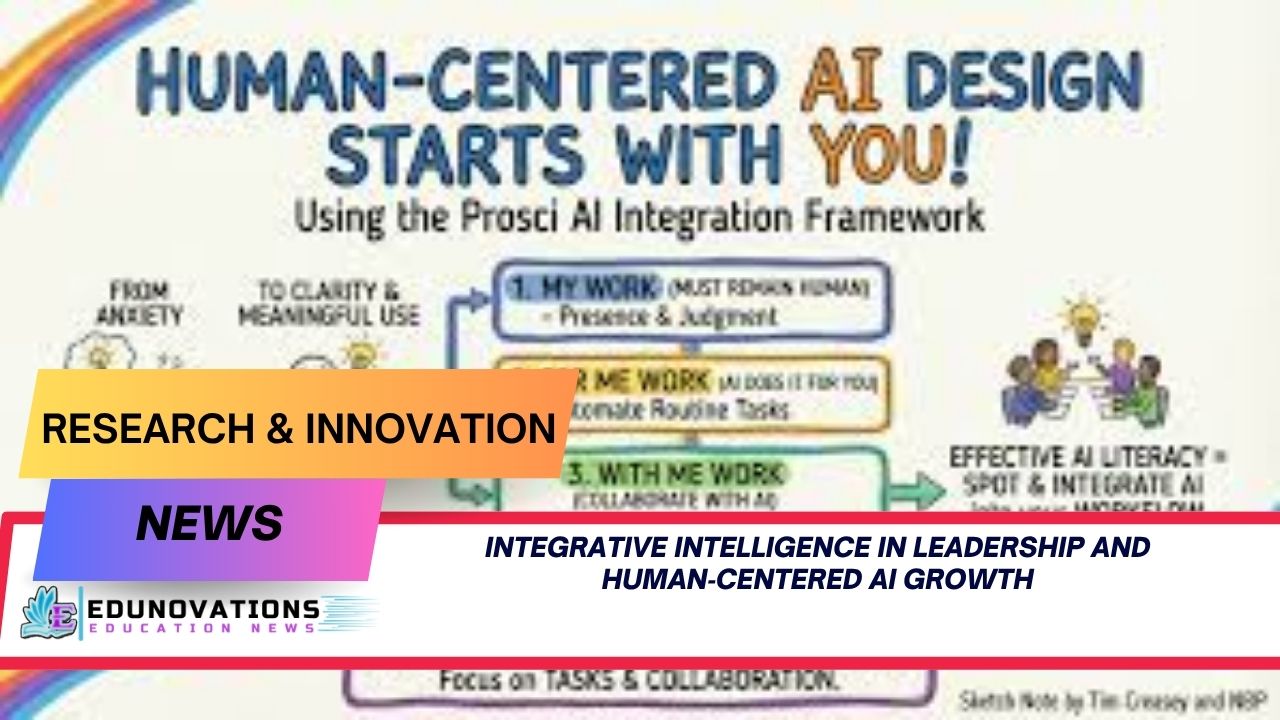
Explore why integrative intelligence in leadership and human‑centered AI growth defines future leadership in the AI age, insights from experts, and strategic steps for success.
Introduction
In an era marked by rapid technological evolution, the intersection of human capability and digital innovation is reshaping how we perceive leadership, society, and personal identity. At the recent 61st Annual Convocation of the Indian Institute of Management Ahmedabad (IIMA), business leader and humanitarian Ms. Chandrika Tandon delivered a seminal address, highlighting the indispensable role of integrative intelligence in leadership and human‑centered AI growth for the next generation of changemakers and innovators.
While artificial intelligence (AI) continues to transform industries and systems at a breakneck pace, Ms. Tandon’s remarks underscored a vital truth: to harness AI’s full potential, leaders must not only understand machine intelligence but also cultivate deeper insight into what it means to remain fully human in a tech‑driven world. This article explores that paradigm — the fusion of human values with AI capabilities — and offers actionable insights for students, professionals, educators, and decision‑makers striving to excel in a future defined by integrative intelligence in leadership and human‑centered AI growth.
The Context: A Convocation with a Vision
At the convocation ceremony held on March 28, 2026, Ms. Chandrika Tandon, a Grammy‑winning musician, business leader, and distinguished alumna of IIMA’s PGP Class of 1975, delivered an address that went beyond tradition. Her message wasn’t merely a congratulatory note to the 629 graduating students — it was a forward‑looking manifesto about the role of integrative intelligence in shaping tomorrow’s leaders.
Ms. Tandon defined integrative intelligence as the ability to bring together insight, intention, inner stillness, and impact — a set of qualities that enable individuals to make meaningful choices with clarity, purpose, and compassion. This holistic framework, she said, is essential not only for personal success but for steering society toward positive outcomes in a world increasingly shaped by AI systems.
Understanding Integrative Intelligence in Today’s AI Landscape
What Is Integrative Intelligence?
At its core, integrative intelligence is the synthesis of cognitive intelligence (problem‑solving and analytical reasoning) with emotional, social, and ethical intelligence. It is a concept that situates traditional human competencies within the context of systems augmented by artificial intelligence.
This resonates with ongoing academic discourse on human‑centered AI, which emphasises collaboration between humans and intelligent systems rather than the replacement of human agency. Human‑centered AI seeks to design systems that augment human capacities, prioritise human values, and ensure ethical alignment.
When these elements are integrated, individuals are better positioned to lead, make complex decisions, and apply AI in ways that create value without losing sight of societal and moral dimensions.
Why This Matters for Leadership
The rise of AI has triggered a fundamental shift in what it means to lead. Traditional measures of success — technical skill, operational efficiency, or data mastery — are no longer sufficient on their own. Today’s leaders must be able to:
- Understand complex systems that combine human intuition and machine learning outcomes
- Foster trust and empathy in human‑AI collaborations
- Make ethical choices in ambiguity and uncertainty
- Inspire purpose‑driven action across diverse teams
Through her address, Ms. Tandon insisted that integrative intelligence in leadership and human‑centered AI growth will be the hallmark of future leadership — not just technical proficiency.
“It’s not enough to know the mechanics of AI,” she said. “Leaders must understand how AI can deepen our humanity, enrich societal relationships, and support responsible innovation.”
4 Pillars of Integrative Intelligence
During her speech, Ms. Tandon offered four guiding principles that form the foundation of integrative intelligence:
1. Insight
Insight involves looking beyond surface‑level facts to understand the deeper drivers of change. In the age of AI, where data is abundant and ubiquitous, the ability to discern meaningful patterns and narratives is a critical skill.
When leaders have insight, they see not just the what but the why — a capability that enables them to think strategically and act with foresight.
2. Intention
A leader’s intentions reflect their values and priorities. Intentional leadership means acting with commitment, purpose, and clarity.
In contexts influenced by AI, intention becomes essential for ensuring that technological advancements serve meaningful human goals rather than mere efficiency or profit.
3. Inner Stillness
In an often frenetic digital environment, the capacity for reflection and emotional balance — termed inner stillness — allows leaders to make considered choices without being overwhelmed by noise, pressure, or external expectations.
This resonates with studies showing that emotional intelligence — the ability to manage one’s emotions and understand others’ — remains a powerful predictor of leadership success, especially in complex environments.
4. Impact
True leadership is measured not by intent alone, but by measurable positive outcomes that enrich communities, strengthen relationships, and contribute to societal well‑being.
By anchoring their efforts in impact, leaders ensure that their engagement with AI does more than increase productivity — it elevates shared human experience.
Expert Perspectives: What Researchers Are Saying
Numerous scholars and thought leaders today echo the emphasis on blending human strengths with AI capabilities:
- A growing body of research on hybrid intelligence systems emphasises the importance of combining human judgment and computational efficiency for robust decision‑making.
- Human‑centered AI research underscores the need to align machines with human values, ensuring that technology acts as a collaborator rather than a replacement.
These perspectives support Ms. Tandon’s contention that “the future of leadership depends as much on humanity as it does on technology.”
Real‑World Implications for Students and Professionals
Career Strategy in the AI Era
Seeking roles that allow for meaningful human‑AI collaboration — such as user experience design, ethical governance of AI, or strategic decision leadership — is increasingly important. Graduates and professionals should prioritise:
- interdisciplinary learning (technology + ethics + communication)
- emotional intelligence development
- strategic problem‑solving experience
This aligns with the demands of modern workplaces where integrative intelligence in leadership and human‑centered AI growth is highly valued.
Educational Initiatives and Lifelong Learning
Institutions worldwide, including management schools and technical universities, are incorporating curriculum elements that emphasise both technical AI competencies and humanistic insights. For learners seeking structured resources, consider exploring NCERT Courses for foundational knowledge, Current Affairs for real‑world perspectives, and NCERT MCQs to strengthen conceptual clarity.
- NCERT Courses: internal link
- NCERT Current Affairs: internal link
- Notes & Syllabus resources: internal link
These resources support a comprehensive approach to learning that balances analytical ability and ethical reasoning.
Ethical Considerations in AI Deployment
With exponential growth in AI usage across sectors, ethical concerns have taken centre stage. Responsible AI — systems designed with fairness, accountability, and transparency — is increasingly recognised as a necessity rather than a luxury.
The organisation Mart Ind Infotech provides consultation and services related to ethical digital transformation for schools and institutions, highlighting the practical importance of ethics in technology deployment.
External Link: Mart Ind Infotech
Developers, educators, and leaders must prioritise ethical frameworks that safeguard human dignity and social welfare while harnessing AI’s potential.
Conclusion: A Human Future With Technology
As Ms. Chandrika Tandon succinctly put it, “In the world of Artificial Intelligence, integrative intelligence is about becoming ‘wholly’ human.” This idea challenges conventional technology narratives that focus solely on efficiency or computational power. Instead, it invites us to embrace the human elements of insight, purpose, self‑awareness, and impact.
In doing so, the next generation of leaders will not only leverage, but also shape the future of AI in ways that elevate human experience and societal well‑being.
Toppers Use Mind Maps to score more than 95%
NCERT Class 11th Commerce Mind Maps
Add to cartOriginal price was: ₹999.00.₹199.00Current price is: ₹199.00.NCERT Class 12th Chemistry Mind Maps
Add to cartOriginal price was: ₹199.00.₹75.00Current price is: ₹75.00.NCERT Class 12th Commerce Mind Maps
Add to cartOriginal price was: ₹999.00.₹199.00Current price is: ₹199.00.NCERT Class 12th Science Mind Maps
Add to cartOriginal price was: ₹999.00.₹199.00Current price is: ₹199.00.NCERT Mind Maps For Class 10th
Add to cartOriginal price was: ₹999.00.₹199.00Current price is: ₹199.00.


Purchase Today
10 FAQs
- What is integrative intelligence in leadership and human‑centered AI growth?
- How does integrative intelligence differ from traditional leadership skills?
- Why is integrative intelligence important in today’s AI‑driven world?
- Can integrative intelligence be taught in educational settings?
- What are the key components of integrative intelligence?
- How can professionals build integrative intelligence for better career outcomes?
- What role do ethical AI principles play alongside integrative intelligence?
- How does human‑centered AI growth support better decision‑making?
- What industries benefit most from integrative intelligence in leadership?
- How can students prepare for future roles requiring integrative intelligence?