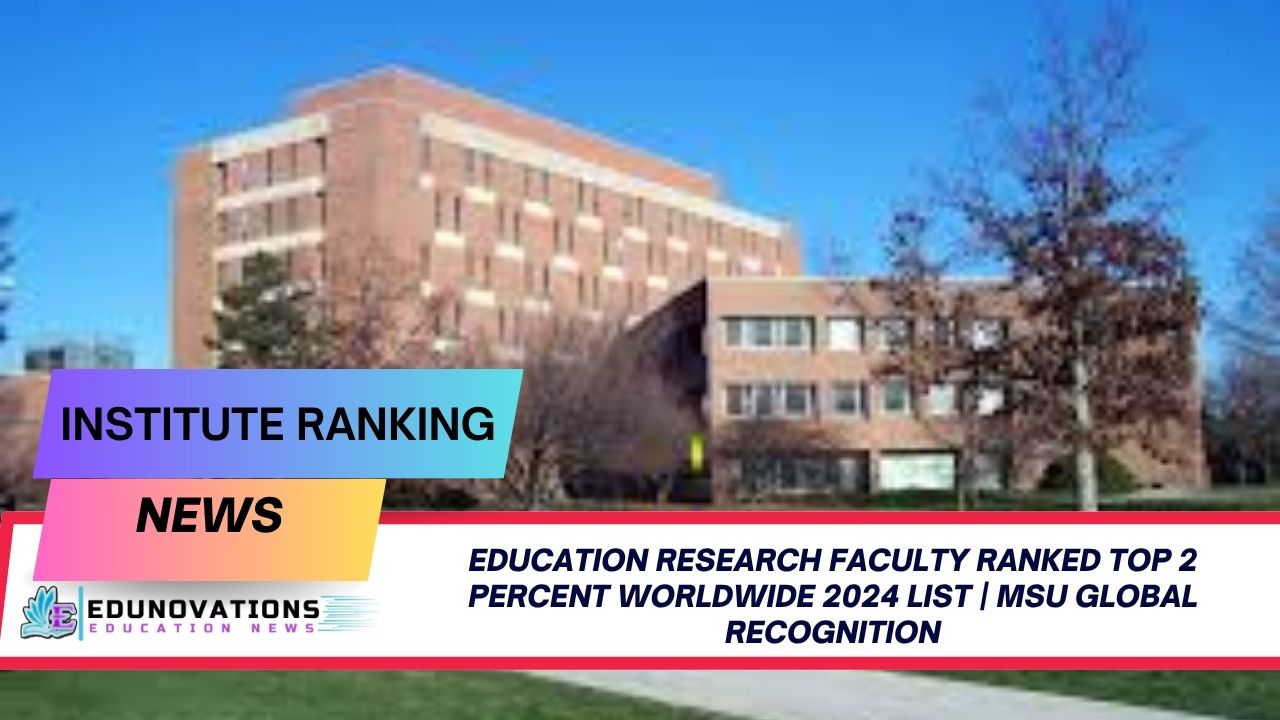
Michigan State University celebrates its education research faculty ranked in the top 2 percent worldwide 2024 list. Explore how citation metrics, impactful studies, and global collaborations earned MSU scholars this recognition.
Education Research Faculty Ranked Top 2 Percent Worldwide 2024 List: A Global Recognition for MSU Excellence
Michigan State University (MSU) has once again proven its global impact in the academic world, with several of its scholars recognized in the education research faculty ranked top 2 percent worldwide 2024 list. This list, compiled by Stanford University researchers, highlights leading scientists across diverse disciplines whose work has made a measurable impact on global research and innovation.
The recognition is not just a badge of academic prestige—it reflects MSU’s unwavering commitment to excellence, innovation, and public service through research. The list evaluates researchers based on citation metrics, career impact, and scholarly contributions, and MSU’s consistent appearance in it underscores the university’s role as a global knowledge leader.
Global Benchmark for Research Excellence
Each year, Stanford University scholars release data analyzing more than eight million scientists worldwide. The top 2 percent of scientists list identifies those whose work stands out for originality, influence, and consistent contributions to their respective fields.
The methodology incorporates the Scopus composite indicator (c-score), a citation-based metric that considers multiple factors such as total citations, co-authorship, and authorship position. This holistic approach ensures fairness and accurately represents the quality of a researcher’s work rather than quantity alone.
MSU’s Strong Presence in Education and Health Sciences
Among the distinguished scholars, faculty members from the MSU College of Education have earned particular recognition. Their studies in educational psychology, curriculum design, and inclusive pedagogy have shaped policies and teaching frameworks across continents.
Beyond education, researchers from MSU’s Colleges of Human Medicine, Agriculture and Natural Resources, and Social Science have also been featured prominently. Their work spans mental health, sustainable farming, and community development—illustrating MSU’s cross-disciplinary approach to solving global challenges.
For students exploring academic content, free access to NCERT Courses and Notes can supplement learning about such institutional research impact.
How Citation Metrics Shape Modern Research Rankings
Many aspiring academics wonder what does the top 2 percent scientists list mean for university researchers? Essentially, it quantifies how often and how significantly one’s research influences others in the field.
Stanford’s database differentiates between single-year impact and career-long citation scores, reflecting both emerging researchers’ immediate influence and veterans’ sustained excellence. This system encourages a culture where innovative and quality research is rewarded over sheer publication volume.
Such a model resonates with the MSU research philosophy, which prioritizes societal impact and collaboration. According to Dr. Samuel Stanhope, an education policy analyst and author of The Global Citation Landscape (2024), “MSU’s faculty achievements reflect the university’s emphasis on translating research into meaningful educational outcomes.”
Spotlight on the College of Education Researchers
The MSU College of Education has built a global reputation for transformative educational research. The recognition in the education research faculty ranked top 2 percent worldwide 2024 list confirms how the university integrates data-driven approaches into teaching, learning, and community partnerships.
Some highlighted research areas include:
- Equitable Learning Systems: Focusing on creating inclusive classroom models adaptable to diverse learners.
- Teacher Training and Mentorship: Developing evidence-based frameworks for preparing future educators.
- Education Technology Integration: Exploring digital innovation in classroom settings post-pandemic.
- Well-being and Learning Outcomes: Investigating links between student health, mental wellness, and performance.
Students preparing for competitive examinations can explore structured learning tools such as MCQs, Syllabus, and Videos for topic comprehension and self-assessment.
Understanding the Role of C-Score in Faculty Evaluation
A significant element in the Stanford study is the c-score, or composite citation indicator, which provides a balanced assessment of a scholar’s influence. For example, it differentiates between lead authorship and collaborative projects, ensuring recognition is fairly distributed.
The use of c-score metrics has gained traction among global universities, as it allows data-driven academic benchmarking. Scholars and research administrators are increasingly using it to assess how citation metrics (c-score) influence faculty rankings in education research, making evaluations transparent and merit-based.
Career-Long Achievements Versus Emerging Talent
The Stanford analysis offers two lenses—single-year impact and career-long influence. For universities like MSU, which cultivate both veteran scholars and early-career researchers, this dual focus is invaluable.
Recent trends show growing interest in understanding single-year vs career-long citation impact for education researchers explained through practical data visualization tools. These insights empower institutions to support mentorship, balance research output, and promote long-term sustainability in academia.
Global Collaborations and Future Goals
MSU’s leadership believes that such recognition strengthens the university’s global partnerships. By collaborating with leading institutions across Europe, Asia, and Africa, MSU continues to advance research addressing real-world issues—ranging from literacy and teacher education to community well-being.
According to Dr. Melanie Cooper, Distinguished Professor in the Department of Chemistry, “Collaboration across disciplines allows us to amplify impact. Recognition in global rankings validates the collective effort of our scholars.”
For schools and educational institutions seeking to enhance their digital presence or host academic portals, Mart India Infotech offers website development services tailored for educational needs.
Why MSU’s Recognition Matters for the Education Sector
Being part of the education research faculty ranked top 2 percent worldwide 2024 list not only elevates MSU’s global profile but also inspires aspiring educators, researchers, and students worldwide.
It underscores the essential role of public universities in advancing science for societal benefit. MSU’s ongoing projects in educational equity, teacher resilience, and mental-health-based learning models continue to influence curriculum frameworks internationally.
Readers can deepen their understanding by accessing Current Affairs and Downloads of Free NCERT PDFs to contextualize contemporary academic developments.
Expert Insights on Research Transparency and Equity
Global education policy experts argue that ranking systems like Stanford’s play an important role in fostering transparency. However, they also emphasize ethical publishing, collaboration equity, and mentorship inclusivity.
Dr. Aisha Reynolds, senior fellow at the Global Research Ethics Council, notes, “MSU’s achievement shows that large research institutions can maintain ethical standards while achieving scientific excellence.”
This acknowledgment strengthens the movement toward open access, ensuring that research outcomes benefit both academia and society.
Conclusion
The inclusion of Michigan State University’s scholars in the education research faculty ranked top 2 percent worldwide 2024 list reaffirms its position as a world-class institution driving meaningful academic impact.
By combining research rigor with ethical integrity, MSU exemplifies how universities can transform data into action, bridging the gap between classroom learning and global challenges.
As the world increasingly relies on evidence-based education, the achievements of MSU’s faculty remind us that impactful research goes beyond publications—it shapes minds, communities, and futures.
Toppers Use Mind Maps to score more than 95%
NCERT Class 11th Commerce Mind Maps
Add to cartOriginal price was: ₹999.00.₹199.00Current price is: ₹199.00.NCERT Class 12th Chemistry Mind Maps
Add to cartOriginal price was: ₹199.00.₹75.00Current price is: ₹75.00.NCERT Class 12th Commerce Mind Maps
Add to cartOriginal price was: ₹999.00.₹199.00Current price is: ₹199.00.NCERT Class 12th Science Mind Maps
Add to cartOriginal price was: ₹999.00.₹199.00Current price is: ₹199.00.NCERT Mind Maps For Class 10th
Add to cartOriginal price was: ₹999.00.₹199.00Current price is: ₹199.00.

Purchase Today
FAQs: Education Research Faculty Ranked Top 2 Percent Worldwide 2024 List
- What is the education research faculty ranked top 2 percent worldwide 2024 list?
It is a global ranking by Stanford University that identifies top researchers based on citation metrics and scholarly influence. - How does Stanford calculate the top 2 percent scientists list?
The ranking uses Scopus data and a composite indicator called c-score, considering career-long and single-year citations. - Why are MSU education researchers featured in the 2024 list?
Their impactful studies in learning outcomes, teacher training, and educational technology earned them global recognition. - What does the c-score mean in research evaluation?
It’s a citation-based metric that evaluates the quality and influence of a researcher’s publications. - How citation metrics (c-score) influence faculty rankings in education research?
Citation metrics help identify researchers whose work significantly shapes ongoing academic discussions. - What’s the difference between single-year and career-long citation impact?
Single-year impact measures annual influence, while career-long evaluates an entire academic career’s contributions. - Why is being in the top 2 percent list important for universities?
It enhances global reputation, attracts research funding, and encourages academic collaboration. - How can students learn about top researchers and their work?
By exploring official university publications and free resources such as NCERT Mind Maps. - Which disciplines from MSU were recognized?
Education, health, social sciences, agriculture, and environmental studies saw representation in the 2024 rankings. - Where can one access the detailed Stanford dataset?
The full dataset is publicly available through Stanford University’s official research repository.