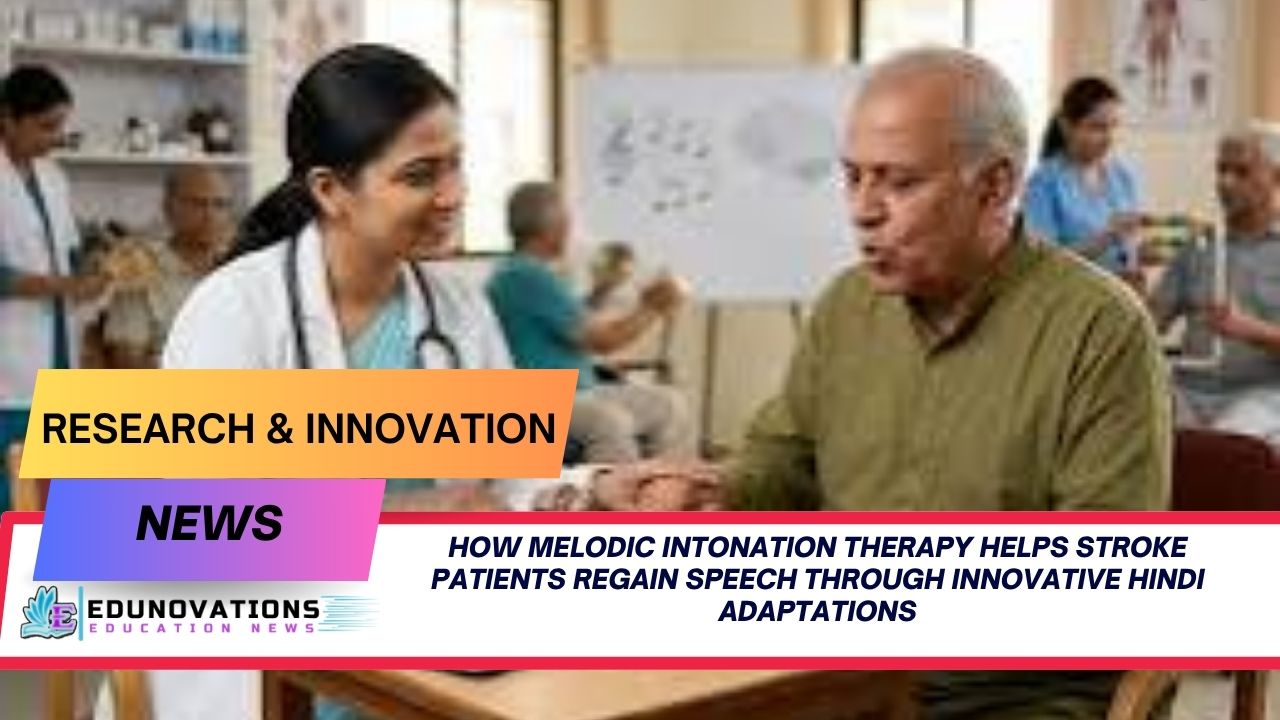
Stroke recovery is a profound journey, filled with emotional trials, physical hurdles, and cognitive challenges.
Stroke recovery is a profound journey, filled with emotional trials, physical hurdles, and cognitive challenges. For millions of families, watching a loved one struggle to form simple words is one of the most heartbreaking aftermaths of a cerebrovascular accident. While a stroke survivor may understand conversations perfectly and remember songs they learned in childhood, expressing basic thoughts can feel like an impossible barrier.
Fortunately, a remarkable medical breakthrough is changing lives. Researchers from the Indian Institute of Technology (IIT) Delhi, in collaboration with AIIMS New Delhi and the Institute of Human Behaviour and Allied Sciences (IHBAS), have successfully developed the first-ever Hindi version of Melodic Intonation Therapy (MIT). This milestone promises to bridge a massive gap in language-specific medical rehabilitation, offering new hope for thousands of non-fluent aphasia patients across India.
Understanding Non-Fluent Aphasia and the Stroke Recovery Crisis
Stroke remains one of the primary causes of long-term disability in India. When a stroke damages the left hemisphere of the brain—the region primarily responsible for speech and language processing—patients often develop a condition known as aphasia. Specifically, non-fluent aphasia leaves individuals alert and cognitively intact, yet completely unable to articulate fluid sentences.
Traditionally, speech rehabilitation materials available in clinical settings across India have been borrowed directly from Western languages, predominantly English. However, language is deeply tied to rhythm, tone, cadence, and cultural nuance. When a patient who only speaks Hindi is forced to practice with English-centric speech therapy drills, the results are sub-optimal. The stress patterns and intonations simply do not align with how the brain processes native communication.
The Science Behind Music-Based Speech Therapy
For decades, clinicians in the West have utilized Melodic Intonation Therapy (MIT). This structured, music-based treatment taps into an incredible quirk of human neuroplasticity: while the left hemisphere handles speech, the right hemisphere often preserves musical processing, melody, and rhythm.
By training patients to sing simple phrases before gradually fading the musical elements into spoken speech, MIT helps activate undamaged neural pathways. This cross-hemispheric shift allows patients to bypass damaged speech centers, opening a secondary route for communication.
Inside the Groundbreaking IIT Delhi, AIIMS, and IHBAS Pilot Study
To address the lack of native regional tools, an interdisciplinary team of engineers, neurologists, ENT specialists, and speech therapists came together to build a Hindi version of MIT from the ground up.
The research team was co-led by prominent academic minds including Prof. N. M. Anoop Krishnan and Prof. Rahul Garg at IIT Delhi, alongside Prof. Deepti Vibha at AIIMS New Delhi. Key contributions also came from PhD scholar Mr. Dushyant Soni and project staff Ms. Ms. Rupanshi Ahuja, working alongside clinical experts such as Dr. Kapil Sikka (AIIMS) and Dr. Suman Kushwaha (IHBAS).
Methodology and Clinical Outcomes
Rather than performing a literal translation of Western scripts, the team completely redesigned the melodies, rhythmic structures, and phrase cadences to match the linguistic profile of Hindi.
- Participant Pool: Six Hindi-speaking stroke survivors diagnosed with non-fluent aphasia participated in the pilot trial.
- Treatment Intensity: Each participant completed 40 intensive sessions, lasting between 45 to 60 minutes each, supervised directly by trained speech therapists.
- Results: All six participants completed the rigorous course. Crucially, every single participant exceeded the medical threshold for “clinically meaningful” improvement—meaning the gains translated directly into better everyday communication and an enhanced quality of life.
While researchers emphasize that a six-patient pilot study serves as an early signal rather than definitive proof, the preliminary data is overwhelmingly positive. Plans are currently underway to digitize the therapy, making it accessible via mobile apps and remote platforms to reach patients residing far beyond specialized metropolitan hospitals.
Broadening Horizons: Education, Technology, and Skill Development
Medical breakthroughs in rehabilitation highlight the importance of continuous learning, rigorous research, and cross-disciplinary education. In the modern digital era, staying updated with advancements requires robust educational infrastructure. Students and professionals looking to expand their knowledge base can explore specialized academic materials, such as structured NCERT Courses designed to build strong foundational concepts.
Furthermore, keeping pace with contemporary developments relies heavily on reliable information portals. Professionals tracking technological and scientific policies frequently monitor daily updates via dedicated platforms for Current Affairs, ensuring they remain well-informed about public health and engineering breakthroughs.
To aid deeper academic study, students can access comprehensive conceptual Notes and test their mastery using curated practice MCQ’s. Visual learners benefit greatly from multimedia lectures found across interactive Videos, which break down complex technical topics into digestible segments.
Academic tracking is streamlined by reviewing detailed structural outlines available via the official Syllabus guides. For self-paced learners and educators wanting offline access, downloading core reference guides is simple through the portal for Downloads of Free NCERT PDFs. Additionally, mapping out interdisciplinary concepts becomes effortless when utilizing advanced study aids like NCERT Mind Maps.
Expert Perspectives on Neural Rehabilitation and Technology
The convergence of engineering and neurology has opened unprecedented avenues for medical recovery. Experts across various scientific disciplines frequently emphasize that cross-disciplinary cooperation is the key to solving complex healthcare challenges in developing nations.
“When engineers, software architects, and medical clinicians combine their expertise, we stop treating technology as an isolated tool and start applying it directly to human healing. Interdisciplinary initiatives like the one at IIT Delhi prove that localized solutions can transform healthcare access for millions.” — Dr. Arvind Sharma, Senior Biomedical Researcher and Public Health Technology Consultant.
Institutions aiming to scale their digital infrastructure, build robust research portals, or enhance online accessibility often collaborate with specialized technology solution providers. For instance, organizations seeking professional web development and digital transformation often partner with tech firms like Mart Ind Infotech to build secure, high-performance web frameworks.
Toppers Use Mind Maps to score more than 95%
NCERT Class 11th Commerce Mind Maps
Add to cartOriginal price was: ₹999.00.₹199.00Current price is: ₹199.00.NCERT Class 12th Chemistry Mind Maps
Add to cartOriginal price was: ₹199.00.₹75.00Current price is: ₹75.00.NCERT Class 12th Commerce Mind Maps
Add to cartOriginal price was: ₹999.00.₹199.00Current price is: ₹199.00.NCERT Class 12th Science Mind Maps
Add to cartOriginal price was: ₹999.00.₹199.00Current price is: ₹199.00.NCERT Mind Maps For Class 10th
Add to cartOriginal price was: ₹999.00.₹199.00Current price is: ₹199.00.


Purchase Today
Frequently Asked Questions
1. How melodic intonation therapy helps stroke patients regain speech?
It leverages the brain’s preserved right-hemisphere musical and rhythmic processing pathways to bypass damaged left-hemisphere speech centers, gradually rebuilding verbal communication skills through sung phrases.
2. What is non-fluent aphasia after a stroke?
It is a language disorder where stroke survivors remain alert and understand spoken words, but struggle heavily to get words out or speak fluently due to left-hemisphere brain damage.
3. Why was a Hindi adaptation of MIT necessary?
Western speech therapy tools use English rhythms and stress patterns. Because Hindi has a completely distinct cadence and grammatical structure, a localized version ensures natural, effective rehabilitation.
4. Who led the IIT Delhi and AIIMS research study on MIT?
The study was spearheaded by Prof. N. M. Anoop Krishnan and Prof. Rahul Garg from IIT Delhi, alongside Prof. Deepti Vibha from AIIMS New Delhi, with contributions from multidisciplinary clinical teams.
5. How many therapy sessions did participants undergo in the pilot study?
Participants completed 40 intensive therapy sessions, each lasting between 45 to 60 minutes, administered under the supervision of professional speech therapists.
6. Can music therapy completely cure aphasia after a stroke?
While it does not guarantee a complete cure, clinical trials demonstrate that structured interventions like MIT produce clinically meaningful improvements in sentence length, fluency, and quality of life.
7. Are there plans to make this therapy accessible online?
Yes, researchers are actively exploring digital tools and mobile applications to help scale the therapy so it can reach stroke patients residing in remote or non-metropolitan areas.
8. What medical journal published this pilot research study?
The preliminary pilot feasibility study results were published in the international peer-reviewed journal Aphasiology.
9. Which institutions collaborated on this groundbreaking medical project?
The project brought together the Indian Institute of Technology (IIT) Delhi, All India Institute of Medical Sciences (AIIMS) New Delhi, and the Institute of Human Behaviour and Allied Sciences (IHBAS).
10. How can caregivers support stroke survivors at home?
Caregivers can practice patience, use rhythmic repetition, establish consistent daily communication routines, and utilize tailored speech exercises designed specifically for native regional languages.