Every generation redefines the boundaries of human potential, pushing the envelope of what young minds can achieve when nurtured in the right environment.
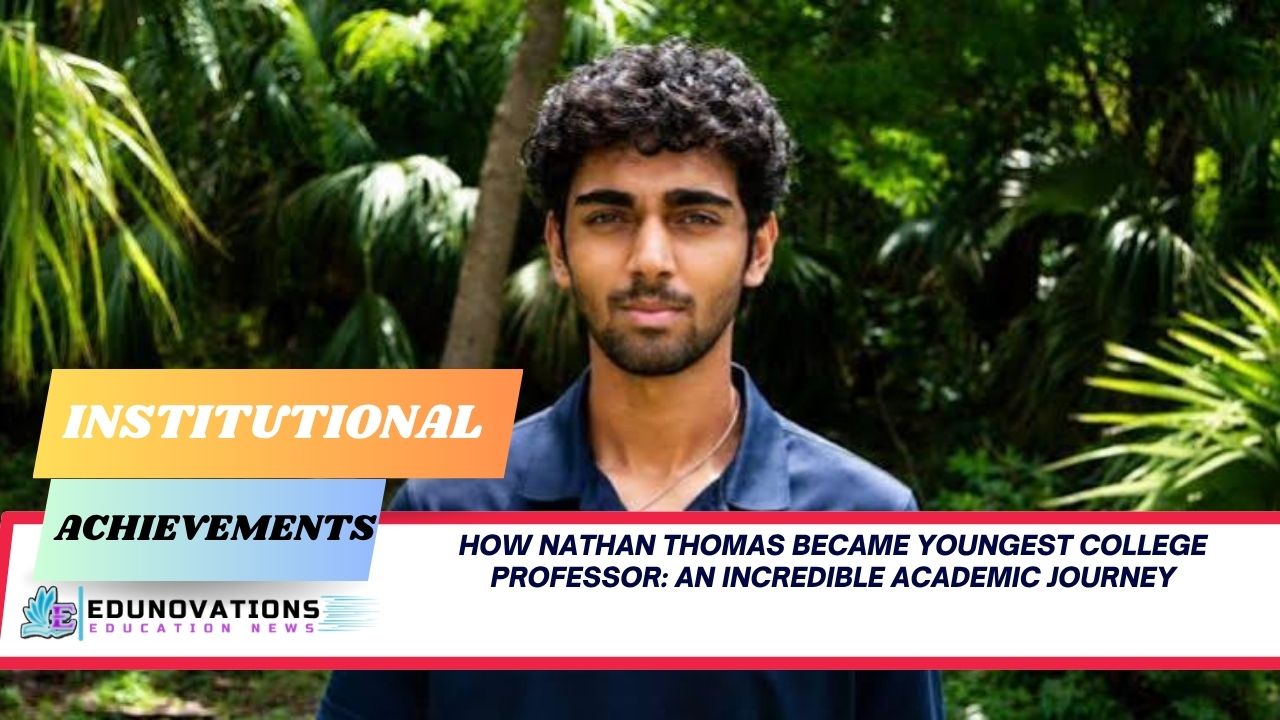
Every generation redefines the boundaries of human potential, pushing the envelope of what young minds can achieve when nurtured in the right environment. In a monumental achievement that has sent ripples through the academic world, Nathan Thomas has officially been recognized by Guinness World Records as the world’s youngest male college professor. At just 18 years and 346 days old when he began teaching his first official course at Miami Dade College, he shattered a record held by a 19-year-old for over 306 years. This incredible milestone is not merely a testament to raw intellect, but a profound reflection of non-traditional homeschooling, structured project-based learning, and an unwavering family commitment to holistic child development.
For educators, parents, and academic institutions, the story of how nathan thomas became youngest college professor offers a fascinating blueprint into how early identification of giftedness can be guided without sacrificing emotional maturity or social development. Let us dive deep into the extraordinary life, educational framework, and inspiring path of this young academic prodigy.
The Breakthrough: Breaking a 306-Year-Old Guinness Record
Official recognition from Guinness World Records is no small feat. Nathan Thomas earned this distinguished title after stepping into the lecture hall at Miami Dade College’s Wolfson Campus. He was teaching courses while managing a schedule that would intimidate seasoned educators. What makes this feat even more remarkable is the historical context: the previous record of a 19-year-old professor had stood unchallenged for over three centuries.
When reflecting on his entry into academia, Nathan has often spoken about the initial anxieties of stepping in front of a lecture hall full of students who were, in many cases, older than him or closer to his age. Earning respect in an academic environment typically requires decades of experience, research publications, and classroom hours. Yet, Nathan bridged that gap through deep subject mastery, clear communication, and a calm, professional demeanor that immediately commanded respect from his students.
Early Signs of Exceptional Intelligence and Early Challenges
Nathan’s academic trajectory began long before he stepped onto a college campus. Entering kindergarten, standardized tests revealed that he was already operating at a third-grade learning level. Recognizing his advanced capabilities, school administrators placed him into a first-grade gifted class. However, this initial transition exposed a common dilemma faced by gifted children: the friction between intellectual advancement and emotional alignment.
While Nathan could comfortably write complex sentences while his peers were still learning the alphabet, emotionally he struggled to fit in. He wanted to blend in with children his own age, and the visible gap caused social discomfort. Sensing that the traditional public school environment was doing a disservice to his holistic growth, school counselors advised his mother, Merlyn Rani Thomas, to explore alternative educational avenues.
Following this advice, his parents pulled him out of standard public schooling and transitioned him into homeschooling—a pivotal turning point that shaped how nathan thomas became youngest college professor today.
The Homeschooling Revolution: Project-Based and Real-World Learning
Traditional classrooms often rely on rigid, one-size-fits-all curricula that can either bore gifted students or overwhelm struggling learners. Recognizing this, Nathan’s parents implemented an innovative homeschooling structure. Rather than forcing him to sit at a desk for hours rote-learning textbooks, they adopted a project-based learning model.
Under this system, Nathan studied for no more than one to one and a half hours a day. The remaining hours were dedicated to experiential, real-world learning:
- Financial Literacy: Instead of reading about math and currency in a textbook, his family took him to local grocery stores and markets, giving him real money to manage transactions and calculate taxes in real time.
- Civic Education: Visits to local post offices and community centers taught him how large logistical and administrative systems operate.
- Social Integration: His parents placed an overwhelming emphasis on social activities. Nathan played competitive youth basketball far more hours than he spent studying, ensuring that his emotional intelligence and social skills developed in tandem with his cognitive abilities.
This tailored approach worked wonders. Four months after beginning homeschool, testing showed that Nathan had leaped two and a half to three grade levels ahead, proving the incredible efficacy of personalized education structures. For students and educators looking for specialized academic tracks and resources, exploring comprehensive digital learning platforms like NCERT Courses can provide structured pathways, while free downloadable modules are available via Downloads of Free NCERT PDFs.
Higher Education Milestones: From Miami Dade to Florida International University
Nathan’s transition into higher education happened at an age when most children are barely entering high school. At just 10 years old, he began dual enrollment at Miami Dade College. His journey through higher education progressed at a blistering pace:
- High School & Associate Degree: By age 14, Nathan had successfully earned both his high school diploma and an Associate Degree in Mathematics.
- Bachelor’s Degree: He advanced to Florida International University, completing his Bachelor’s degree at the tender age of 16.
- Master’s Degree: He secured his Master’s degree in Electrical Engineering at 18 years old.
His family’s academic streak didn’t stop with him; his younger brother, Noah, followed closely in his footsteps, even breaking some of Nathan’s early college graduation records by a matter of months. This family dynamic highlights how supportive domestic environments cultivate intellectual fearlessness. For those tracking academic updates and competitive exam milestones, keeping an eye on Current Affairs is essential.
Balancing Academia, Gap Years, and Law School
After earning his master’s degree in electrical engineering, Nathan chose to take a two-year gap before diving straight into further professional studies. During this break, he focused on enjoying life, spending time with friends, and pursuing personal interests. However, his driven personality meant he could not stay idle for long.
During these gap years, teaching blossomed organically. He began teaching online courses, eventually leading to his historic faculty role at Miami Dade College. Demonstrating incredible versatility, Nathan continued teaching online during his first year of law school at the University of Miami School of Law, before stepping away from active professorial duties to focus fully on his rigorous second-year legal studies.
For students preparing for competitive exams or advanced academic research, utilizing specialized study aids such as Notes, practicing MCQ’s, engaging with structured Videos, reviewing official Syllabus, and integrating visual learning tools like NCERT Mind Maps can dramatically streamline the learning curve. Furthermore, educational institutions seeking robust digital infrastructure often partner with technology leaders like Mart Ind Infotech to build modern e-learning ecosystems.
Expert Insights and Statistical Perspectives on Gifted Education
Educational psychologists and child development experts frequently point to prodigies like Nathan Thomas to emphasize the importance of flexibility in modern educational systems. According to recent educational studies:
- The Gifted Dropout Rate: Up to 20% of gifted students underachieve or drop out in traditional school environments due to lack of intellectual stimulation and engagement.
- Project-Based Retention: Studies show that experiential and project-based learning improves long-term concept retention by up to 75% compared to passive lecture formats.
- Emotional Balance: Experts maintain that children accelerated in academic environments require intentional social-emotional support, mirroring the basketball and community engagement prioritized by Nathan’s mother, Merlyn Rani Thomas.
As education continues to evolve in the digital age, the integration of flexible online courses, targeted micro-learning, and supportive institutional frameworks will remain critical in discovering and nurturing future prodigies.
Toppers Use Mind Maps to score more than 95%
NCERT Class 11th Commerce Mind Maps
Add to cartOriginal price was: ₹999.00.₹199.00Current price is: ₹199.00.NCERT Class 12th Chemistry Mind Maps
Add to cartOriginal price was: ₹199.00.₹75.00Current price is: ₹75.00.NCERT Class 12th Commerce Mind Maps
Add to cartOriginal price was: ₹999.00.₹199.00Current price is: ₹199.00.NCERT Class 12th Science Mind Maps
Add to cartOriginal price was: ₹999.00.₹199.00Current price is: ₹199.00.NCERT Mind Maps For Class 10th
Add to cartOriginal price was: ₹999.00.₹199.00Current price is: ₹199.00.
Purchase Today
Frequently Asked Questions (FAQs)
1. How did Nathan Thomas become the youngest college professor?
Nathan Thomas earned this title by completing his higher education at an accelerated pace through homeschooling and dual enrollment, eventually securing a teaching position at Miami Dade College and receiving certification from Guinness World Records at 18 years and 346 days old.
2. What homeschooling methods were used for gifted children in this case?
His family utilized project-based learning, real-world practical experiences, short and focused daily study sessions, and an equal emphasis on social activities like basketball and community interaction.
3. Which institution recognized Nathan Thomas as a college professor?
Miami Dade College served as the institution where he taught his historic courses, while Guinness World Records officially certified his record-breaking achievement.
4. What degrees did Nathan Thomas earn before teaching?
Before becoming a professor, he earned an Associate Degree in Mathematics by age 14, a Bachelor’s degree from Florida International University at age 16, and a Master’s degree in Electrical Engineering at age 18.
5. How old was Nathan Thomas when he started dual enrollment?
Nathan began his dual enrollment journey at Miami Dade College when he was only 10 years old.
6. What record did Nathan Thomas break?
He broke the record for the youngest male college professor, surpassing a 19-year-old record holder who had held the title for over 306 years.
7. What is Nathan Thomas studying now?
After completing his engineering master’s degree and teaching for a period, Nathan enrolled at the University of Miami School of Law to pursue a law degree.
8. How did his family handle the social challenges of being a child prodigy?
His parents actively prioritized social integration, ensuring he spent ample time playing sports, interacting with friends, and engaging in community activities rather than focusing solely on academics.
9. What role did Merlyn Rani Thomas play in her son’s education?
His mother recognized early on that traditional public schooling was causing emotional discomfort, advocated for his switch to homeschooling, and designed an environment that balanced academics with real-world social experiences.
10. Why is project-based learning effective for gifted students?
Project-based learning connects abstract academic concepts to real-world applications, reducing burnout, encouraging curiosity, and allowing accelerated students to progress at a pace that matches their cognitive capabilities.