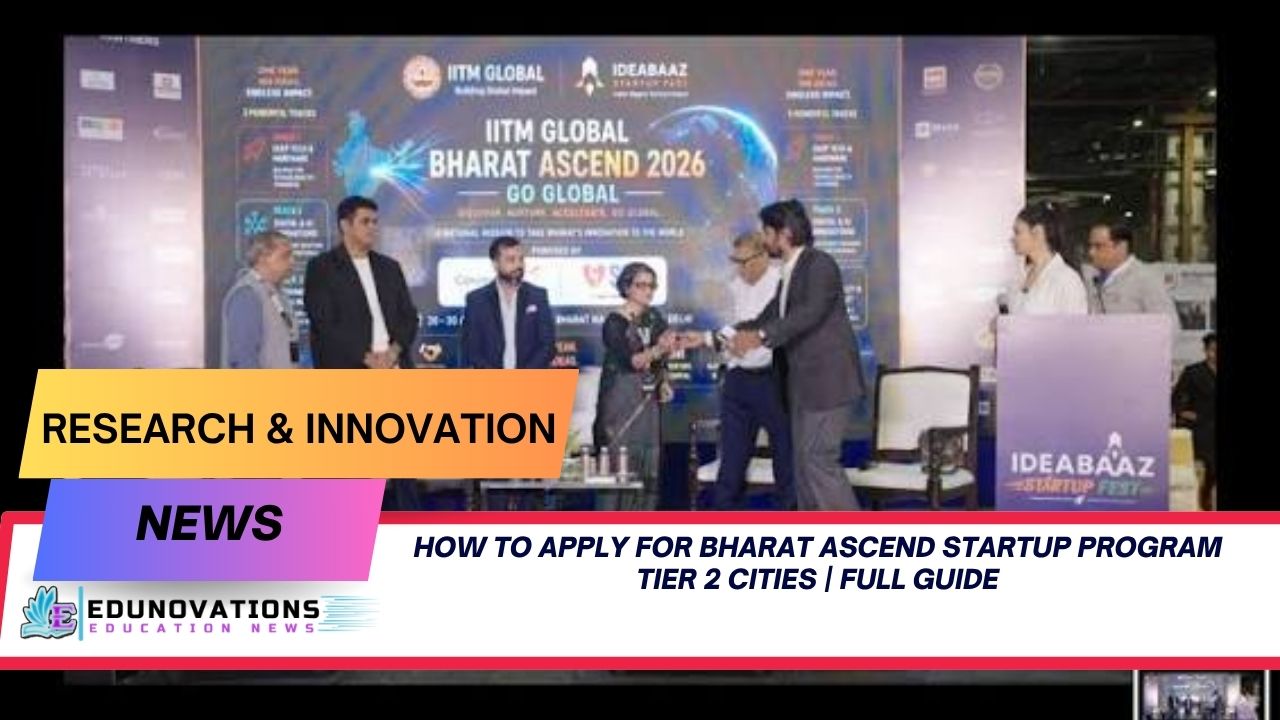
Learn how to apply for Bharat Ascend startup program tier 2 cities, a national mission by IIT Madras Global and Ideabaaz driving Viksit Bharat 2047.
|                    BHARAT ASCEND 5-STAGE LIFECYCLE                      |
+-------------------------------------------------------------------------+
|  1. DISCOVER     -> Identify 100 raw innovations across Tier-2/3 cities |
|  2. NURTURE      -> Validate & mentor 50 selected high-potential ideas   |
|  3. ACCELERATE   -> Build 25 Minimum Viable Products (MVPs)             |
|  4. EMPOWER      -> Execute 15 real-world pilots & customer validations  |
|  5. IMPACT       -> Scale 10 investor-ready ventures & 5+ global exits |
+-------------------------------------------------------------------------+
The mission targets 100 innovations during its inaugural year, funneling them through five structured checkpoints:
- Idea Discovery (100 Projects): Uncovering early-stage concepts across non-traditional startup hubs via academic networks, regional innovation centers, and digital outreach.
- Mentorship & Validation (50 Projects): Delivering rigorous technical and commercial validation from IIT Madras faculty, deep-tech specialists, and seasoned entrepreneurs.
- Prototyping & MVP Creation (25 Solutions): Supplying engineering support, lab testing access, and infrastructure to build robust Minimum Viable Products.
- Real-World Pilot Testing (15 Ventures): Deploying functional prototypes into active test markets, regional business environments, or government testbeds for validation.
- Investment & Global Expansion (10+ Ventures): Connecting fully validated startups with early-stage venture funds, domestic angel networks, and international trade corridors. At least 5 ventures will be connected directly with global corporate partners.
Understanding how to apply for bharat ascend startup program tier 2 cities requires candidate teams to align their business plans with these specific progression metrics. If you are preparing detailed business proposals or competitive exams, utilizing structured Notes can refine your strategic planning and comprehension.
Bridging the Access Gap for Small Town Founders
A major structural vulnerability in India’s technology ecosystem has been the discovery gap. While capital and incubators abound in Tier-1 cities, talented engineers in smaller districts often lack access to specialized prototyping equipment, IP filings, and domain mentorship.
Prof. Preeti Aghalayam highlighted that India’s growth story relies on expanding bridges between domestic talent and international opportunities. By linking regional innovators with IIT Madras’ extensive global research setup, startups are empowered to build locally while engineering for global adoption. Similarly, Mr. Thirumalai Madhavnarayan noted that the primary focus remains measurable impact—focusing on customer acquisition, functional pilot deployments, and venture funding over vanity metrics.
Furthermore, Mr. Mudit Kumar explained that Ideabaaz was established to bridge the exposure gap. Combining media reach with structured technical mentoring ensures that location no longer dictates the trajectory of a ground-breaking idea. Founders looking to leverage iit madras startup incubator opportunities for small town founders gain access to world-class laboratory equipment, cleanrooms, and testing facilities through IITM Global’s extensive institutional backing.
For academic institutions or regional incubator centers seeking to build modern digital portals to showcase their regional innovation hubs, specialized web development agencies like Mart Ind Infotech offer comprehensive custom web solutions tailored for educational and corporate growth.
Key Focus Sectors Driving National Value
The mission invites solutions addressing critical economic, societal, and technological bottlenecks. Selected startups receive sector-specific mentorship tailored to domestic conditions and international standards.
+--------------------------------------------------------------------------+
|                      TARGET INNOVATION SECTORS                           |
+--------------------------------------------------------------------------+
| [AgriTech]      -> Precision farming, supply chain & cold storage        |
| [HealthTech]    -> Remote diagnostics, affordable medical devices         |
| [CleanTech]     -> Renewable energy, water treatment & waste recycling   |
| [Mobility]      -> Electric vehicle components & smart logistics         |
| [Deep Tech]     -> AI, robotics, advanced materials & semiconductor engineering |
| [FinTech]       -> Rural financial inclusion & micro-merchant tools        |
+--------------------------------------------------------------------------+
1. Sustainable Agriculture and Rural Supply Chains
Agricultural technology remains vital for regional economies. Innovations optimizing cold-chain logistics, soil diagnostics, autonomous farming equipment, and precision irrigation help smallholder farmers boost yields and reduce post-harvest losses.
2. Healthcare Accessibility and Medical Devices
Remotely operated diagnostic kits, portable health monitors, and AI-driven screening applications bridge the urban-rural healthcare gap. Innovators receive direct support from deep-tech specialized centers, learning how ideabaaz helps tier 3 entrepreneurs get seed funding while validating medical prototypes under regulatory standards.
3. Clean Energy, Climate, and Water Mobility
Developing low-cost water purification units, localized solar grids, and battery management components for electric two- and three-wheelers directly advances national sustainability goals.
4. Advanced Manufacturing and Deep Technology
Starting from semiconductor packaging to industrial automation and robotics, the program provides access to advanced central facilities, enabling founders to engineer physical hardware solutions alongside software.
Founders and engineering candidates seeking to evaluate their technical knowledge across these domains can test their core concepts using targeted self-assessment sets like MCQ’s or visualize complex scientific workflows with detailed NCERT Mind Maps.
Comprehensive Step-by-Step Application Roadmap
To maximize the probability of selection into national innovation programs, prospective founding teams must follow a disciplined preparation methodology.
+-------------------------------------------------------------------------+
|                 STEP-BY-STEP APPLICATION WORKFLOW                       |
+-------------------------------------------------------------------------+
| STEP 1: Problem Definition  -> Identify clear regional/industry bottleneck |
| STEP 2: Proof of Concept    -> Develop initial technical architecture     |
| STEP 3: Ecosystem Pitch     -> Detail scalable economics & pilot plan     |
| STEP 4: Portal Submission   -> Submit application via Bharat Ascend Hub   |
| STEP 5: Technical Defense   -> Present before IITM & Ideabaaz Panel       |
+-------------------------------------------------------------------------+
Step 1: Clearly Define a High-Impact Problem Statement
Your submission should articulate a well-defined bottleneck in key sectors such as agriculture, manufacturing, healthcare, or energy. Demonstrate deep familiarity with the problem landscape, particularly as it manifests in Tier-2 and Tier-3 environments.
Step 2: Establish Technical Feasibility
Demonstrate that your proposed solution goes beyond speculative ideas. Present basic lab testing data, initial software architecture, or low-cost physical prototypes to prove technical viability.
Step 3: Map Out Sustainable Economics and Scalability
Outline how your business model will transition from local deployment to multi-state or international markets. Understanding best startup acceleration grants for deeptech innovations in india helps founders combine non-dilutive research funding with early equity capital.
Step 4: Submit via Official Ecosystem Channels
Complete the official application forms provided through the joint IITM Global and Ideabaaz portals. Ensure all founder credentials, patent documentation, and video demonstrations are uploaded systematically.
Step 5: Prepare for Technical and Commercial Panel Reviews
Shortlisted teams present before a combined evaluation panel consisting of IIT Madras faculty, industry veterans, and venture capitalists. Be prepared to defend your technical IP, unit economics, and target execution milestones.
To complement written applications with visual conceptual clarity, founders and technical teams can review interactive educational modules available via Videos.
Industry Collaboration & The Road to Viksit Bharat @2047
The ultimate ambition of national missions like Bharat Ascend extends beyond incubating individual enterprises; it focuses on building a self-sustaining ecosystem. Achieving national economic goals requires active participation from multiple stakeholders:
- Corporate Partners: Providing early pilot environments, corporate venture capital, and acting as first customers for enterprise solutions.
- Academic Institutions: Serving as regional discovery engines where students convert academic research into commercial applications.
- Venture Capitalists & Angel Networks: Supplying follow-on growth capital to scale validated prototypes into sustainable enterprises.
- Policy & Regional Governance: Streamlining local regulatory approvals, granting access to public infrastructure, and setting up incubation testbeds.
By orchestrating these components into a unified model, national initiatives ensure that geographical location no longer limits entrepreneurial success. Mastering how to build a market ready prototype for viksit bharat 2047 enables young Indian founders to lead technological advancement, creating solutions that serve domestic needs while scaling globally.
Toppers Use Mind Maps to score more than 95%
NCERT Class 11th Commerce Mind Maps
Add to cartOriginal price was: ₹999.00.₹199.00Current price is: ₹199.00.NCERT Class 12th Chemistry Mind Maps
Add to cartOriginal price was: ₹199.00.₹75.00Current price is: ₹75.00.NCERT Class 12th Commerce Mind Maps
Add to cartOriginal price was: ₹999.00.₹199.00Current price is: ₹199.00.NCERT Class 12th Science Mind Maps
Add to cartOriginal price was: ₹999.00.₹199.00Current price is: ₹199.00.NCERT Mind Maps For Class 10th
Add to cartOriginal price was: ₹999.00.₹199.00Current price is: ₹199.00.



Purchase Today
Frequently Asked Questions (FAQs)
1. How to apply for bharat ascend startup program tier 2 cities online?
Founders can apply by visiting the official program portals hosted by IIT Madras Global and Ideabaaz during open call rounds. Candidates submit project documentation, technical specs, and a short video demonstration explaining their problem statement and target market.
2. What are the main eligibility criteria for small-town innovators under this initiative?
The program primarily seeks early-stage founders, student innovators, and research teams located in Tier-2, Tier-3, or rural regions across India. Projects must address real-world challenges across sectors like agriculture, healthcare, deep tech, clean energy, or manufacturing.
3. How ideabaaz helps tier 3 entrepreneurs get seed funding during the mission?
Ideabaaz uses its media-integrated platform to showcase promising startups directly to angel investors, corporate venture funds, and national mentors. This visibility is paired with technical validation from IITM Global, making early-stage ventures investment-ready.
4. Are there iit madras startup incubator opportunities for small town founders who lack a physical prototype?
Yes. The program is specifically structured into five stages—Discover, Nurture, Accelerate, Empower, and Impact. Promising early concepts selected during the Discover phase receive technical guidance and lab access to build their initial functional prototype.
5. What makes the best startup acceleration grants for deeptech innovations in india different from general startup funds?
Deep-tech grants provide non-dilutive capital, extended incubation timelines, and specialized laboratory access tailored for hardware, biotech, or advanced materials development, whereas general accelerators focus primarily on rapid software scaling.
6. How to build a market ready prototype for viksit bharat 2047 with academic support?
Founders can collaborate with research institutions like IIT Madras to access specialized testing equipment, faculty mentorship, and validation frameworks, ensuring their prototype meets industry safety, regulatory, and commercial standards.
7. Does the program require equity dilution from early-stage founders?
In initial validation and incubation phases, non-dilutive grants, mentorship, and prototyping access are provided. Commercial equity investments occur later when startups match with participating venture networks or angel investors.
8. Can college students from rural technical institutes apply for this national initiative?
Yes. Colleges and regional universities are encouraged to act as regional discovery hubs, allowing student engineers to turn final-year research projects into commercial enterprises.
9. What specific deep-tech sectors are prioritized under the mission?
Priority sectors include Artificial Intelligence, advanced manufacturing, agricultural machinery, remote healthcare devices, clean energy storage, water purification, and smart mobility solutions.
10. How does international market scaling work for selected startups?
Through IITM Global’s international network, top-performing startups connect with foreign corporate partners, global trade corridors, and overseas pilot programs to launch their products internationally.