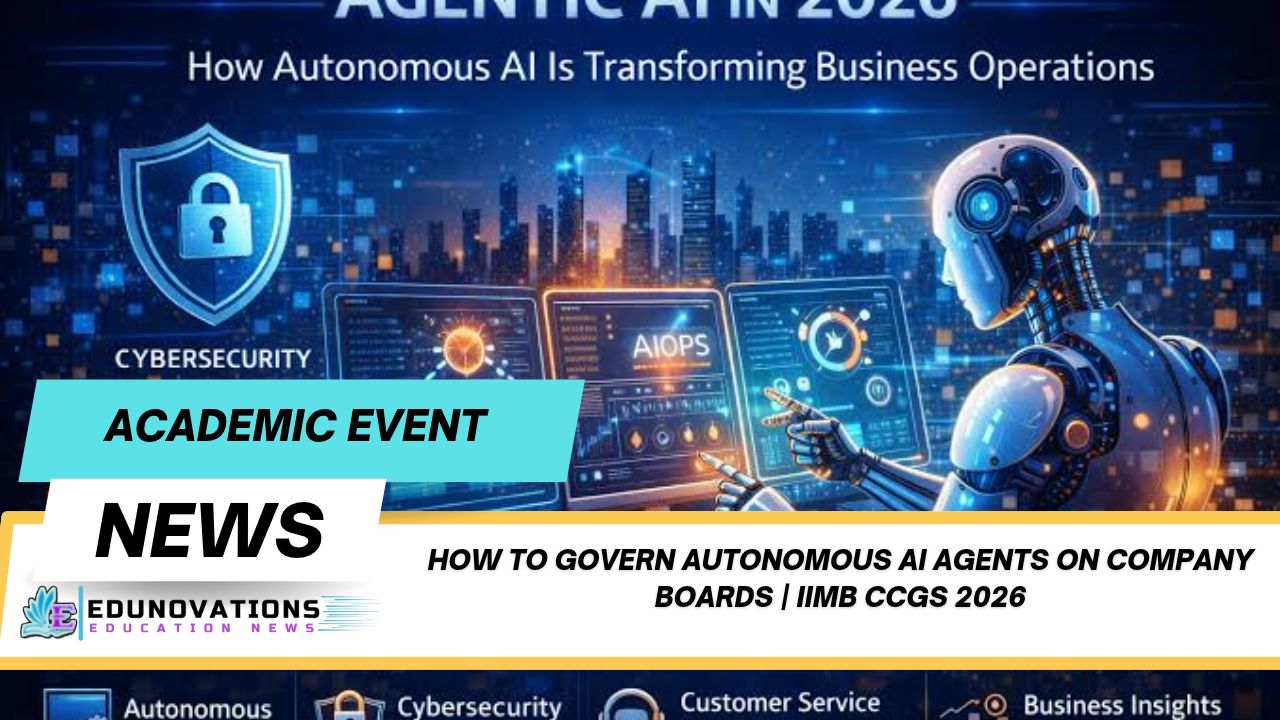
Discover how to govern autonomous AI agents on company boards as leaders at IIM Bangalore’s CCGS conference warn boards to look past compliance toward lasting trust.
How to Govern Autonomous AI Agents on Company Boards: IIMB Leaders Sound Alarm on Longevity
When technology moves faster than boardroom rules, organizations face a quiet test of character: will the enterprise still stand—and still command public trust—two decades from now? That urgent question anchored the inauguration of the International Conference on Corporate Governance & Sustainability at the Indian Institute of Management Bangalore on November 20, 2026. Hosted by IIMB’s Centre for Corporate Governance & Sustainability (CCGS), the two-day gathering brought together academics, corporate leaders, and policymakers to examine how rapid artificial intelligence adoption, geopolitical friction, supply-chain strain, and sustainability mandates are reshaping modern stewardship.
For newer and lower-authority digital publishers, students of management, and corporate observers tracking India’s governance debate, the conference offered more than academic theory. Speakers challenged boards to rethink how to govern autonomous AI agents on company boards, move past routine regulatory checklists, and confront human biases that reward short-term wins over durable institutional health. As business leaders debate how to govern autonomous AI agents on company boards, the Bengaluru forum highlighted why accountability must remain anchored in human judgment rather than automated code or external vendors.
Why Governance Must Look Beyond Compliance Checkboxes
Too often, corporate boards treat governance as a defensive exercise designed to satisfy statutory filings, audit trails, and minimum legal thresholds. At the opening of the CCGS conference, Kris Gopalakrishnan, Co-Founder of Infosys and Chairman of Axilor Ventures, pushed back against that narrow view. Framing institutional longevity as the clearest benchmark of enterprise success, Gopalakrishnan asked a deceptively simple question: whether a company will still exist—and still be trusted—twenty years down the line.
In his keynote address on AI, Governance and the Board, Kris Gopalakrishnan argued that durable enterprises rest on three interconnected pillars:
- Long-term value creation driven by predictable, profitable growth rather than one-off windfalls.
- Stakeholder trust earned through fairness, transparency, and consistent integrity across market cycles.
- Adaptive capacity powered by values-led innovation when markets, technologies, or regulations shift.
Governance, Gopalakrishnan noted, turns those ambitions from chance into routine. Without strong governance structures, success can look like luck; with them, discipline becomes a habit. That distinction carries added weight for organizations learning how to govern autonomous AI agents on company boards, where speed and automation can easily outpace oversight.
Two Decades of CCGS and Shifting Macro Pressures
Welcoming delegates from academia, industry, and policy, Prof. Padmini Srinivasan, Chairperson of CCGS and faculty member in the Finance & Accounting area at IIM Bangalore, noted that boards today operate amid a dense convergence of pressures. Geopolitical disruptions, fragile supply chains, accelerating digital tools, environmental sustainability requirements, and vocal stakeholder activism are colliding all at once.
Prof. Padmini Srinivasan also reminded participants of the Centre’s twenty-year journey, built on the foundational work of the late Prof. N. Balasubramanian, whose research and teaching shaped generations of governance scholars and practitioners in India. Alongside Prof. Padmini Srinivasan and Kris Gopalakrishnan, the inaugural lineup featured Prof. Sourav Mukherji, Dean of Faculty at IIM Bangalore; Prof. Sanjay G Kallapur, faculty member in Accounting at the Indian School of Business (ISB); and Soumitra Bhattacharya, Chairman and Non-Executive Director at Bosch Limited and a member of the CCGS Advisory Committee.
Moving From AI Pilots to Measurable Transformation
Across boardrooms in 2025 and 2026, artificial intelligence has shifted from an experimental novelty to an operational layer embedded in workflows, customer service, coding, and financial analysis. Yet launching dozens of pilot projects does not automatically translate into durable competitive strength.
Kris Gopalakrishnan urged executives and directors to change their yardstick: boards should measure transformation, not mere AI adoption. Counting pilots or announcing experiments tells stakeholders very little about whether the company is building stronger strategy, defensible intellectual property, cleaner data foundations, higher productivity, safety, trust, innovation, and operational resilience.
Recent governance data underscores how uneven board readiness remains even among large corporations. Analysis of S&P 500 boardrooms cited in 2026 research shows that while roughly two-thirds of companies have at least one non-executive director with AI skills, only about a quarter have three or more, and formal model inventories with clear ownership and validation protocols are still works in progress across many firms. For organizations deciding how to govern autonomous AI agents on company boards, closing that literacy gap is no longer optional.
Breaking Down Siloes Across Board Committees
One of the clearest warnings from Kris Gopalakrishnan was against isolating AI oversight inside a single technical committee or IT department. Because artificial intelligence touches enterprise risk, internal audit, technology architecture, executive compensation, and nomination decisions, treating it as a siloed project leaves blind spots.
Directors need boardroom fluency—not necessarily to write code, but to ask sharp, informed questions, test claims with independent evidence, demand validation, and ensure named executives remain personally accountable for outcomes. When something goes wrong, accountability cannot be allowed to dissolve into a third-party model, a software vendor, or an automated system.
Students, researchers, and aspirants following business policy and current events can explore structured learning resources—including Current Affairs, Notes, MCQ’s, and Syllabus—to connect real-world corporate developments with foundational management concepts.
Controls and Guardrails for Autonomous AI Agents
The sharpest operational shift highlighted at the conference involves autonomous AI agents—systems capable of executing multi-step tasks, making decisions, or interacting with workflows with varying degrees of independence. When companies debate how to govern autonomous AI agents on company boards, the core trap is anthropomorphizing software or assuming automation equals autonomy from responsibility.
Kris Gopalakrishnan emphasized that organizations must treat autonomous AI agents as delegated actors inside a controlled system, never as accountable persons. A software agent cannot bear legal, ethical, or fiduciary blame; human leaders do.
Essential Guardrails Every Delegation Needs
To keep delegated systems safe and auditable, Kris Gopalakrishnan outlined six non-negotiable controls for every delegation of authority:
- An identifiable human owner who holds clear responsibility for the agent’s actions and outcomes.
- Clearly defined scope and permissions specifying exactly what data the agent can access and what actions it is allowed to take.
- Strict operating limits that cap financial exposure, transaction size, frequency, or blast radius.
- Comprehensive activity logs that record decisions, inputs, and outputs for auditability and root-cause analysis.
- Continuous monitoring to detect drift, anomalies, errors, or unintended side effects in real time.
- A reliable human override so operators or supervisors can intervene or halt execution immediately when needed.
Industry governance research published in 2026 reinforces this focus on human supervision, showing that requiring separate human review in higher-risk scenarios remains the top safeguard cited by executives, while data risks, regulatory compliance, and execution risks top board agendas. Knowing how to govern autonomous AI agents on company boards starts with putting these exact guardrails in place before scaling autonomy.
Overcoming Short-Termism to Protect Longevity
Even with strong technical guardrails, boards face a deeper behavioral hurdle: human beings and corporate incentive structures often favor immediate, visible rewards over uncertain, long-term payoffs.
In his address on organizational design, Prof. Sourav Mukherji examined why institutions frequently struggle to look far ahead. Drawing on the classic organizational tension between exploitation (refining existing operations for predictable near-term returns) and exploration (investing in new capabilities whose payoff is uncertain and distant), Prof. Sourav Mukherji observed that companies naturally lean toward exploitation.
Why Human Instincts Favor Immediate Gains
Prof. Sourav Mukherji pointed out that human biology is wired to respond to incentives that are tangible, certain, immediate, and personal. Because organizations are rarely engineered to counter that instinct—and people are not naturally predisposed toward distant horizons—short-termism creeps into strategy and capital allocation.
He also raised questions about the purpose of the firm itself: whether businesses exist solely to maximize short-term profit, or whether customer and employee welfare must shape how value is created. Turning to rapid advances in AI, including the prospect of recursive self-improvement, Prof. Sourav Mukherji noted growing warnings among researchers about severe or even catastrophic risks, arguing that preventing exponential harms requires early global attention before warning signs become irreversible.
In his framing, effective governance acts as a vital counterweight so that society (samaj), the state (sarkar), and markets (bazaar) do not rush headlong toward avoidable harm. Meanwhile, Prof. Sanjay G Kallapur of the Indian School of Business examined practical realities and blind spots in corporate governance research and boardroom practice, adding a rigorous empirical lens to the discussion.
Balancing Sustainability Costs and Stakeholder Trust
Sustainability remains central to that long-term equation, yet Prof. Padmini Srinivasan noted that environmental initiatives often run into immediate cost pressures that can slow or deter corporate action. Balancing upfront transition expenses against long-term resilience tests whether boards truly view sustainability as a core strategic asset rather than a public-relations exercise.
For institutions, schools, and digital platforms building modern online ecosystems, clear structure and trustworthy information architecture matter just as much as offline governance—for instance, organizations looking to launch or upgrade educational portals can explore Mart Ind Infotech for school website development services, while learners can access NCERT Courses, Videos, Free NCERT PDFs, and NCERT Mind Maps for structured study support.
Ultimately, the message emerging from Kris Gopalakrishnan, Prof. Padmini Srinivasan, Prof. Sourav Mukherji, Prof. Sanjay G Kallapur, and Soumitra Bhattacharya at the IIMB-CCGS conference is clear: how to govern autonomous AI agents on company boards is inseparable from broader questions of ethics, accountability, and institutional durability. When leaders govern innovation wisely, protect stakeholder trust, and resist short-term blind spots, they give their organizations the best chance to thrive decades into the future.
Toppers Use Mind Maps to score more than 95%
-
NCERT Class 11th Commerce Mind Maps
Add to cartOriginal price was: ₹999.00.₹199.00Current price is: ₹199.00. -
NCERT Class 12th Chemistry Mind Maps
Add to cartOriginal price was: ₹199.00.₹75.00Current price is: ₹75.00. -
NCERT Class 12th Commerce Mind Maps
Add to cartOriginal price was: ₹999.00.₹199.00Current price is: ₹199.00. -
NCERT Class 12th Science Mind Maps
Add to cartOriginal price was: ₹999.00.₹199.00Current price is: ₹199.00. -
NCERT Mind Maps For Class 10th
Add to cartOriginal price was: ₹999.00.₹199.00Current price is: ₹199.00.



Purchase Today
Frequently Asked Questions (FAQs)
1. How to govern autonomous AI agents on company boards effectively?
Boards should treat autonomous AI agents as delegated system actors with a named human owner, strict scope and permissions, operating limits, audit logs, active monitoring, and a human override rather than granting unchecked autonomy.
2. Why did Kris Gopalakrishnan say corporate governance is about 20-year longevity?
Kris Gopalakrishnan emphasized that governance is not merely about compliance; it helps determine whether a company remains viable and trusted 20 years from now by supporting long-term value creation, stakeholder trust, and adaptability.
3. What is the difference between AI adoption and AI transformation on a board agenda?
Counting AI pilots reflects initial adoption, whereas AI transformation measures whether AI genuinely strengthens strategy, intellectual property, data quality, productivity, safety, trust, innovation, and resilience.
4. Why should board committees avoid working in siloes on AI governance?
Because AI impacts audit, risk management, technology, executive pay, and leadership succession, siloed oversight creates blind spots and weakens enterprise-wide accountability.
5. What role did Prof. Padmini Srinivasan highlight for AI and sustainability governance?
Prof. Padmini Srinivasan highlighted risks around algorithmic bias, privacy, employment, overreliance, and accountability in AI alongside cost pressures that can challenge environmental sustainability priorities.
6. How does corporate short-termism affect long-term organizational resilience?
Short-termism pushes leaders toward immediate, certain payoffs from existing operations while underinvesting in long-term innovation, risk mitigation, and stakeholder well-being.
7. Why did Prof. Sourav Mukherji warn about human bias toward immediate rewards?
Prof. Sourav Mukherji noted that people naturally respond to tangible, certain, immediate, and personal incentives, which makes deliberate governance essential to prioritize long-term outcomes.
8. Who must stay accountable when autonomous AI systems make operational errors?
Named human executives and board oversight structures must retain accountability so responsibility is never shifted away onto models, software vendors, or automated agents.
9. What governance themes were discussed at the 2026 IIMB-CCGS conference?
Speakers at IIM Bangalore’s Centre for Corporate Governance & Sustainability discussed AI accountability, boardroom oversight, autonomous AI agents, sustainability costs, geopolitical and supply-chain risks, and organizational design.
10. How can boards build stronger AI literacy among directors?
Directors can build AI literacy by asking informed questions, challenging unverified claims, requiring independent validation, and ensuring clear ownership across executive leadership.