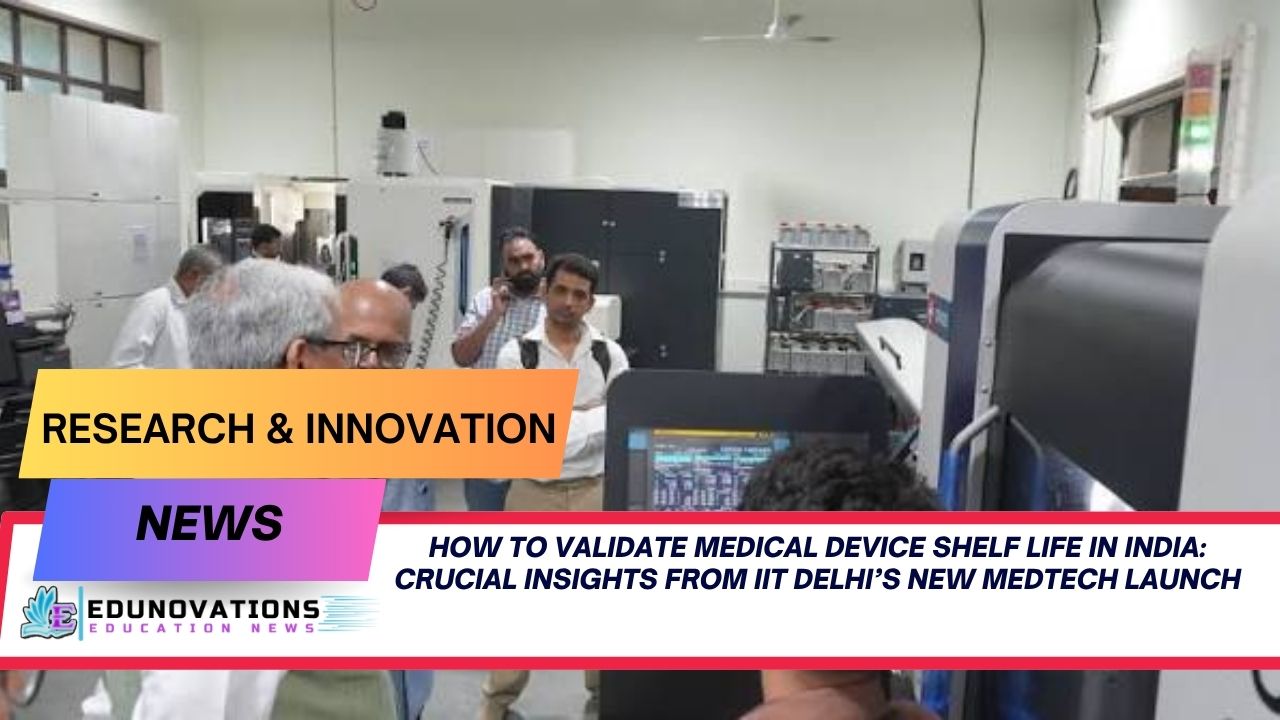
Wondering how to validate medical device shelf life in India? Discover crucial insights from IIT Delhi’s newly inaugurated mPragati lab, shaping the future of indigenous biomedical device manufacturing and regulatory compliance.
Revolutionizing Indian Healthcare: How IIT Delhi’s Groundbreaking New mPragati Labs Are Accelerating MedTech Self-Reliance
The landscape of biomedical innovation in India is undergoing a monumental shift. As healthcare demands grow increasingly complex, the domestic medical device sector has historically grappled with an acute challenge: bridging the massive gap between laboratory prototypes and scalable, market-ready, clinically validated products. In a major stride toward national self-reliance, the Indian Institute of Technology Delhi (IIT Delhi) has officially inaugurated a state-of-the-art Computer Numerical Control (CNC) and Sterilization & Packaging lab at its national translational platform, mPragati.
Unveiled by Dr. Rajiv Bahl, Secretary to the Government of India, Department of Health Research, and Director General of the Indian Council of Medical Research (ICMR), this dual-facility infrastructure is engineered to transform how domestic manufacturers navigate production, testing, and regulatory landscapes. For biomedical engineers, researchers, and healthcare entrepreneurs looking at the technicalities of bringing an item to market, understanding the rigorous compliance protocols—specifically how to validate medical device shelf life in india—remains the absolute bedrock of commercial success.
A Monumental Leap for India’s MedTech Ecosystem
India’s medical technology sector has traditionally been heavily reliant on imports, particularly for high-precision components, surgical tools, and advanced implants. The newly established facilities at mPragati aim to dismantle this dependence by creating an end-to-end pathway for indigenous development.
Speaking at the inauguration ceremony, Dr. Rajiv Bahl emphasized the critical intersection of academic engineering and medical execution. “True medical innovation cannot happen in isolation,” Dr. Bahl noted during his address to scientists and faculty. “By establishing a dedicated, centralized space for high-precision prototyping alongside rigorous biological and sterility testing, we are ensuring that Indian scientists can take a design from a digital blueprint all the way to a certified, patient-ready product. This initiative directly accelerates our national healthcare priorities by lowering costs and elevating global quality standards.”
The ceremony was attended by key visionaries, including Dr. Suchita Markan, Head of Innovation and Translation Research at ICMR; Prof. Rangan Banerjee, Director of IIT Delhi; Prof. Ashwini Agrawal, Dean of R&D; Prof. Manidipa Banerjee, Head of the Central Research Facility (CRF); and Prof. Dinesh Kalyanasundaram, Coordinator of mPragati. This high-level alignment highlights the strategic national importance of the facility, positioning it as a core driver for the Atmanirbhar Bharat (Self-Reliant India) vision in advanced healthcare.
High-Precision Engineering: Advanced Manufacturing for Implants
The newly unveiled CNC facility focuses heavily on providing high-precision machining services that have long been a bottleneck for domestic medical startups. Equipped with multi-axis machining tools, high-speed milling systems, and Swiss-type turning apparatuses, the lab is built to handle complex geometries required by modern medical treatments.
The CNC hub specializes in handling certified, biocompatible materials to manufacture:
- Customized orthopedic and patient-specific bone implants.
- Highly intricate surgical instruments and dental devices.
- Next-generation diagnostic hardware components and microfluidic chips.
By bridging this critical gap in the domestic value chain, the facility reduces structural turnaround times. Instead of sending designs abroad for prototyping, researchers can now iterate rapidly within a controlled environment, ensuring that intellectual property remains secure while minimizing development costs.
Demystifying Compliance: The Science of Longevity and Packaging
While creating a physical prototype is an achievement, a medical device is practically useless without stringent regulatory clearance. The Sterilization & Packaging Facility at mPragati is explicitly designed to handle these exact parameters, offering an integrated framework for the development, validation, and secure sealing of biomedical products.
When introducing a new product to the market, a primary obstacle that developers face is establishing a predictable expiration matrix. Knowing how to validate medical device shelf life in india requires extensive testing under accelerated and real-time environmental conditions. The mPragati facility addresses this by housing advanced stability chambers specifically designed for reagent and product shelf-life validation.
Understanding the Validation Matrix
To successfully validate a device’s shelf life within the framework of Indian regulatory bodies like the Central Drugs Standard Control Organisation (CDSCO), manufacturers must analyze how environmental stress impacts both the product and its packaging over time. The testing ecosystem at IIT Delhi provides an exhaustive array of tools to ensure this compliance:
- Sterilization Infrastructure: The lab utilizes cutting-edge Ethylene Oxide (EtO) systems and advanced steam autoclaves to ensure absolute sterility assurance without compromising material integrity.
- Environmental Micro-Climates: Stability chambers mimic extreme humidity and temperature variations, allowing engineers to track real-time degradation of chemical reagents and physical polymers.
- Structural Sealing and Tracking: Precision device assembly workstations work alongside secure vacuum packaging networks, integrated with automated batch coding and high-precision laser marking systems to preserve complete product traceability.
Advanced Molecular and Biological Testing Infrastructure
Complementing the mechanical and environmental packaging systems is an incredibly robust analytical testing suite. To ensure absolute biocompatibility and safety before human trials, the laboratory integrates an array of complex molecular tools.
The testing architecture includes real-time PCR systems, thermal cyclers, and Trans-Blot systems alongside gel electrophoresis equipment. For deeper biological validation, researchers have access to high-speed ultracentrifuges, High-Performance Liquid Chromatography (HPLC), CO₂ incubators, and specialized fluorescence microscopy. This allows for rigorous mammalian cell culture testing, ensuring that any device machined in the neighboring CNC room meets the highest non-toxic, non-pyrogenic standards.
Strategic Academic Integration and National Impact
The inauguration of these labs at IIT Delhi also presents a significant learning opportunity for the academic community. Medical technology engineering requires an interdisciplinary understanding of physics, biology, and materials science. Students pursuing advanced research can easily supplement their foundational studies by observing these real-world translational ecosystems in action.
For students looking to build a career in these expanding scientific domains, utilizing comprehensive educational resources is vital. Aspiring engineers can review core scientific concepts through specialized portals like For NCERT Courses or stay abreast of macro-economic changes in healthcare via For Current Affairs. Accessing structural academic frameworks like For Notes or evaluating technical proficiency via For MCQ’s can further refine foundational analytical skills. Visual learners can benefit from targeted educational material found at For Videos, while tracking comprehensive engineering curricula is made simpler by monitoring updates For Syllabus. Furthermore, academic foundations can be enhanced through the For Downloads of Free NCERT PDFs utility and structural conceptual tracking available at For NCERT Mind Maps.
As institutions like IIT Delhi establish these capital-intensive hubs, the surrounding ecosystem of schools, incubation cells, and local manufacturing facilities must also upgrade their technical infrastructure. For educational organizations aiming to develop modern digital footprints to showcase their labs or coordinate research schedules, collaborating with established web engineering firms like Mart Ind Infotech provides the necessary technical foundation to manage these multi-tiered communication requirements.
The Path Forward for India’s MedTech Industry
According to recent industrial market analyses, India’s medical devices market is expected to reach billions of dollars by the end of the decade, growing at a compounding annual rate of over 15%. However, sustainable growth is impossible if the country remains reliant on overseas facilities for basic testing and precision manufacturing.
By establishing a centralized, state-backed node that combines precision engineering, biological validation, and sterilization under one roof, mPragati is fundamentally shortening the time-to-market for life-saving technologies. It shifts the paradigm from simple academic research to high-impact commercial translation. For an industry striving to establish global trust, mastering precision systems and knowing how to validate medical device shelf life in india will dictate which companies lead the next generation of global healthcare delivery.
Toppers Use Mind Maps to score more than 95%
NCERT Class 11th Commerce Mind Maps
Add to cartOriginal price was: ₹999.00.₹199.00Current price is: ₹199.00.NCERT Class 12th Chemistry Mind Maps
Add to cartOriginal price was: ₹199.00.₹75.00Current price is: ₹75.00.NCERT Class 12th Commerce Mind Maps
Add to cartOriginal price was: ₹999.00.₹199.00Current price is: ₹199.00.NCERT Class 12th Science Mind Maps
Add to cartOriginal price was: ₹999.00.₹199.00Current price is: ₹199.00.NCERT Mind Maps For Class 10th
Add to cartOriginal price was: ₹999.00.₹199.00Current price is: ₹199.00.





Purchase Today
Frequently Asked Questions (FAQs)
1. How to validate medical device shelf life in india using the new mPragati facilities?
The mPragati facility features specialized environmental stability chambers that subject medical devices and diagnostic reagents to controlled temperature and humidity stresses. This allows manufacturers to gather data on accelerated aging and real-time degradation to satisfy CDSCO regulatory guidelines.
2. What makes biocompatible cnc machining for medical implants unique at IIT Delhi?
Unlike standard industrial machining, biocompatible cnc machining for medical implants utilizes multi-axis Swiss-type turning and high-speed milling explicitly calibrated for medical-grade metals and polymers, ensuring no cross-contamination occurs during the fabrication of surgical or dental implants.
3. What are the core medical device sterilization validation guidelines icmr supports?
The medical device sterilization validation guidelines icmr promotes focus on absolute sterility assurance levels (SAL). The facility utilizes validated Ethylene Oxide (EtO) and steam autoclave systems paired with biological indicators to ensure devices are completely free of viable microorganisms.
4. How can startups utilize indigenous medical device manufacturing platforms india has established?
Startups can collaborate with national hubs like mPragati at IIT Delhi to gain access to cost-effective, state-of-the-art infrastructure. These indigenous medical device manufacturing platforms india offers help small enterprises avoid heavy initial capital expenditure on testing and prototyping machinery.
5. What is mpragati iit delhi medtech facility’s primary objective?
The primary goal of the what is mpragati iit delhi medtech facility initiative is to act as a national translational platform. It bridges the gap between raw laboratory innovation and market-ready commercialization for high-end medical devices and molecular diagnostics.
6. Why is packaging validation crucial when learning how to validate medical device shelf life in india?
Packaging validation ensures that the sterile barrier protecting a device remains completely intact throughout its stated lifespan. Without proper vacuum sealing, laser marking, and batch tracking tested under simulated transport stress, a device cannot safely pass Indian regulatory validation.
7. What types of materials are processed via biocompatible cnc machining for medical implants?
This specialized manufacturing methodology primarily processes certified bio-stable and bio-resorbable materials, including titanium alloys, cobalt-chromium, medical-grade stainless steel, and specialized polymers like PEEK (Polyether ether ketone).
8. Does mPragati assist with regulatory adherence beyond medical device sterilization validation guidelines icmr protocols?
Yes. Beyond sterility metrics, the facility’s comprehensive biological testing infrastructure—including real-time PCR, HPLC, and mammalian cell culture suites—helps developers gather data for full biological validation and global quality compliance.
9. Who can access these indigenous medical device manufacturing platforms india is launching?
These platforms are designed for an open ecosystem, supporting academic researchers, clinical scientists, independent biomedical engineers, and commercial MedTech startups looking to transition prototypes into scalable products.
10. Where can I find complete technical specifications regarding what is mpragati iit delhi medtech facility?
Detailed technical capabilities, equipment lists (such as the stability chambers, autoclaves, and multi-axis CNC machines), and collaboration guidelines can be reviewed through the official Indian Institute of Technology Delhi research and R&D portals.