In an era where fiscal discipline, accountability, and robust governance dictate the trajectory of national growth, institutional interventions are more crucial than ever.
In an era where fiscal discipline, accountability, and robust governance dictate the trajectory of national growth, institutional interventions are more crucial than ever. Recently, a major milestone was achieved when the premier accounting body of the country stepped forward to bridge the gap between technical accounting standards and legislative decision-making. If you are looking to brush up on your core subjects while keeping track of such vital national developments, you can easily explore comprehensive learning tools like NCERT Courses or stay ahead of the curve with regular updates on Current Affairs.
Understanding the Landscape of Public Financial Management
Public financial management (PFM) forms the bedrock of any functioning democracy. When taxpayer money is allocated, managed, and audited transparently, public trust deepens, and welfare schemes yield maximum outputs. However, bridging the gap between legislative policy-making and meticulous financial accounting has historically been a challenge. Legislators draft laws, pass budgets, and oversee execution, but deep-diving into the numbers requires specialized domain knowledge.
Recognizing this dynamic, the Institute of Chartered Accountants of India (ICAI), through its Public Relations Committee, organized a groundbreaking initiative. The ICAI public financial management workshop West Bengal MLAs emerged as a pioneering endeavor designed to equip newly elected representatives with the financial acumen necessary for modern legislative oversight.
To understand these institutional mechanisms thoroughly, students and researchers can delve deeper using structured study material available via Notes or test their knowledge through practice platforms like MCQ’s. For visual learners, conceptual breakdowns can also be explored through educational Videos.
Inside the Historic Workshop: Bridging Policy and Accounting
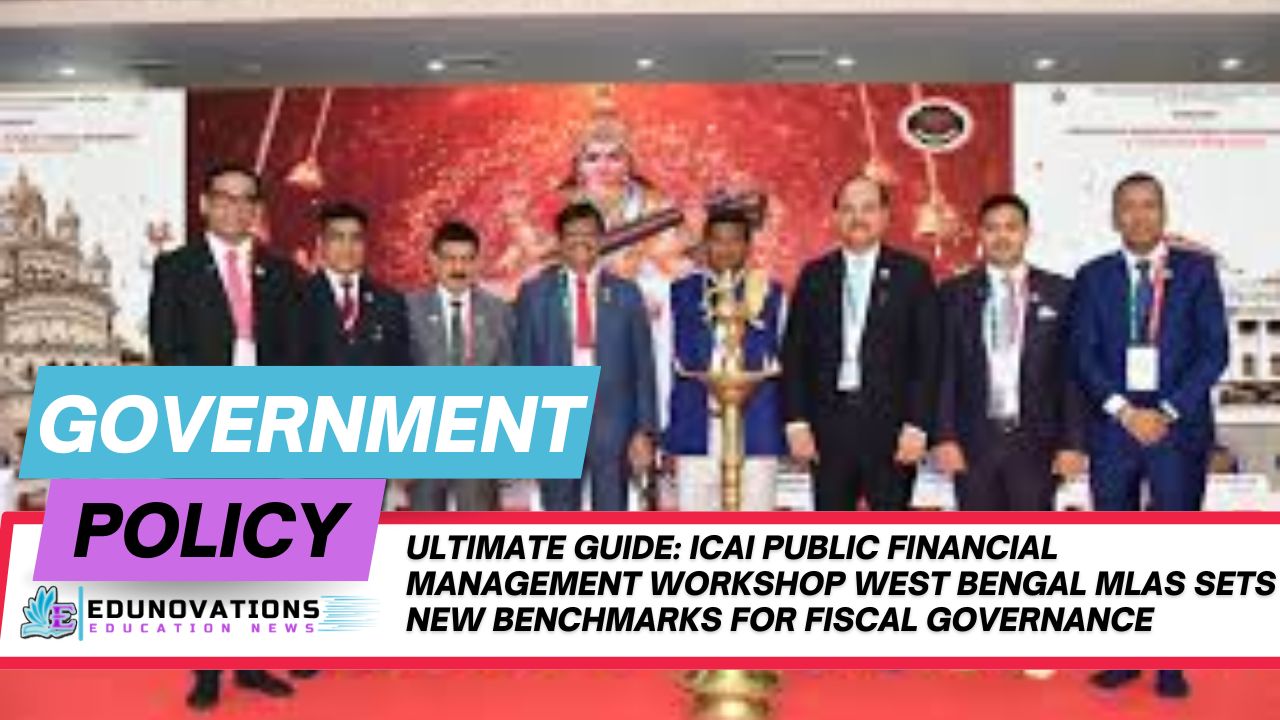
The one-day specialized workshop, titled “Strengthening Governance in Public Financial Management: A Legislative Perspective,” was hosted at the prestigious ICAI Centre of Excellence in Kolkata. Designed specifically for the Honorable Members of the Legislative Assembly of West Bengal, the program gathered over 200 newly elected MLAs under one roof.
The core objective was straightforward yet ambitious: to demystify public finance, budget analysis, and governmental accounting for lawmakers. When legislators understand how balance sheets, audit reports, and fiscal allocations interact, they can hold executive bodies more accountable. This directly aligns with the broader institutional objectives seen in various competitive curriculums and educational Syllabus structures across India.
Key Highlights of the Legislative Training Module
- Demystifying Budgets: Breaking down complex macroeconomic data into actionable local insights.
- Fiscal Responsibility: Training attendees on debt management, deficit control, and sustainable state expenditure.
- Legislative Oversight: Enhancing the role of committees in tracking public fund allocation and preventing leakages.
- Auditing and Compliance: Familiarizing lawmakers with Comptroller and Auditor General (CAG) reports and internal audit findings.
Visionary Insights and Dignitary Remarks
No major institutional reform or workshop succeeds without high-level administrative backing and visionary leadership. The event witnessed a powerful coming together of political leadership and financial experts.
The inaugural session was graced by the Honorable Chief Minister of West Bengal, Shri Suvendu Adhikari, who served as the Chief Guest, alongside Shri Rathindra Bose, the Honorable Speaker of the Legislative Assembly of West Bengal, serving as the Guest of Honour.
In his keynote address, Chief Minister Shri Suvendu Adhikari emphasized that transparency in spending is the cornerstone of effective regional development. He noted:
“A state progresses only when every single rupee of public money reaches the grassroots efficiently. Equipping our legislators with financial literacy is not just an administrative upgrade; it is a direct investment in the democratic integrity of West Bengal.”
Echoing this sentiment, CA. Prasanna Kumar D, President of ICAI, highlighted the broader national vision during the event. He stated:
“As a trusted partner in nation-building, ICAI is working closely with the government to fulfil the Hon’ble Prime Minister’s vision of a Viksit Bharat by 2047. There is a strategic necessity of strengthening financial reporting and public financial management across all tiers of government—including local bodies. These workshops are instrumental in ensuring efficient expenditure and the optimal utilization of public funds for our citizens.”
Such large-scale administrative transformations require digital infrastructure and systemic tracking, mirroring how modern institutions leverage tech solutions. For organizations seeking robust digital transformation and backend support, consulting professional technology partners like Mart Ind Infotech can streamline institutional operations.
Why Financial Literacy Matters for Lawmakers
Why must lawmakers undergo specialized accounting orientation? Historically, financial management was viewed strictly as the domain of bureaucrats, finance secretaries, and chartered accountants. However, modern governance demands that elected representatives look beyond political rhetoric and engage deeply with financial data.
- Informed Decision-Making: When an MLA understands deficit financing and expenditure metrics, they can prioritize developmental projects more scientifically.
- Combating Corruption: Financial literacy acts as a natural deterrent to financial malpractices and fiscal leakages.
- Optimizing Local Body Funds: With local governance tiers handling massive central and state grants, monitoring execution at the grass-root level has become paramount.
For students and competitive exam aspirants who wish to study these governance models comprehensively, structured resources like Downloads of Free NCERT PDFs and analytical NCERT Mind Maps offer invaluable structural clarity.
The Broader Context: ICAI’s Role in National Development
The Institute of Chartered Accountants of India is not just a professional examining body; it is a statutory institution established under the Chartered Accountants Act, 1949. Functioning under the administrative supervision of the Ministry of Corporate Affairs, ICAI represents a massive global workforce of over 4.67 lakh members and 12.32 lakh students.
Through initiatives like the Kolkata workshop, ICAI continues to extend its technical expertise beyond corporate boardrooms and into the halls of legislative governance. By training lawmakers, ICAI ensures that fiscal discipline permeates from the top policy-making tiers down to municipal and rural local bodies.
Toppers Use Mind Maps to score more than 95%
NCERT Class 11th Commerce Mind Maps
Add to cartOriginal price was: ₹999.00.₹199.00Current price is: ₹199.00.NCERT Class 12th Chemistry Mind Maps
Add to cartOriginal price was: ₹199.00.₹75.00Current price is: ₹75.00.NCERT Class 12th Commerce Mind Maps
Add to cartOriginal price was: ₹999.00.₹199.00Current price is: ₹199.00.NCERT Class 12th Science Mind Maps
Add to cartOriginal price was: ₹999.00.₹199.00Current price is: ₹199.00.NCERT Mind Maps For Class 10th
Add to cartOriginal price was: ₹999.00.₹199.00Current price is: ₹199.00.





Purchase Today
Frequently Asked Questions (FAQs)
1. What was the main objective of the ICAI public financial management workshop West Bengal MLAs?
The primary objective was to enhance the financial understanding, fiscal governance, and legislative oversight capabilities of newly elected West Bengal MLAs to ensure better utilization of public funds.
2. Who were the key dignitaries present at the ICAI governance workshop in Kolkata?
The inaugural session featured the Honorable Chief Minister of West Bengal, Shri Suvendu Adhikari, as the Chief Guest, and Shri Rathindra Bose, Honorable Speaker of the West Bengal Legislative Assembly, as the Guest of Honour.
3. How does the ICAI training program for West Bengal legislators financial governance help ordinary citizens?
By training lawmakers to analyze budgets and manage fiscal responsibilities efficiently, the workshop helps prevent fund leakages, ensuring that public welfare schemes and infrastructure projects are executed transparently.
4. What specific topics were covered during the public financial management workshop ICAI Kolkata August 2026?
The curriculum covered budget analysis, government accounting, fiscal discipline, debt management, and the vital role of legislative oversight in public administration.
5. Who is CA. Prasanna Kumar D and what did he state regarding Viksit Bharat?
CA. Prasanna Kumar D is the President of ICAI. He stated that ICAI is working closely with the government to fulfill the Prime Minister’s vision of a Viksit Bharat by 2047 through improved financial reporting and public financial management.
6. Where was the specialized legislative financial training program conducted?
The workshop was conducted at the ICAI Centre of Excellence located in Kolkata, West Bengal.
7. How many participants attended the ICAI initiative for public financial management in state assembly?
Over 200 newly elected Members of the Legislative Assembly (MLAs) from West Bengal participated in and benefited from this first-of-its-kind training initiative.
8. What is the significance of the strengthening public financial management legislative perspective ICAI initiative?
It bridges the gap between technical accounting practices and legislative policy formulation, enabling lawmakers to make data-backed, financially sound decisions.
9. Under which act is the Institute of Chartered Accountants of India (ICAI) established?
ICAI is a statutory body established by an Act of Parliament under the Chartered Accountants Act, 1949, functioning under the Ministry of Corporate Affairs, Government of India.
10. Why is early financial literacy essential for modern elected representatives?
Financial literacy empowers legislators to critically examine state budgets, track expenditures, evaluate audit reports, and ensure optimal resource allocation for public welfare.