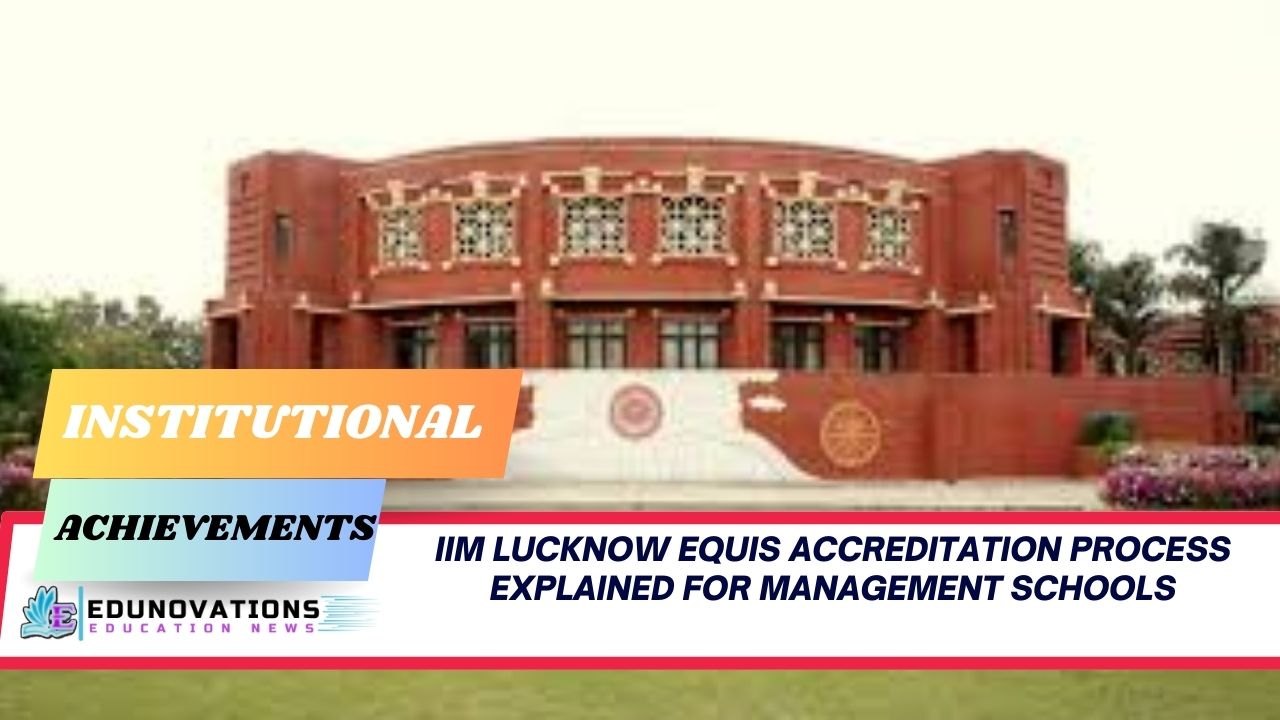
IIM Lucknow EQUIS accreditation process explained for management schools, its benefits, global impact, EFMD evaluation criteria, and what it means for Indian MBA education.
Indian Institute of Management Lucknow has achieved a landmark global recognition, placing Indian management education on an elite international pedestal. The IIM Lucknow EQUIS accreditation process explained for management schools offers crucial insight into how a rigorous international quality framework evaluates academic excellence, governance, ethics, internationalisation, and industry relevance.
The recognition by the European Foundation for Management Development (EFMD) through its prestigious EQUIS (EFMD Quality Improvement System) accreditation is not just a badge of honour for IIM Lucknow. It reflects the institute’s sustained commitment to global benchmarks in teaching, research, leadership, innovation, and societal impact.
Globally, fewer than one percent of business schools hold EQUIS accreditation. In India, only a handful of elite institutions have crossed this demanding threshold. With this recognition, IIM Lucknow joins an exclusive league of globally respected management schools, strengthening India’s academic reputation in international business education ecosystems.
Understanding the Global Significance of EQUIS Accreditation
The EQUIS framework is widely regarded as one of the most comprehensive and demanding accreditation systems for business schools worldwide. It evaluates institutions holistically rather than focusing only on individual programs.
The IIM Lucknow EQUIS accreditation process explained for management schools highlights how EQUIS goes beyond curriculum assessment and examines:
- Strategic governance and leadership
- Internationalisation of faculty, students, and curriculum
- Research quality and global impact
- Corporate engagement and industry relevance
- Ethics, responsibility, and sustainability
- Innovation, entrepreneurship, and future readiness
Unlike national accreditations, EQUIS places strong emphasis on global competitiveness, ensuring that graduates are prepared for international leadership roles.
Why IIM Lucknow’s EQUIS Accreditation Matters for Indian Education
IIM Lucknow’s achievement sends a powerful signal about the rising global stature of Indian management institutions. The IIM Lucknow EQUIS accreditation process explained for management schools demonstrates how Indian B-schools can compete with leading institutions in Europe, North America, and Asia.
This accreditation strengthens India’s position in the global MBA market by:
- Enhancing international student and faculty mobility
- Improving global employer recognition of Indian MBA graduates
- Encouraging international academic collaborations
- Promoting globally relevant research output
For aspirants preparing through structured academic resources such as NCERT-aligned courses or current affairs platforms, global recognitions like EQUIS reinforce the importance of quality-driven education pathways. Learners can explore foundational concepts through https://courses.edunovations.com/ and stay updated via https://edunovations.com/currentaffairs/.
Inside the Rigorous Evaluation Journey
The EQUIS evaluation typically spans 12 to 24 months, involving multiple assessment stages. The IIM Lucknow EQUIS accreditation process explained for management schools sheds light on the depth of scrutiny institutions undergo before receiving approval.
Key phases include:
- Eligibility Assessment: Initial evaluation of institutional readiness
- Self-Assessment Report: Detailed institutional introspection covering all operational dimensions
- Peer Review Visit: International experts conduct on-site evaluations
- Accreditation Board Decision: Final approval based on global benchmarks
Each stage demands extensive documentation, evidence-based performance metrics, and long-term strategic clarity.
Leadership, Governance, and Strategic Vision
A defining feature of the IIM Lucknow EQUIS accreditation process explained for management schools is its strong focus on leadership and governance structures. EQUIS assesses whether institutional leadership demonstrates:
- Strategic foresight
- Transparent decision-making
- Academic autonomy
- Financial sustainability
IIM Lucknow’s governance model reflects a balance between academic independence and accountability, enabling it to respond effectively to global education trends while maintaining Indian contextual relevance.
Research Excellence and Academic Impact
Research plays a central role in EQUIS accreditation. Institutions are evaluated on the quality, consistency, and global relevance of scholarly output.
The IIM Lucknow EQUIS accreditation process explained for management schools reveals how the institute’s faculty research contributes to:
- International peer-reviewed journals
- Policy formulation and advisory roles
- Industry problem-solving
- Societal development initiatives
For students and educators accessing structured academic notes and resources, platforms like https://edunovations.com/notes/ support deeper understanding of research-driven learning frameworks.
Industry Engagement and Corporate Integration
EQUIS places strong emphasis on how institutions engage with industry. IIM Lucknow’s accreditation reflects its robust corporate partnerships, executive education programs, and consulting engagements.
The IIM Lucknow EQUIS accreditation process explained for management schools underscores the importance of:
- Curriculum co-created with industry leaders
- Live projects and experiential learning
- Corporate internships and placements
- Executive leadership development
Such integration ensures graduates remain industry-ready and globally employable.
Ethics, Sustainability, and Social Responsibility
Modern business education demands ethical leadership and sustainability consciousness. EQUIS evaluates whether institutions embed responsible management practices into teaching, research, and operations.
The IIM Lucknow EQUIS accreditation process explained for management schools highlights how ethics and sustainability are no longer optional but core evaluation pillars.
This aligns well with the growing emphasis on value-based education supported by academic syllabi and learning tools available at https://edunovations.com/syllabus/ and https://edunovations.com/mcq/.
Global Recognition and Internationalisation
Internationalisation is a cornerstone of EQUIS accreditation. IIM Lucknow’s achievement reflects its strong global engagement through:
- International student exchange programs
- Visiting international faculty
- Joint research initiatives
- Global case study development
The IIM Lucknow EQUIS accreditation process explained for management schools shows how global exposure enhances classroom diversity and prepares students for cross-border leadership roles.
Expert Insight: What Global Leaders Say About EQUIS
Professor Eric Cornuel, President of EFMD Global, has repeatedly emphasised that EQUIS accreditation recognises institutions that demonstrate “continuous improvement, global relevance, and responsible leadership.” His leadership at EFMD has shaped EQUIS into a benchmark of excellence worldwide.
Such endorsements reinforce the credibility of institutions like IIM Lucknow and validate the stringent nature of the IIM Lucknow EQUIS accreditation process explained for management schools.
Benefits for Students, Faculty, and Employers
EQUIS accreditation creates a multi-stakeholder advantage ecosystem:
For Students
- Enhanced global employability
- International academic exposure
- Higher degree credibility
For Faculty
- International research collaborations
- Global teaching opportunities
- Increased academic influence
For Employers
- Assurance of graduate quality
- Industry-aligned skill development
For aspirants preparing through digital learning resources and video explanations, https://edunovations.com/videos/ offers complementary academic support.
Strengthening Digital and Outreach Ecosystems
Global recognition also boosts institutional digital presence and outreach. Institutions often collaborate with technology and education service providers for enhanced engagement. For schools seeking digital infrastructure and outreach solutions, Mart Ind Infotech (https://www.martindiainfotech.com/) supports institutional digital transformation and student engagement platforms.
What This Means for Emerging Indian Management Institutes
The IIM Lucknow EQUIS accreditation process explained for management schools serves as a blueprint for emerging institutions aiming for global excellence. It demonstrates that long-term vision, academic rigor, ethical leadership, and international integration are essential for global recognition.
Future Outlook for Indian Business Education
With more Indian institutions aspiring for global accreditation, EQUIS recognition is expected to drive:
- Curriculum innovation
- International faculty hiring
- Cross-border academic collaborations
- Research-driven policy impact
This milestone positions India as a serious contributor to global management education thought leadership.
Toppers Use Mind Maps to score more than 95%
NCERT Class 11th Commerce Mind Maps
Add to cartOriginal price was: ₹999.00.₹199.00Current price is: ₹199.00.NCERT Class 12th Chemistry Mind Maps
Add to cartOriginal price was: ₹199.00.₹75.00Current price is: ₹75.00.NCERT Class 12th Commerce Mind Maps
Add to cartOriginal price was: ₹999.00.₹199.00Current price is: ₹199.00.NCERT Class 12th Science Mind Maps
Add to cartOriginal price was: ₹999.00.₹199.00Current price is: ₹199.00.NCERT Mind Maps For Class 10th
Add to cartOriginal price was: ₹999.00.₹199.00Current price is: ₹199.00.




Purchase Today
Frequently Asked Questions (FAQs)
1. What is the IIM Lucknow EQUIS accreditation process explained for management schools?
It is a comprehensive global evaluation by EFMD assessing governance, academics, research, ethics, and internationalisation.
2. Why is EQUIS accreditation important for Indian MBA institutions?
It validates global quality standards and enhances international recognition.
3. How long does the EQUIS accreditation process take?
Typically between 12 to 24 months depending on institutional readiness.
4. How many Indian institutes have EQUIS accreditation?
Only a limited number of elite Indian institutions have achieved this recognition.
5. Who awards EQUIS accreditation?
EQUIS is awarded by the European Foundation for Management Development (EFMD).
6. How does EQUIS differ from AACSB and AMBA?
EQUIS evaluates the institution holistically, while others focus on specific dimensions.
7. Does EQUIS accreditation improve student placements?
Yes, it enhances employer trust and global employability.
8. Can emerging institutes apply for EQUIS accreditation?
Yes, provided they meet EFMD eligibility and quality benchmarks.
9. How does EQUIS promote ethical management education?
It evaluates sustainability, ethics, and responsible leadership integration.
10. Why is the IIM Lucknow EQUIS accreditation process explained for management schools relevant today?
It sets a global roadmap for quality, accountability, and innovation in business education.