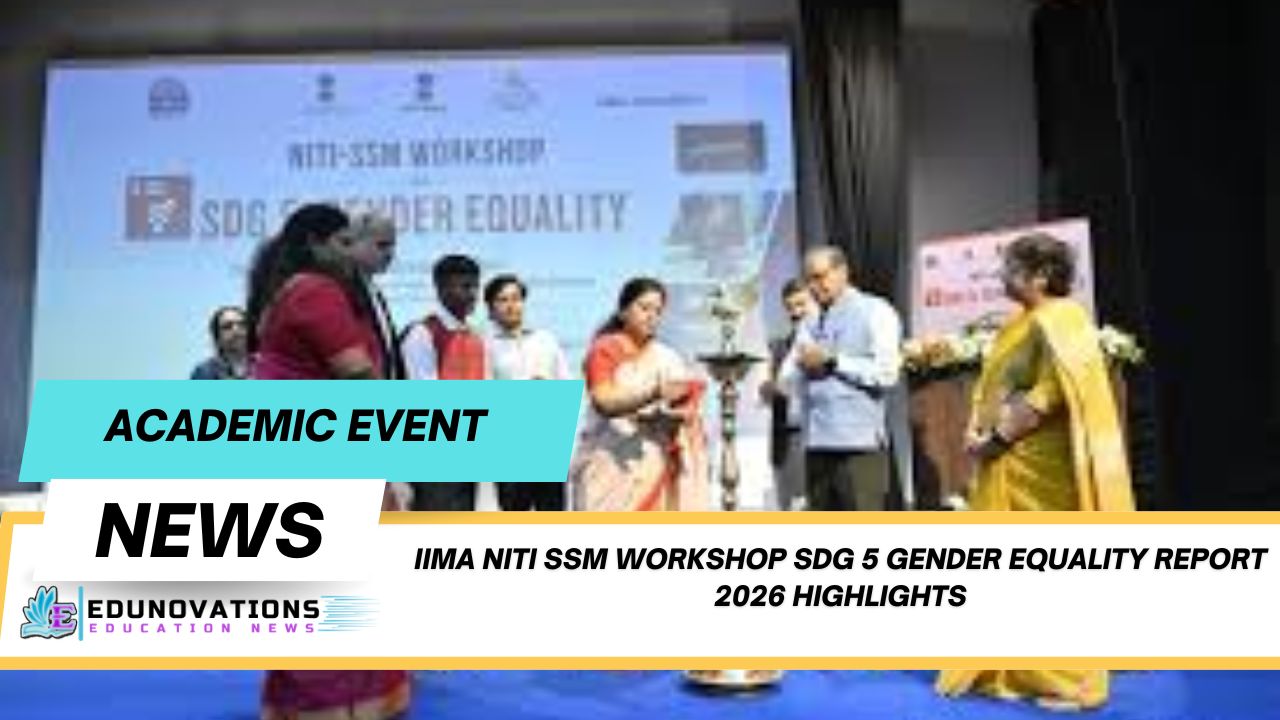
The iima niti ssm workshop sdg 5 gender equality report 2026 showcased key findings on women empowerment, workforce participation, and gender inclusion across India through expert discussions and policy insights.
IIMA Hosts Landmark Workshop on Gender Equality and Sustainable Development
The iima niti ssm workshop sdg 5 gender equality report 2026 has emerged as a significant milestone in India’s ongoing efforts toward achieving gender equality and inclusive development. Hosted by the prestigious Indian Institute of Management Ahmedabad, the event brought together policymakers, academicians, researchers, and development experts to discuss the status of Sustainable Development Goal 5 (SDG 5) in India.
The workshop, organized in collaboration with NITI State Support Mission (SSM), focused on women’s empowerment, gender parity, workforce participation, leadership representation, and social inclusion. The launch of the comprehensive report during the event highlighted both the progress India has made and the challenges that still remain in achieving equitable opportunities for women across sectors.
The iima niti ssm workshop sdg 5 gender equality report 2026 has generated considerable attention among education experts, civil society organizations, governance researchers, and policy institutions because it offers valuable district-level and state-level insights into gender indicators.
India’s commitment to the United Nations Sustainable Development Goals has accelerated in recent years, and SDG 5 remains one of the most important targets due to its direct impact on economic growth, social justice, and national development.
For students preparing for competitive examinations and policy studies, such discussions are highly relevant. Readers can also explore more educational resources through NCERT Courses and the latest Current Affairs Updates.
Why Gender Equality Remains a National Priority
Gender equality is not merely a social issue; it is an economic and developmental necessity. Experts participating in the workshop emphasized that empowering women can significantly improve economic productivity, health outcomes, educational attainment, and governance efficiency.
India has introduced several welfare initiatives over the past decade aimed at improving women’s participation in education, entrepreneurship, and public administration. However, gaps still exist in labor force participation, digital access, healthcare availability, and political representation.
The newly released report discussed at the event analyzed these concerns in detail. The findings revealed variations among states and districts, indicating that regional policy implementation remains uneven.
The iima niti ssm workshop sdg 5 gender equality report 2026 also emphasized the importance of localized governance strategies for sustainable improvement.
Key Highlights from the Report Launch Event
The workshop included panel discussions, presentations, expert talks, and data-driven policy recommendations. Researchers presented district-level statistics and gender indicators related to:
- Female literacy
- Workforce participation
- Maternal health
- Women’s political representation
- Access to education
- Financial inclusion
- Digital literacy among women
- Gender-based violence indicators
One of the most important themes discussed during the event was the need for data-backed policymaking. Experts noted that states with better education and health infrastructure tend to perform better in SDG 5 indicators.
The report launch also encouraged collaboration between government institutions, academic bodies, and private organizations to strengthen implementation frameworks.
The women empowerment district level sdg 5 report india discussion highlighted how district-specific data can help administrators design more targeted interventions.
Role of Academic Institutions in Social Development
Educational institutions are increasingly playing a major role in shaping public policy discussions in India. The involvement of IIMA demonstrates how management institutes can contribute beyond business education into social governance and developmental research.
Experts noted that universities and higher educational institutions can provide:
- Policy research support
- Data analytics
- Community engagement models
- Capacity-building initiatives
- Gender inclusion strategies
The gender equality workshop at iim ahmedabad 2026 became an important platform for interdisciplinary discussions connecting governance, economics, sociology, and public administration.
Institutions focusing on research-based policymaking are becoming central to India’s development agenda. Students interested in governance studies can access academic resources through NCERT Notes Platform and practice material through MCQs for Exams.
Women’s Workforce Participation Still a Challenge
One of the strongest observations made during the workshop was regarding India’s female labor force participation rate. Despite educational advancements, women continue to face barriers in entering and remaining in the workforce.
Several experts identified major factors contributing to this issue:
- Safety concerns
- Unequal pay structures
- Lack of childcare support
- Cultural barriers
- Limited leadership opportunities
- Digital divide
The women workforce participation report by iima gender centre discussed strategies for improving employment opportunities for women through skill development, entrepreneurship support, and workplace inclusion policies.
Experts also highlighted the importance of remote work opportunities and digital training in increasing women’s economic participation in rural and semi-urban areas.
State and District-Level Analysis Offers Valuable Insights
The report presented during the event focused heavily on regional analysis. Policymakers believe that district-level data allows governments to understand local challenges more effectively than national averages.
The niti aayog sdg 5 state and district report launch showcased comparative data among states and districts on multiple gender-related indicators.
Some states showed significant progress in:
- Female education
- Institutional healthcare access
- Political participation
- Financial literacy
However, several districts still lag behind in gender-sensitive development metrics.
Experts stressed that successful states could serve as models for others through knowledge-sharing initiatives and policy adaptation.
Expert Opinions Shared During the Workshop
Several prominent academicians and policy researchers shared their perspectives during the workshop.
Experts from governance institutions stated that achieving SDG 5 requires:
- Long-term political commitment
- Better funding allocation
- Grassroots awareness campaigns
- Improved monitoring systems
- Technology-enabled governance
Development researchers also pointed out that gender equality directly contributes to poverty reduction and economic resilience.
According to policy experts, increasing women’s workforce participation could substantially boost India’s GDP growth over the next decade.
The iima niti ssm workshop sdg 5 gender equality report 2026 therefore serves as a roadmap for future reforms and policy actions.
Importance of Data-Driven Governance
One of the workshop’s central themes was evidence-based policymaking. Participants emphasized that governments must rely on reliable data for planning and evaluation.
The report introduced detailed datasets that can help:
- Identify vulnerable regions
- Track policy effectiveness
- Improve resource allocation
- Measure social impact
- Enhance accountability
The women empowerment district level sdg 5 report india also recommended regular monitoring mechanisms and transparent public reporting systems.
Experts argued that data accessibility can strengthen citizen participation and encourage better governance outcomes.
India’s Progress Toward Sustainable Development Goal 5
India has made notable progress in several areas connected to SDG 5:
- Rising female literacy rates
- Increased girls’ school enrollment
- Expansion of self-help groups
- Better maternal healthcare access
- Growth in women-led entrepreneurship
However, experts at the workshop noted that deeper structural reforms are still needed.
The gender equality workshop at iim ahmedabad 2026 discussed how gender inclusion must be integrated into every policy sector including education, infrastructure, healthcare, finance, and technology.
Participants highlighted that achieving SDG 5 requires collaboration between:
- Government agencies
- Educational institutions
- Civil society organizations
- Corporate stakeholders
- Community groups
Technology and Digital Inclusion for Women
Another important topic discussed was digital empowerment. Experts noted that digital literacy has become essential for educational access, financial inclusion, and employment opportunities.
The report identified a persistent gender gap in internet access and digital device usage in several regions.
To address this challenge, experts recommended:
- Affordable internet connectivity
- Digital literacy campaigns
- Women-focused tech training
- Rural technology centers
- Online entrepreneurship support
The women workforce participation report by iima gender centre stressed that technology can become a transformative tool for women’s empowerment if implemented inclusively.
Readers interested in educational videos and digital learning resources may explore Educational Video Resources.
Role of Policy Innovation in Gender Inclusion
Policy innovation emerged as another major discussion point during the workshop. Experts suggested that conventional welfare approaches should evolve toward empowerment-focused strategies.
Recommended reforms included:
- Gender-responsive budgeting
- Flexible workplace policies
- Women entrepreneurship incentives
- Skill development programs
- Leadership training initiatives
The niti aayog sdg 5 state and district report launch also emphasized inter-state collaboration and knowledge exchange.
Experts believe India’s demographic and economic transformation will remain incomplete without strong female participation in leadership and governance.
Educational Awareness and Social Transformation
Participants highlighted that education remains the strongest tool for social transformation.
The workshop discussed the need for:
- Gender-sensitive school curricula
- Career guidance for girls
- STEM education promotion
- Scholarship expansion
- Safe educational environments
Academic experts also emphasized the importance of mentoring programs for young women.
The iima niti ssm workshop sdg 5 gender equality report 2026 underlined how education directly influences workforce participation, healthcare outcomes, and financial independence.
Students preparing for academic and competitive examinations can also access syllabus materials through Exam Syllabus Resources and free textbooks via Free NCERT PDF Downloads.
Corporate and Industry Participation
Private sector involvement was another important aspect discussed at the workshop. Industry leaders are increasingly recognizing the value of diversity and inclusion in organizational performance.
Experts recommended:
- Gender diversity hiring goals
- Equal pay frameworks
- Women leadership mentorship
- Inclusive workplace culture
- Flexible work arrangements
The women workforce participation report by iima gender centre highlighted how corporate participation can accelerate national gender equality goals.
External educational and institutional support services are also important for awareness outreach. Educational institutions can benefit from digital support services provided by Mart Ind Infotech.
International Context and SDG Commitments
India’s efforts toward SDG 5 are part of a larger global commitment under the United Nations Sustainable Development Goals framework.
Experts at the workshop compared India’s progress with global benchmarks and highlighted areas where improvement is still necessary.
Key concerns discussed included:
- Wage disparities
- Representation in leadership
- Access to healthcare
- Safety and legal protections
The women empowerment district level sdg 5 report india suggested that international best practices could help strengthen local implementation strategies.
Future Roadmap for Gender Equality in India
The workshop concluded with a strong emphasis on collaborative action and long-term planning.
Experts proposed:
- Stronger institutional coordination
- Better gender data systems
- Increased funding support
- Community-based implementation
- Youth engagement programs
The iima niti ssm workshop sdg 5 gender equality report 2026 is expected to influence future policy discussions and contribute to India’s broader development strategy.
As India moves toward becoming a major global economy, gender equality will remain central to sustainable and inclusive growth.
Toppers Use Mind Maps to score more than 95%
NCERT Class 11th Commerce Mind Maps
Add to cartOriginal price was: ₹999.00.₹199.00Current price is: ₹199.00.NCERT Class 12th Chemistry Mind Maps
Add to cartOriginal price was: ₹199.00.₹75.00Current price is: ₹75.00.NCERT Class 12th Commerce Mind Maps
Add to cartOriginal price was: ₹999.00.₹199.00Current price is: ₹199.00.NCERT Class 12th Science Mind Maps
Add to cartOriginal price was: ₹999.00.₹199.00Current price is: ₹199.00.NCERT Mind Maps For Class 10th
Add to cartOriginal price was: ₹999.00.₹199.00Current price is: ₹199.00.





Purchase Today
FAQs
1. What is the iima niti ssm workshop sdg 5 gender equality report 2026?
It is a policy-focused workshop and report launch hosted by IIMA discussing India’s progress toward Sustainable Development Goal 5 related to gender equality.
2. Why is the women empowerment district level sdg 5 report india important?
The report provides district-level gender data that helps policymakers create targeted development strategies.
3. What was discussed during the gender equality workshop at iim ahmedabad 2026?
Experts discussed women’s empowerment, workforce participation, digital inclusion, education, governance, and policy reforms.
4. What is the purpose of the niti aayog sdg 5 state and district report launch?
The initiative aims to assess gender equality indicators across states and districts for better policy implementation.
5. What insights were shared in the women workforce participation report by iima gender centre?
The report analyzed barriers preventing women from participating fully in the workforce and suggested reform measures.
6. How does SDG 5 impact India’s economy?
Gender equality improves productivity, economic growth, education outcomes, and social stability.
7. Why are district-level gender statistics important?
They help identify local challenges and allow governments to implement region-specific solutions.
8. How can technology improve women’s empowerment in India?
Digital literacy and online opportunities can improve education, employment, and financial inclusion for women.
9. What role do academic institutions play in SDG implementation?
Institutions contribute through policy research, training, awareness programs, and evidence-based recommendations.
10. Why is women’s workforce participation important for development?
Higher female workforce participation strengthens economic growth, innovation, and household financial stability.