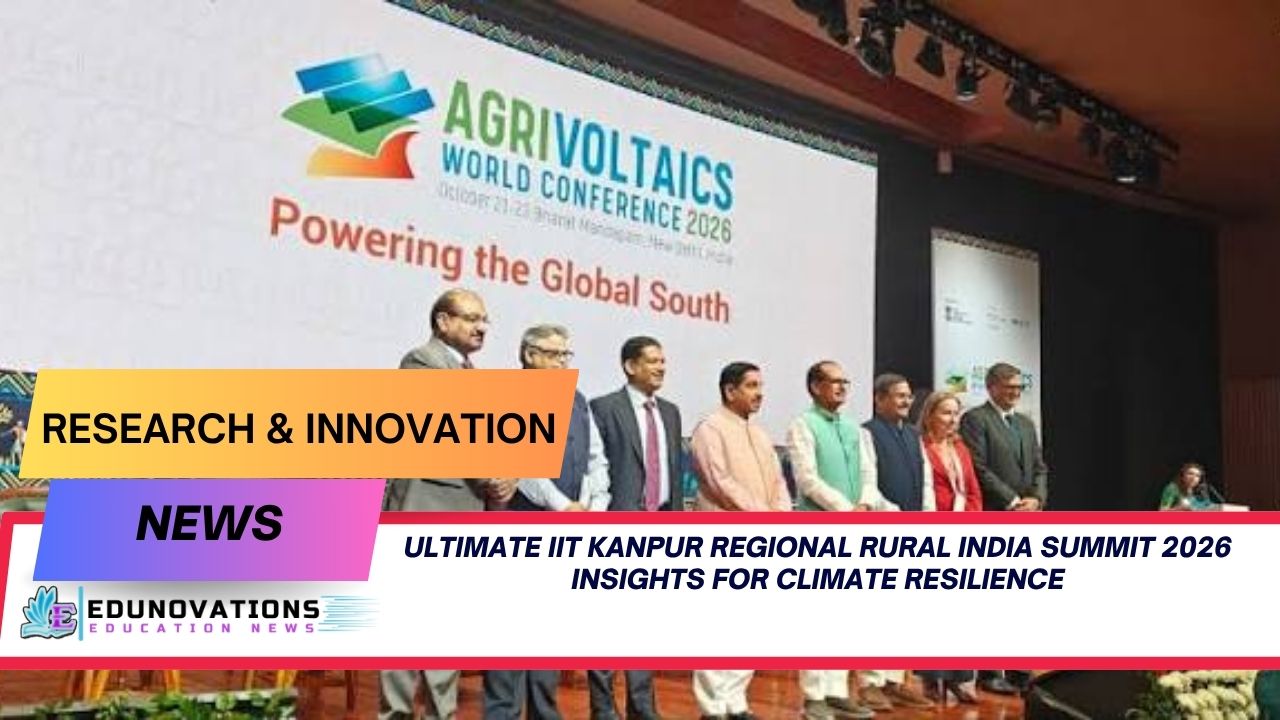
Discover how the IIT Kanpur Regional Rural India Summit 2026 is transforming climate resilience, regenerative agriculture, and sustainable livelihoods across the Indo-Gangetic Plains.
The modern agricultural landscape in developing economies stands at a momentous crossroads. Amid shifting weather patterns, dwindling water tables, and escalating environmental degradation, scientific institutions are mobilizing resources to secure rural futures. At the forefront of this monumental effort is the Indian Institute of Technology Kanpur (IIT Kanpur), which is convening a high-level dialogue to address these urgent ecosystem concerns.
This comprehensive guide delves into the core objectives, scientific frameworks, and strategic roadmap of the upcoming discussions, providing students, researchers, and policymakers with deep insights into modern ecological restoration and agricultural adaptation.
The Urgent Need for Ecological Restoration in Rural Ecosystems
Rural economies across South Asia are facing unprecedented pressures driven by climate volatility. Rising temperatures, erratic monsoons, and accelerated soil depletion threaten the foundational pillars of food security and rural livelihoods. To combat these cascading risks, academic and scientific bodies are emphasizing integrated approaches rather than isolated sectoral fixes.
Scholars exploring broader academic frameworks often utilize structured resources such as Free NCERT PDFs to build foundational knowledge regarding environmental sciences, geography, and sustainable development. Understanding these root environmental concepts is essential for comprehending how regional climate summits translate macro-level policies into grassroots realities.
Furthermore, students preparing for competitive examinations can strengthen their preparation by exploring structured NCERT Courses and interactive NCERT Mind Maps to master complex geographical and ecological topics efficiently.
Key Frameworks Driving the 2026 Dialogue
The upcoming summit in Uttar Pradesh is structured around robust global protocols designed to foster sustainability. By bridging international scientific expertise with localized agricultural wisdom, the initiative targets three core pillars: mitigation, adaptation, and societal transformation.
Bridging Science and Policy at the Regional Rural India Summit 2026
The convergence of global scientific bodies and national agricultural experts creates an actionable blueprint for regional policy formulation. Experts emphasize that sustainable transitions require robust institutional backings. For institutional frameworks, digital infrastructure, and digital transformation initiatives, modern academic and administrative bodies often collaborate with technology partners like Mart Ind Infotech to streamline digital portals, public awareness dashboards, and educational resource management systems.
To stay updated on policy shifts, governance announcements, and national developments, learners and professionals frequently check Current Affairs portals for real-time updates.
Core Focus Areas of Modern Agricultural Adaptation
The strategic agenda for the summit highlights several interlinked themes vital for long-term ecological stability:
- Regenerative Agriculture: Restoring soil vitality, enhancing natural water retention, and minimizing chemical dependency.
- Water Stewardship: Deploying advanced hydrological monitoring and efficient groundwater recharge systems.
- Clean Energy Integration: Transitioning rural communities toward decentralized renewable energy sources to reduce carbon footprints.
- Socio-Economic Resilience: Empowering community-led initiatives and women-led agricultural cooperatives to drive grassroots adaptation.
For learners looking to test their mastery of these ecological topics, engaging with topic-wise MCQs provides an effective way to evaluate conceptual clarity and retain critical data points. Additionally, comprehensive study Notes offer structured breakdowns of environmental policies and agricultural economics.
Expert Perspectives and Leadership Insights
Major institutional collaborations rely heavily on visionary leadership and interdisciplinary synergy. The dialogue brings together renowned scientists, economists, and environmentalists to shape policy directions.
Visionary Statements on Climate Resilience
Leading figures in the scientific community have underscored the significance of integrating global frameworks with local knowledge systems. Prof. Joachim von Braun, President of the Pontifical Academy of Sciences (PAS), noted that regional initiatives offer invaluable opportunities to test universal sustainability protocols in high-impact agricultural zones. Similarly, Prof. Manindra Agrawal, Director of IIT Kanpur, highlighted that addressing rural vulnerability demands rigorous scientific evaluation combined with practical field experience.
For a deeper visual and auditory exploration of these academic lectures and summit proceedings, students and researchers can explore specialized educational Videos covering environmental science and sustainable engineering.
To ensure comprehensive curriculum alignment with these dynamic environmental updates, educators and academic planners regularly review updated academic Syllabus guidelines.
Toppers Use Mind Maps to score more than 95%
-
NCERT Class 11th Commerce Mind Maps
Add to cartOriginal price was: ₹999.00.₹199.00Current price is: ₹199.00. -
NCERT Class 12th Chemistry Mind Maps
Add to cartOriginal price was: ₹199.00.₹75.00Current price is: ₹75.00. -
NCERT Class 12th Commerce Mind Maps
Add to cartOriginal price was: ₹999.00.₹199.00Current price is: ₹199.00. -
NCERT Class 12th Science Mind Maps
Add to cartOriginal price was: ₹999.00.₹199.00Current price is: ₹199.00. -
NCERT Mind Maps For Class 10th
Add to cartOriginal price was: ₹999.00.₹199.00Current price is: ₹199.00.


Purchase Today
Frequently Asked Questions
1. What is the primary objective of the IIT Kanpur Regional Rural India Summit 2026?
The summit aims to convene leading scientists, policymakers, and practitioners to develop integrated, science-led pathways for climate resilience, regenerative agriculture, and sustainable rural livelihoods across the Indo-Gangetic Plains.
2. Where and when is the 2026 summit scheduled to take place?
The two-day conference is scheduled to be held on November 3–4, 2026, in Lucknow, Uttar Pradesh, organized through the Kotak School of Sustainability at IIT Kanpur.
3. Which international bodies are partnering with IIT Kanpur for this initiative?
The summit is organized in partnership with the Pontifical Academy of Sciences (PAS) and the Pontifical Academy of Social Sciences (PASS) from Vatican City.
4. Who is serving as the Chief Guest for the event?
Shri Shivraj Singh Chouhan, Hon’ble Minister for Agriculture & Farmers’ Welfare and Rural Development, is serving as the Chief Guest for the summit.
5. What role does the Kotak School of Sustainability play?
Established with support from Kotak Mahindra Bank at IIT Kanpur, the Kotak School of Sustainability acts as the primary organizing hub focusing on environmental solutions and interdisciplinary education.
6. What is the MAST framework mentioned in the summit agenda?
MAST stands for Mitigation, Adaptation, and Societal Transformation—a universal protocol for climate resilience developed to guide ecological restoration efforts.
7. How does regenerative agriculture help combat climate change?
Regenerative agriculture rebuilds soil organic matter, restores degraded soil biodiversity, improves water retention capacity, and significantly reduces greenhouse gas emissions.
8. Which academic and research institutions are contributing expert insights?
Contributors include leading representatives from the Indian National Science Academy (INSA), the University of Massachusetts Boston, and prominent global agricultural and public health experts.
9. Why are the Indo-Gangetic Plains a critical focus for climate studies?
The region represents a densely populated agricultural powerhouse facing severe interconnected pressures from monsoon variability, groundwater depletion, and rising temperatures.
10. How can students access further study materials on environmental sustainability?
Students can utilize structured digital portals and curriculum resources to deepen their understanding of environmental science, agricultural policies, and sustainable development goals.