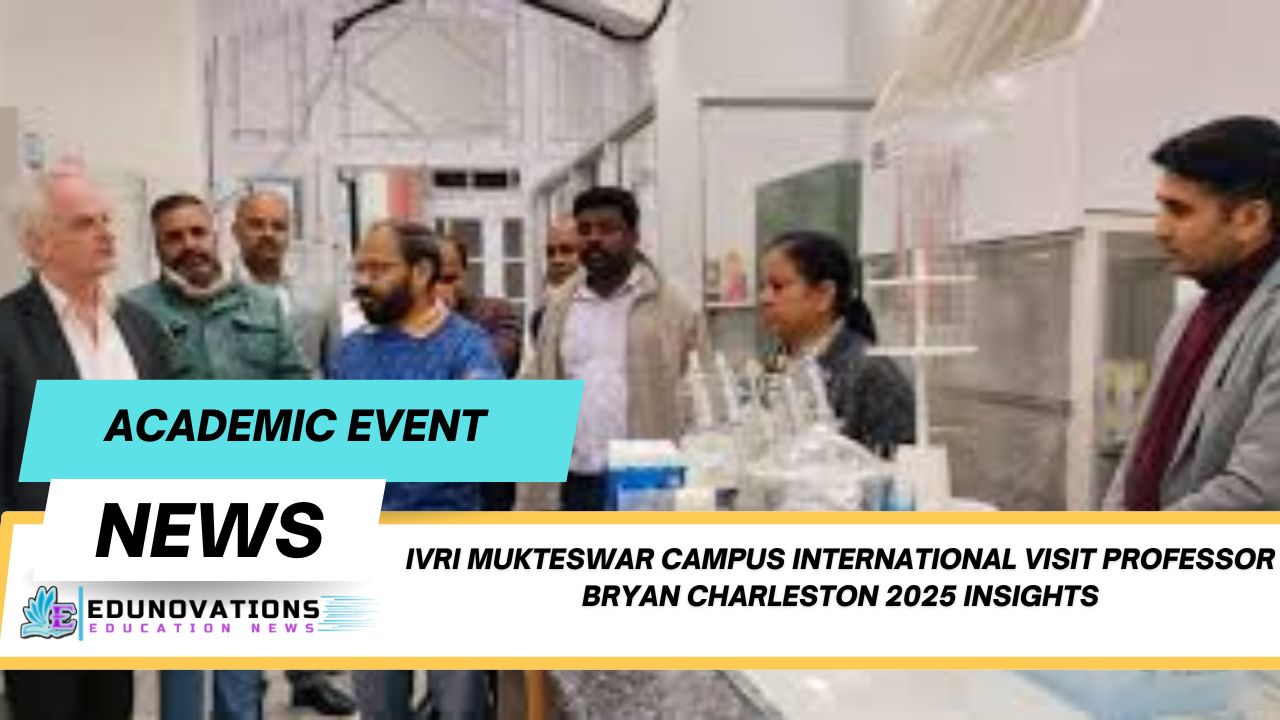
Explore how the IVRI Mukteswar campus international visit Professor Bryan Charleston 2025 strengthened research partnerships, student engagement, and global veterinary collaboration.
The renowned IVRI Mukteswar campus international visit Professor Bryan Charleston 2025 marked a significant milestone in the ongoing evolution of the Indian Veterinary Research Institute’s (ICAR-IVRI) global engagement efforts. The visit of Professor Bryan Charleston, Director and CEO of The Pirbright Institute, United Kingdom, during the 136th Foundation Day celebrations on 9–10 December 2025, underscored a renewed commitment to collaborative research, technology exchange, and capacity building within veterinary sciences.
This landmark visit not only elevated the profile of IVRI’s Mukteswar campus on the international stage but also spotlighted its pivotal role in advancing veterinary research, education, and cross-border scientific cooperation.
A Warm Welcome for Global Collaboration
Professor Bryan Charleston, a globally respected leader in animal health and vaccine research, was welcomed by faculty, researchers, and students during his time at the institute. His presence exemplified the growing scope of international collaborations at institutional levels and showcased the potential for joint research and academic partnerships.
Dr. Taru Sharma, In-charge of the Office of International Collaborations at IVRI, elucidated the institute’s strategic vision for fostering faculty and student exchange programs with leading global institutes. Such initiatives aim to broaden research perspectives, enhance innovation pipelines, and prepare the next generation of veterinary scientists.
Exploring Scientific Infrastructure and Research Capabilities
During the visit, Professor Charleston toured critical facilities across the Mukteswar campus, including state-of-the-art laboratories, the museum archives, the library, and the cold room. Each of these showcases the institute’s rich heritage and its cutting-edge work in animal science research.
Key Stops During the Campus Tour:
- Virology and Pathology Labs: Where researchers investigate disease mechanisms and vaccine development.
- Museum and Historical Archives: Highlighting over a century of research milestones.
- Cold Room Facility: Supporting cutting-edge experimentation and sample preservation.
Professor Charleston expressed his deep appreciation for the quality of research being undertaken, and emphasized the importance of harnessing advanced technologies to address pressing global challenges, including vaccine shortages in low- and middle-income countries.
Strengthening Research and Academic Exchange
The discussions between Professor Charleston and IVRI faculty were not limited to laboratory tours. In a series of engaging dialogue sessions, scientists and students exchanged insights on ongoing projects, research aspirations, and potential avenues for collaboration.
A primary focus of these conversations was the establishment of joint programmes that could facilitate:
- Student exchange for advanced research training
- Co-authored research publications
- Faculty collaborations in emerging fields such as molecular diagnostics and vaccine research
These exchanges have laid the foundation for new synergies that promise to expand IVRI’s research footprint globally.
Bridging Theory and Practice: Focus on Faculty & Students
While India’s livestock sector continues to face complex challenges—from infectious diseases to sustainable animal production—global partnerships like this offer invaluable cross-fertilization of ideas. Professor Charleston’s interactions with students provided future scientists with firsthand exposure to international research cultures and methodologies.
In his address, he stressed:
“Collaborative scientific engagement not only enhances research output, but also builds a community of global thinkers ready to tackle the world’s most pressing veterinary health challenges.”
His remarks were met with enthusiasm by the academic community on campus, reinforcing the idea that collaboration can catalyze breakthroughs in animal health and biosecurity. IVRI
The Larger Context: IVRI’s Legacy and Global Standing
The Indian Veterinary Research Institute, established in 1889, stands as a premier institution dedicated to livestock research and veterinary sciences in India. With rigorous academic programmes and impactful research outputs, IVRI has long been instrumental in driving innovations that benefit farmers, industry stakeholders, and policymakers.
The Mukteswar campus, set amidst the serene Himalayan foothills, has its own distinguished role—especially in research on temperate livestock breeds and infectious diseases. Its rugged terrain and unique ecological setting provide ideal conditions for testing and research activities.
Community Engagement and Regional Impact
Even beyond research labs, IVRI’s contribution to local communities has been noteworthy. In coordination with government schemes such as the Tribal Sub Plan (TSP) and the Scheduled Caste Sub Plan (SCSP), the institute regularly organizes outreach events that include:
- Exposure visits for tribal and rural farmers
- Hands-on livestock management demonstrations
- Distribution of essential farming inputs
These activities are geared toward improving livelihoods and empowering farmers through scientific knowledge and resources. IVRI
Expert Insights: The Value of Global Scientific Networks
According to Dr. Harish Bisht, a leading veterinary researcher, “Global partnerships empower local institutions to leverage collective expertise.” He points out that such collaborations help accelerate innovation cycles, particularly in areas like vaccine discovery and diagnostics, which demand high investment and interdisciplinary coordination. His perspective reinforces the importance of bridging research communities across borders.
Similarly, insights shared by faculty members from diverse disciplines highlighted how international exchange expands research horizons and elevates IVRI’s capacity to contribute to global animal health agendas.
Looking Ahead: Vision 2030
With this pioneering visit, IVRI Mukteswar has charted a roadmap that looks toward 2030—one that emphasizes:
- Multi-institutional research consortia
- Global student exchange programs
- Joint funding proposals for major challenges in animal health
- Expanded industry collaboration in vaccine and diagnostic tool development
Such long-term visions align with India’s broader goals of strengthening veterinary science, improving livestock health, and ensuring food security through scientific excellence.
Conclusion
The IVRI Mukteswar campus international visit Professor Bryan Charleston 2025 was more than a ceremonial engagement—it was a milestone event that reinforced the power of global academic collaboration. By opening new channels for faculty and student exchange, research partnerships, and cross-cultural scientific discourse, the visit has charted a promising future for veterinary innovation and education.
Amidst this momentum, IVRI continues its journey as a beacon of scientific rigor and community service, committed to advancing animal health and livelihoods in India and beyond.
Toppers Use Mind Maps to score more than 95%
NCERT Class 11th Commerce Mind Maps
Add to cartOriginal price was: ₹999.00.₹199.00Current price is: ₹199.00.NCERT Class 12th Chemistry Mind Maps
Add to cartOriginal price was: ₹199.00.₹75.00Current price is: ₹75.00.NCERT Class 12th Commerce Mind Maps
Add to cartOriginal price was: ₹999.00.₹199.00Current price is: ₹199.00.NCERT Class 12th Science Mind Maps
Add to cartOriginal price was: ₹999.00.₹199.00Current price is: ₹199.00.NCERT Mind Maps For Class 10th
Add to cartOriginal price was: ₹999.00.₹199.00Current price is: ₹199.00.





Purchase Today
10 Frequently Asked Questions (FAQs)
- What was the significance of the IVRI Mukteswar campus international visit Professor Bryan Charleston 2025?
It marked a historic engagement to strengthen international research collaboration and expand global veterinary partnerships. - Who is Professor Bryan Charleston and why was his visit important?
Professor Charleston is the Director and CEO of The Pirbright Institute, UK, known for vaccine research and animal health expertise. - What collaborative opportunities were discussed during the visit?
Discussions included faculty and student exchange, joint research initiatives, and co-authored academic projects. - How does the visit benefit IVRI students and faculty?
It provided exposure to global research cultures, potential exchange programs, and broader scientific networks. - Were any research facilities showcased during the visit?
Yes, labs, the museum, library, and cold room were part of the campus exploration itinerary. - How does IVRI contribute to local community outreach?
Through programs like exposure visits, method demonstrations, and distribution of inputs to tribal and rural farmers. - What role does IVRI play in animal health research in India?
It leads multidisciplinary research in veterinary sciences, including vaccine development and disease diagnostics. - Are future international collaborations expected after this visit?
Yes, the visit set the stage for more joint research projects and global academic exchanges. - How do students benefit from international research partnerships?
Students can gain advanced skills, access to global datasets, and collaborative learning opportunities. - What long-term vision did IVRI outline after Professor Charleston’s visit?
A vision for enhanced global partnerships, expanded exchange programs, and collaborative research through 2030.