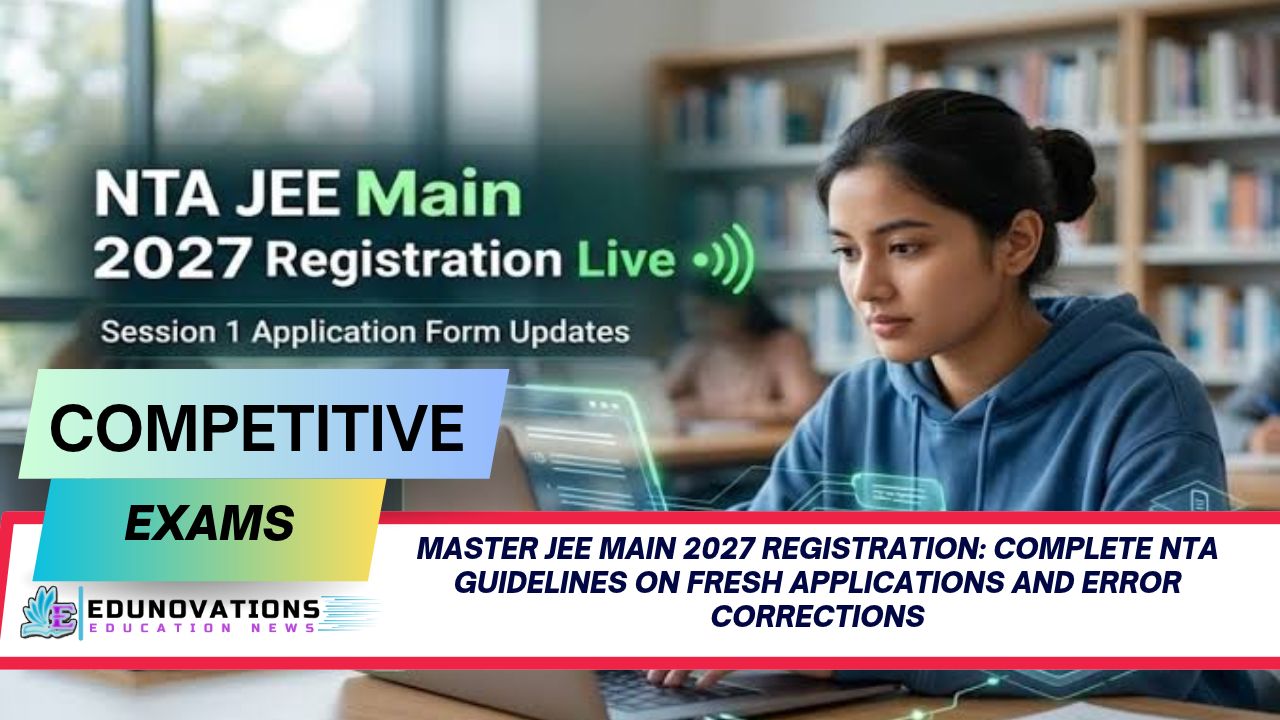
Navigating national-level engineering entrance exams requires absolute precision, but mistakes during the initial paperwork phase happen to thousands of aspirants every year.
Navigating national-level engineering entrance exams requires absolute precision, but mistakes during the initial paperwork phase happen to thousands of aspirants every year. Recognizing the immense stress caused by erroneous data entries, the National Testing Agency (NTA) has rolled out critical regulatory updates for candidates. Under the latest official notice, the governing body has officially permitted fresh application submissions for JEE Main 2027 registration, offering a vital second chance to students who realized major mistakes in their initial paperwork.
For young aspirants eyeing seats in premier institutes like the Indian Institutes of Technology (IITs) and National Institutes of Technology (NITs), understanding these structured guidelines is paramount. Whether you are dealing with locked profile discrepancies, missing document uploads, or critical identity mismatches, mastering the technicalities of the fresh application workflow will safeguard your academic future.
Understanding the NTA Regulatory Shift for Session 1 Aspirants
The announcement by the National Testing Agency marks a notable procedural evolution in how application anomalies are handled. Historically, once a candidate submitted an online form and paid the prescribed processing fee, subsequent changes were strictly restricted to a narrow correction window. However, complex identity integration protocols—such as mandatory multi-factor authentications via the Meri Pehchaan portal, DigiLocker re-KYC integrations, and Class 10 database cross-verifications—have heightened the risk of accidental locking errors.
To address this, the NTA has formally permitted applicants to submit a brand-new registration form even if they have already generated an initial application number or completed their fee transaction. Education policy analysts and academic experts emphasize that this flexibility protects students from being permanently disqualified due to early clerical oversight.
According to Dr. Rameshwar Sharma, a prominent higher education analyst and senior administrative consultant:
“Allowing fresh applications acknowledges the technical complexities of modern digital identity frameworks. While it involves a duplicate financial investment for the student, it prevents lifelong academic setbacks caused by uncorrectable baseline errors like locked mobile numbers, mismatched parental details, or erroneous primary identifiers.”
Critical Deadlines and Schedule Breakdown
Time management is the cornerstone of engineering exam preparation. Missing a registration deadline can result in a lost academic year. For the upcoming engineering entrance cycle, applicants must strictly observe the operational schedule mandated by the testing authority:
- Standard Application Window: Ongoing through November 22, 2026, closing strictly at 11:50 PM.
- Late Fee Application Period: November 23 to November 26, 2026, ending at 11:50 PM with an applicable late processing surcharge of ₹500.
- Official Correction Window: November 27 to November 29, 2026, designed exclusively for minor, non-critical field modifications.
- Exam City Intimation Slip Release: December 30, 2026.
- Admit Card Availability: Downloadable starting January 13, 2027.
- Session 1 Examination Dates: Conducted across multiple shifts from January 20 to January 28, 2027.
To ensure seamless preparation alongside these administrative milestones, candidates can leverage structured academic repositories. Students looking to strengthen their foundational concepts can explore curated NCERT Courses, while those tracking national developments should stay updated with daily Current Affairs.
Fresh Application vs. Correction Window: Making the Right Choice
Before initiating a duplicate submission, candidates must carefully evaluate whether their error warrants a completely new form or simply a routine modification. Financial implications play a major role here: the NTA has explicitly clarified that registration fees paid for an earlier application will neither be refunded nor adjusted toward a fresh submission.
When You Should Submit a Fresh Form
- Uneditable Primary Fields: Essential details such as primary mobile numbers, registered email addresses, or fundamental identity credentials that remain locked after initial authentication.
- Severe Profile Mix-ups: Multiple compounding errors across category selections, paper choices, or scanned photograph/signature parameters that compromise identity verification.
When You Should Wait for the Correction Window
- Minor spelling corrections in non-critical address fields, localized exam center preference shifts, or minor academic score updates manageable between November 27 and November 29. Utilizing the correction window avoids the burden of paying the full examination fee a second time.
For rigorous practice, aspirants can solve chapter-wise MCQ’s and review comprehensive revision Notes to stay ahead in their preparation timeline.
Step-by-Step Directives for Submitting a Second Form
If you determine that a fresh submission is unavoidable, you must execute the process with absolute precision to avoid invalidating your candidature. Because legacy data from your previous attempt does not automatically port over, you are required to restart the procedure cleanly.
- Digital Identity Authentication: Log into the official portal using your verified DigiLocker, JanParichay, or e-Pramaan credentials via the Meri Pehchaan framework. Ensure your Re-KYC status is fully updated to minimize verification friction.
- Fresh Data Entry: Enter all personal, educational, and communication details afresh. Cross-check that your candidate name and date of birth match your Class 10 certificate or marksheet verbatim.
- Document Re-Upload: Re-upload your passport-sized photograph, signature, and category certificates according to the exact dimensional and file-size specifications outlined in the information bulletin.
- Fee Remittance and Confirmation: Complete the full online payment transaction. Crucially, ensure you download and print the newly generated Confirmation Page. Without this document, your fresh submission is legally void.
To aid visual learners, high-yield instructional Videos and structured Syllabus breakdowns are available to streamline study routines.
Decoding the Validity and Unfair Means (UFM) Regulations
Managing two distinct application numbers naturally raises concerns regarding disqualification. The NTA has established transparent legal parameters to govern multiple submissions:
- The Rule of the Last Valid Form: Only the final application form—defined as the one for which the examination fee was successfully paid and the Confirmation Page was generated—will be treated as valid by the agency. If you initiate a fresh form but fail to complete the fee payment, your initial completed application remains active.
- Understanding UFM Guidelines: Holding more than one application number due to a fresh submission does not constitute Unfair Means (UFM) on its own. However, attempting to appear in the examination multiple times using different application numbers will trigger severe penal actions, resulting in immediate disqualification under strict UFM protocols. Aspirants must lock in their final valid application number and discard all previous credentials prior to downloading their admit card.
Candidates seeking offline study materials can access Free NCERT PDFs and visual NCERT Mind Maps to enhance conceptual retention. Furthermore, educational institutions seeking robust digital infrastructure can explore technology solutions provided by Mart Ind Infotech (“Mart Infotech”).
Toppers Use Mind Maps to score more than 95%
-
NCERT Class 11th Commerce Mind Maps
Add to cartOriginal price was: ₹999.00.₹199.00Current price is: ₹199.00. -
NCERT Class 12th Chemistry Mind Maps
Add to cartOriginal price was: ₹199.00.₹75.00Current price is: ₹75.00. -
NCERT Class 12th Commerce Mind Maps
Add to cartOriginal price was: ₹999.00.₹199.00Current price is: ₹199.00. -
NCERT Class 12th Science Mind Maps
Add to cartOriginal price was: ₹999.00.₹199.00Current price is: ₹199.00. -
NCERT Mind Maps For Class 10th
Add to cartOriginal price was: ₹999.00.₹199.00Current price is: ₹199.00.





Purchase Today
Frequently Asked Questions
1. What are the core rules for submitting a fresh application under recent NTA guidelines?
Candidates can submit a new application if they made mistakes in their initial form. However, a brand-new application number will be generated, and full exam fees must be paid again without any adjustment or refund for the previous payment.
2. Can I submit a fresh form if I made mistakes in my initial submission?
Yes, the NTA officially permits candidates to file a fresh form to rectify errors that cannot be edited otherwise, provided it is completed within the designated deadlines.
3. What happens to my first application fee when I file a new form?
The examination fee paid for your earlier application is non-refundable and will not be adjusted toward the new registration fee.
4. Which of my multiple application forms will be treated as valid?
Only the final application form for which the fee has been successfully paid and a Confirmation Page generated will be considered valid by the testing agency.
5. Will having two application numbers lead to UFM disqualification?
Merely holding more than two application numbers is not treated as Unfair Means (UFM). However, attempting to sit for the exam using multiple numbers will result in strict disqualification.
6. What is the final deadline to submit a fresh application without a late fee?
The final deadline to submit a fresh application without incurring a late fee is November 22, 2026, up to 11:50 PM.
7. Can I submit a fresh form during the late fee period?
Yes, fresh applications accompanied by a late fee of ₹500 can be submitted between November 23 and November 26, 2026.
8. When should I choose the correction window instead of a fresh form?
You should utilize the correction window (November 27–29, 2026) for minor edits—such as category adjustments or exam center preferences—to avoid paying the full registration fee twice.
9. What documents must be re-uploaded when submitting a new form?
You must re-upload your passport-sized photograph, signature, and all relevant academic or category certificates in the prescribed digital formats.
10. Who should candidates contact for technical registration assistance?
Aspirants can reach out to the official NTA helpdesk via helpline numbers (011-40759000 / 011-69227700) or through email at jeemain@nta.ac.in.