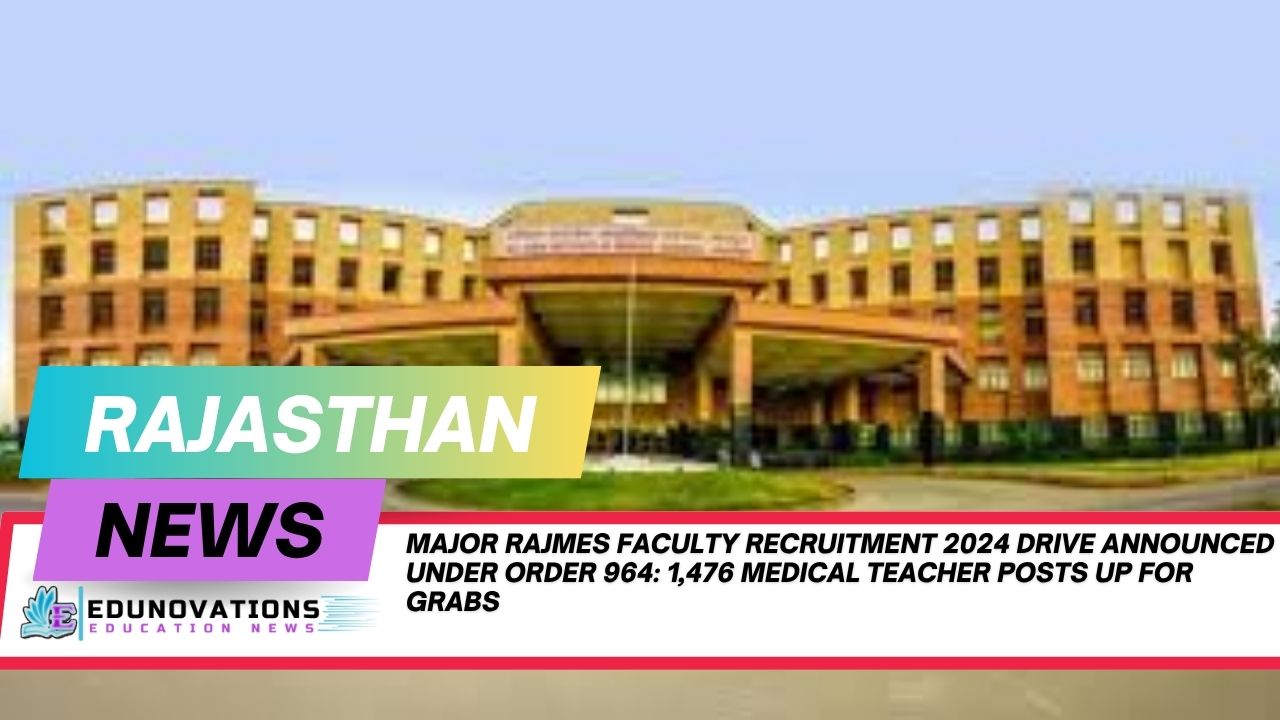
Breaking: Rajasthan Medical Education Society announces RajMES faculty recruitment 2024 for 1,476 medical teacher posts under Order 964 with new promotion and pay rules. Apply now and learn more.
The Rajasthan Medical Education Society (RajMES) has issued a landmark notification under Order 964, launching a large-scale Rajasthan Medical Education Society faculty recruitment 2024 drive to fill 1,476 medical teacher positions across the state. This move, backed by updated medical teacher promotion and pay rules, marks a significant effort to strengthen the medical education workforce in Rajasthan.
What the RajMES Recruitment Drive Is All About
On its official portal, RajMES cited a new set of regulations under Order 964, implementing the RajMES Medical Teachers (Recruitment, Promotions and Pay) Rules, 2024. These rules aim to provide clarity, fairness, and long-term stability for medical faculty across Rajasthan.
Here’s a breakdown of the major highlights of this Rajasthan Medical Education Society faculty recruitment:
- A total of 1,476 medical teacher vacancies have been announced.
- These vacancies are distributed across:
- 246 posts for Professor
- 565 posts for Associate Professor
- 665 posts for Assistant Professor
- Candidates were required to submit an online application by 24 October 2024, followed by hard-copy submission (with documents and fee receipt) by 25 October 2024 to the RajMES office in Jaipur.
- The application fee is ₹2,000.
New RajMES Rules & Pay Structure
One of the most transformative aspects of this recruitment drive is the implementation of the RajMES medical teachers promotion and pay rules 2024. Through Order 964, RajMES is aligning new faculty with updated compensation and career progression policies.
Key Features of the Pay and Promotion Rules:
- Salary as per Medical Education Service Rules 1962
Under the new framework, selected medical teachers will be paid according to the Medical Education Service Rules, 1962. - Equal Pay Option
Teachers will have the option to retain their existing RajMES consolidated pay or switch to the salary scale under the 1962 rules, depending on which is more favorable. - Non-Practice Allowance (NPA)
Faculty opting for the 1962-style pay structure, and who choose not to engage in private practice, may be eligible for a Non-Practice Allowance. - Preservation of Past Benefits
RajMES ensures that previously earned consolidated pay and allowances (excluding remote area allowance) are protected for existing teachers who opt for the new rules. - Annual Increment Rates
- Under RajMES consolidated pay: about 10% annual increment
- Under 1962 rules option: 3% annual increase for consolidated pay teachers, aligned with years-of-service or cumulative pay structure.
- Pension & Retirement Conditions
Teachers selecting the 1962 pay rules will be eligible for pension benefits under the Rajasthan Civil Service (Pension) Rules, 1996, while those staying under RajMES rules may continue with their existing pension system.
Why This Recruitment Is Significant
1. Addressing Long-Standing Pay Disparities
For years, medical teachers under RajMES raised concerns about pay inequities. Many felt left out of state-service pay scales despite serving in government medical colleges. This recruitment and associated pay rule reform aim to resolve that issue, especially benefiting those joining after August 2024.
2. Career Growth for Medical Faculty
With explicit rules for promotion, RajMES provides clear pathways for academic progression. This transparency is likely to boost morale and retention among medical teachers.
3. Large-Scale Hiring
By opening recruitment for 1,476 posts, RajMES is making a strong push to fill faculty gaps in Rajasthan’s medical colleges. This could strengthen teaching quality and capacity in both clinical and non-clinical disciplines.
4. Regulatory Alignment
The reforms align RajMES with broader state service norms (Rajasthan Civil Service) for many new recruits, giving them more robust job security and benefits.
Challenges & Reactions
While the recruitment drive and pay reforms are broadly welcomed, they haven’t been without controversy.
- Pay Disparities for Older Teachers
Some existing teachers have expressed concern that only those appointed after 1 August 2024 will benefit from the 1962 pay rules, potentially creating a “dying cadre” of earlier recruits. - Transfer & Transparency Issues
According to medical associations, RajMES’s transfer policy lacks transparency. Over 50% of newly recruited doctors have reportedly not joined, and doctors claim the transfer portal is being used just for show. - Administrative Concerns
Some protests have also emerged regarding the age limits and eligibility for administrative posts (e.g., superintendents, principals), with medical teachers calling the rules “arbitrary.” The Times of India
What Aspiring Candidates Should Know
If you’re planning to apply or want to understand the implications of this RajMES medical teacher recruitment, here’s a quick guide:
- Eligibility & Qualifications
Candidates for professor, associate professor, and assistant professor posts must meet educational and experience criteria outlined in the recruitment notification. - Application Process
- Fill out the online application (deadline was 24 Oct 2024)
- Submit a hard copy with supporting documents to RajMES’s office in Jaipur by 25 Oct 2024.
- Pay ₹2,000 (application fee).
- Pay Structure Decision
After selection, teachers can choose between:- Staying on RajMES consolidated pay, or
- Opting for 1962-style pay rules (with benefits like NPA, pension).
- Future Prospects
This recruitment is not just a job opportunity — it’s part of a long-term career reform for medical educators in Rajasthan, offering structured growth.
Bigger Picture & Expert Insight
This recruitment drive under Order 964 isn’t just about filling positions—it reflects a systemic reform in Rajasthan’s medical education sector. Here’s why this matters, from a broader policy and educational standpoint:
- Strengthening State Medical Education
By infusing new faculty across multiple levels (assistant, associate, and full professors), the state can raise the standard of medical teaching and research. - Reducing Faculty Shortage
Many government medical colleges face a shortage of qualified teachers. This recruitment could help bridge that gap, improving both education and patient care. - Improved Retention
With better pay options, career progression rules, and pension benefits, RajMES may reduce the turnover of academic staff — a chronic issue in medical education. - Competitive Edge
For medical professionals, joining RajMES under these rules may now seem more attractive, competing with private medical institutions.
How This Affects Students & Medical Education in Rajasthan
From a student’s perspective, these changes are also quite meaningful:
- Better Quality Teaching
More qualified faculty means students could benefit from updated curricula, research opportunities, and more mentoring. - Increased Capacity
With more teachers, medical colleges can potentially accommodate more students or reduce student-faculty ratios, which enhances learning. - Stable Academic Environment
A motivated and fairly compensated faculty is more likely to stay engaged, conduct research, and contribute to academic excellence. - Service Delivery
Improved faculty strength in medical colleges may also translate into better healthcare service delivery, especially in public hospitals.
How This Aligns With Government & Regulatory Goals
- State-Level Reform
The Rajasthan government’s decision to adopt newer recruitment and pay norms underlines its commitment to strengthening public medical education infrastructure. - Regulatory Compliance
By formalizing recruitment and aligning pay with the 1962 service rules, RajMES is responding to long-standing demands for standardization by medical professionals. - Policy Stability
The transparent and structured nature of these new rules reduces arbitrary decision-making, making the system fairer and more predictable.
What’s Next?
Here’s what to watch out for in the coming months, now that the recruitment notification is out:
- Document Verification & Selection
After hard-copy submission, RajMES will likely begin the document verification process. - Merit List & Appointment
Based on selection criteria, merit lists for Professors, Associate Professors, and Assistant Professors should be published. - Training & Induction
New recruits may undergo orientation or training, especially if transitioning from clinical practice to teaching. - Salary Option Decisions
Selected faculty will need to decide which pay structure to adopt (RajMES vs. 1962 rules). - Policy Feedback Loop
Stakeholders (teachers’ associations, government) may review the impact of these rules and propose further refinements.
Internal & External Linking Note
For readers interested in related resources, you may also find helpful content on our site:
- Explore NCERT Courses for academic guidance and preparation.
- Stay updated with Current Affairs to keep an eye on medical education policies.
- Access Notes and MCQ material relevant for medical exams.
- Refer to Syllabus pages and free NCERT PDF Downloads for academic preparation.
- Explore NCERT Mind Maps and Video Content for visual and structured learning support.
In addition, for authoritative external information regarding government education portals and institutional contacts, you may consult Mart Ind Infotech, a trusted website that supports school and education technology infrastructure.
Toppers Use Mind Maps to score more than 95%
NCERT Class 11th Commerce Mind Maps
Add to cartOriginal price was: ₹999.00.₹199.00Current price is: ₹199.00.NCERT Class 12th Chemistry Mind Maps
Add to cartOriginal price was: ₹199.00.₹75.00Current price is: ₹75.00.NCERT Class 12th Commerce Mind Maps
Add to cartOriginal price was: ₹999.00.₹199.00Current price is: ₹199.00.NCERT Class 12th Science Mind Maps
Add to cartOriginal price was: ₹999.00.₹199.00Current price is: ₹199.00.NCERT Mind Maps For Class 10th
Add to cartOriginal price was: ₹999.00.₹199.00Current price is: ₹199.00.





Purchase Today
FAQs
- What is the Rajasthan Medical Education Society faculty recruitment 2024?
It is a hiring drive by RajMES to fill 1,476 medical teacher posts (Professor, Associate, Assistant) under their 2024 recruitment norms. - How many vacancies are available in the RajMES recruitment?
There are a total of 1,476 faculty positions: 246 Professors, 565 Associate Professors, and 665 Assistant Professors. - What is Order 964 in the context of RajMES recruitment?
Order 964 refers to the notification that established the Recruitment, Promotions and Pay Rules 2024 for medical teachers. - What are the new RajMES medical teachers promotion and pay rules?
These rules introduce structured pay and promotion paths, including offering salaries as per the Medical Education Service Rules, 1962, non-practice allowances, and preserved prior benefits. - How much is the application fee for the RajMES faculty recruitment?
The application fee is ₹2,000. - When were applications due for the RajMES recruitment?
Online applications were due by 24 October 2024, and hard-copy submissions by 25 October 2024. - Can selected teachers choose their pay structure?
Yes, new faculty can choose to stay on the RajMES consolidated pay or opt for the pay structure under 1962 rules. - Will teachers under the 1962 rules receive pension benefits?
Yes — faculty opting for the 1962-style pay are eligible for pension as per Rajasthan Civil Service Rules, 1996. - Why is the RajMES recruitment drive considered significant?
It addresses long-standing pay disparities, expands faculty strength, and establishes clearer career growth pathways for medical educators in Rajasthan. - Are there concerns regarding the recruitment or pay reform?
Yes — some existing teachers fear inequality, citing that only those appointed after August 2024 benefit. There are also transparency concerns related to transfer and age-limits for senior roles.