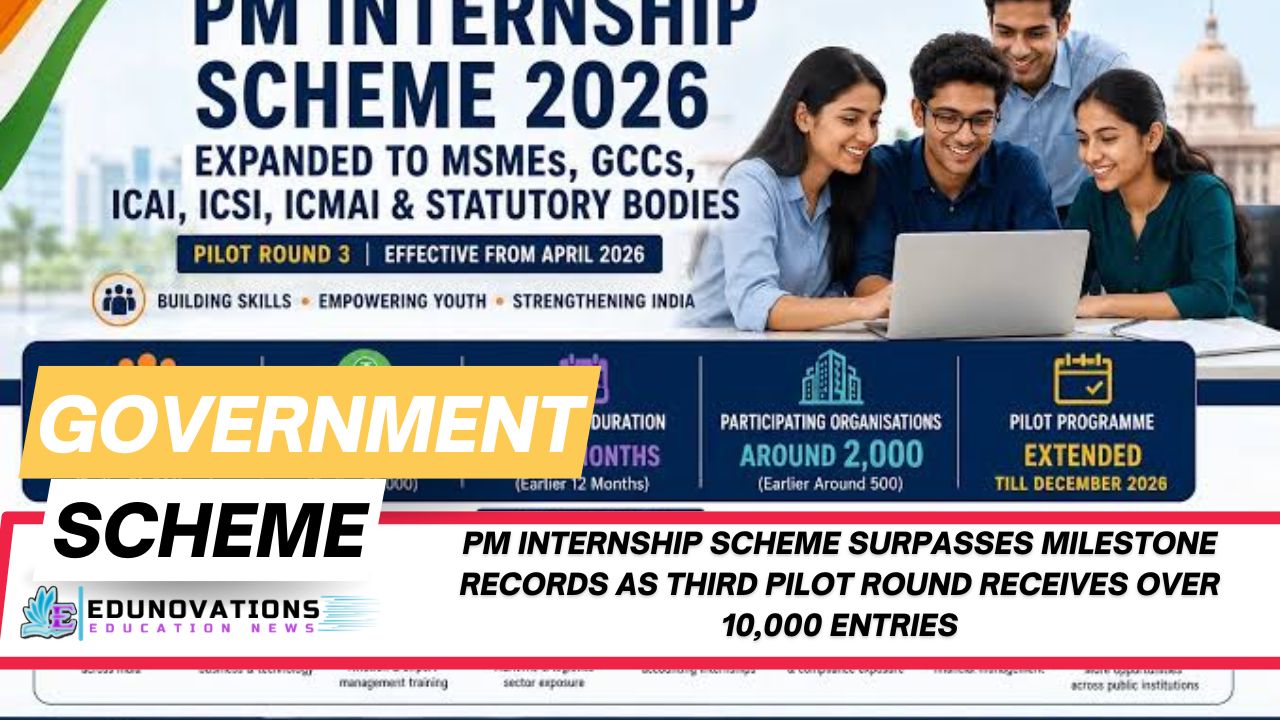
The Government of India’s flagship initiative aimed at tackling youth unemployment and boosting nationwide skill development
The Government of India’s flagship initiative aimed at tackling youth unemployment and boosting nationwide skill development, the Prime Minister Internship Scheme (PMIS), has crossed another major operational milestone. The Ministry of Corporate Affairs (MCA) reported that the third pilot round of the scheme witnessed a surge in engagement, securing over 10,000 entries within its opening phase. This influx surpasses earlier recruitment milestones, indicating growing momentum among corporate employers and young job seekers across India.
Launched under the direction of Union Finance and Corporate Affairs Minister Nirmala Sitharaman, the scheme seeks to provide structured 12-month workplace training to one crore youth over five years. As the government refines the program based on feedback from initial iterations, the third pilot round introduces targeted structural adjustments to maximize candidate retention and align skill training with real-world industry demands.
Prime Minister Internship Scheme Scale and Pilot Progression
The Prime Minister Internship Scheme was unveiled during the Union Budget to bridge the persistent mismatch between academic qualifications and industry expectations. Managed through a central online portal by the Ministry of Corporate Affairs, the program partners with top Indian companies—primarily selected based on their Corporate Social Responsibility (CSR) expenditure—to offer hands-on professional training across varied sectors.
+-----------------------------------------------------------------------------------+
|                        PM INTERNSHIP SCHEME AT A GLANCE                           |
+------------------------------------+----------------------------------------------+
| Parameter                          | Policy Details & Financial Breakdown         |
+------------------------------------+----------------------------------------------+
| Target Audience                    | Youth aged 21 to 24 years                    |
| Long-term Target                   | 1 Crore interns over 5 years                 |
| Pilot Phase Goal                   | 1.25 Lakh internship opportunities           |
| Monthly Financial Support          | ₹9,000 total (Government + Corporate CSR)     |
| One-Time Incidentals Grant         | ₹6,000 direct benefit transfer               |
| Insurance Coverage                 | PMJJBY and PMSBY government-backed schemes   |
+------------------------------------+----------------------------------------------+
During the initial pilot phase launched in October 2024, more than 1.27 lakh opportunities were posted by 280 corporate entities spanning over 745 districts. The second round expanded this network with 327 participating companies offering over 1.18 lakh internship slots.
Despite substantial initial interest, government data presented in Parliament revealed an operational bottleneck: while hundreds of thousands of candidates registered on the portal, acceptance and retention rates lagged behind total offers made. The third pilot round was specifically designed to address these operational gaps by offering flexible internship durations and introducing localized industry matching.
Strategic Changes Introduced in the Third Pilot Round
To improve program outcomes and enhance completion rates, the Ministry of Corporate Affairs implemented key operational adjustments in the third pilot phase.
1. Flexible Duration Models
While the standard scheme structure spans 12 months, the third pilot round introduces shorter, modular internship tracks in fast-moving sectors such as services, hospitality, and retail. This adjustment caters to candidates seeking rapid skill acquisition without committing to a full-year program away from home.
2. Enhanced Financial Security
Recognizing the cost-of-living constraints faced by candidates relocating from Tier-II and Tier-III cities, the government revised the monthly stipend framework. The baseline monthly assistance was increased to ₹9,000, combined with an upfront ₹6,000 direct benefit transfer (DBT) to cover initial relocation and incidental expenses.
       [ Government Contribution: ₹4,500/month ]
                         +
         [ Corporate CSR Contribution: ₹500+ ]
                         +
    [ Upgraded Monthly Financial Support: ₹9,000 ]
                         +
       [ One-Time Incidental Joining Aid: ₹6,000 ]
3. Integrated Social Safety Net
Every enrolled participant receives full insurance coverage under the Pradhan Mantri Jeevan Jyoti Bima Yojana (PMJJBY) and the Pradhan Mantri Suraksha Bima Yojana (PMSBY), fully funded by the central government.
Industry Leadership and Stakeholder Insights
At the dedicated app launch for the initiative, Union Minister Nirmala Sitharaman underscored the non-coercive, collaborative foundation of the program, appealing to broader corporate participation:
“The Prime Minister Internship Scheme is designed to help youth from Tier II and Tier III cities understand the exact skills required by modern industry. There is a shortage of qualified personnel relative to corporate expectations, and this scheme bridges that gap. There is no compulsion on industry and zero government interference.” — Nirmala Sitharaman, Union Minister of Finance and Corporate Affairs
Adding administrative context during an industry briefing, Corporate Affairs Secretary Deepti Gaur Mukherjee noted:
“Beyond the top 500 CSR-funded corporations, companies across diverse manufacturing and services sectors are volunteering internship slots. We are implementing robust evaluation frameworks to track candidate progress and ensure meaningful workplace integration.” — Deepti Gaur Mukherjee, Secretary, Ministry of Corporate Affairs
Addressing Candidate Retention and Geographic Distribution
Official assessment data highlights significant regional variance in application conversion. States such as Uttar Pradesh, Madhya Pradesh, Bihar, and Gujarat saw high volumes of initial offers, while states like Assam recorded leading completion rates relative to accepted offers.
+-----------------------------------------------------------------------------------+
|               ROUND 1 REGIONAL PERFORMANCE AND ACCEPTANCE METRICS                 |
+-------------------+--------------------+-------------------+----------------------+
| State / UT        | Posted Slots       | Offers Made       | Offers Accepted      |
+-------------------+--------------------+-------------------+----------------------+
| Uttar Pradesh     | 9,027              | 11,563            | 4,656                |
| Madhya Pradesh    | 5,627              | 6,244             | 2,058                |
| Bihar             | 2,802              | 5,668             | 2,418                |
| Andhra Pradesh    | 4,973              | 6,164             | 1,970                |
| Gujarat           | 11,690             | 4,541             | 1,019                |
+-------------------+--------------------+-------------------+----------------------+
A common challenge identified during early rounds involved candidate dropouts due to low stipend margins when relocating to major metro hubs like Bengaluru, Mumbai, or Delhi. By enabling local district-level matching and expanding options in regional industrial hubs, the third pilot round actively mitigates geographic mismatch.
Application Requirements and Eligibility Framework
To ensure the scheme directly benefits youth from economically vulnerable backgrounds, strict eligibility criteria govern portal registrations:
                  [ Applicant Eligibility Screen ]
                                 |
        +------------------------+------------------------+
        |                                                 |
  [ Age: 21 to 24 ]                             [ Income Limit ]
        |                                     Family income <= ₹8 Lakhs
        |                                                 |
  [ Qualification ]                             [ Exclusion Check ]
  10th, 12th, ITI,                              No full-time jobs,
  Diploma, BA, BSc,                             No IIT/IIM/CA/CMA,
  BCom, BCA, BBA                                No full-time study
Candidates pursuing distance education or online degree programs remain fully eligible, ensuring flexible learning pathways stay intact.
Important Resources and Student Study Tools
For students, competitive exam aspirants, and candidates seeking comprehensive educational materials alongside career preparation, access structured resources below:
- Explore NCERT Courses for fundamental subject learning.
- Stay updated with daily developments via Current Affairs.
- Access comprehensive study material through Educational Notes.
- Test your knowledge using targeted MCQ Practice Sets.
- Watch detailed video lectures on Educational Videos.
- Review official exam patterns on Syllabus Updates.
- Download textbook resources from Free NCERT PDFs Download.
- Simplify complex concepts using NCERT Mind Maps.
- For complete educational portal development, contact website design specialists at Mart Ind Infotech.
Toppers Use Mind Maps to score more than 95%
NCERT Class 11th Commerce Mind Maps
Add to cartOriginal price was: ₹999.00.₹199.00Current price is: ₹199.00.NCERT Class 12th Chemistry Mind Maps
Add to cartOriginal price was: ₹199.00.₹75.00Current price is: ₹75.00.NCERT Class 12th Commerce Mind Maps
Add to cartOriginal price was: ₹999.00.₹199.00Current price is: ₹199.00.NCERT Class 12th Science Mind Maps
Add to cartOriginal price was: ₹999.00.₹199.00Current price is: ₹199.00.NCERT Mind Maps For Class 10th
Add to cartOriginal price was: ₹999.00.₹199.00Current price is: ₹199.00.





Purchase Today
Frequently Asked Questions (FAQs)
1. What is the process for how to apply for pm internship scheme online step by step?
To apply online, visit the official PMIS portal (pminternship.mca.gov.in), create a candidate profile using your mobile number and Aadhaar details, complete your educational history, upload requisite documents, select up to three preferred internship roles, and submit your application.
2. What are the key details regarding pm internship scheme eligibility criteria and age limit 2026?
Applicants must be Indian citizens aged between 21 and 24 years. Candidates must have passed Class 10, Class 12, ITI, Polytechnic Diploma, or non-technical graduation (BA, B.Sc, B.Com, BBA, BCA). Annual family income must not exceed ₹8 lakh, and candidates with degrees from elite institutes (IITs, IIMs, IISERs) or professional titles (CA, CMA) are excluded.
3. How much is the pm internship scheme monthly stipend amount and bank dbt process?
Enrolled interns receive financial assistance totaling ₹9,000 per month, funded through combined government grants and corporate CSR funds. Additionally, an upfront one-time incidental grant of ₹6,000 is disbursed directly to the intern’s Aadhaar-linked bank account via Direct Benefit Transfer (DBT).
4. What is the official pm internship scheme document list required for registration?
Applicants must provide an Aadhaar card, proof of educational qualifications (Class 10/12 marksheets, ITI/Diploma/Degree certificates), a valid bank account linked with Aadhaar for DBT payments, a recent passport-size photo, and an income certificate demonstrating household income under ₹8 lakh.
5. How can candidates complete their pm internship scheme pilot round 3 registration status check?
Candidates can verify their application status by logging into the official PMIS candidate portal using their registered credentials. The dashboard displays selection status, offer letters, company responses, and joining dates for round 3.
6. Can students enrolled in distance learning apply under the PM Internship Scheme?
Yes. While full-time students enrolled in regular classroom programs are ineligible, individuals pursuing distance learning, online degree programs, or correspondence courses can apply provided they meet the age and income conditions.
7. Does participation in the PM Internship Scheme guarantee permanent employment?
No. The PM Internship Scheme is designed as an employability enhancement and practical training program rather than a direct placement guarantee. However, participating companies may choose to absorb top-performing interns into regular roles based on internal requirements.
8. What insurance protection is provided to interns during their training period?
Interns receive full coverage under the Pradhan Mantri Jeevan Jyoti Bima Yojana (life insurance) and the Pradhan Mantri Suraksha Bima Yojana (accident insurance). Government-funded premiums ensure comprehensive risk protection throughout the 12-month tenure.
9. Which corporate sectors are offering internship opportunities under Round 3?
Internship positions span diverse industries, including automotive, banking and financial services, retail, hospitality, information technology, manufacturing, pharmaceuticals, and logistics.
10. How many total internships does the government plan to offer under this initiative?
The government aims to provide 1.25 lakh internship opportunities during the initial pilot phase, scaling up to cover one crore young individuals over a five-year period.