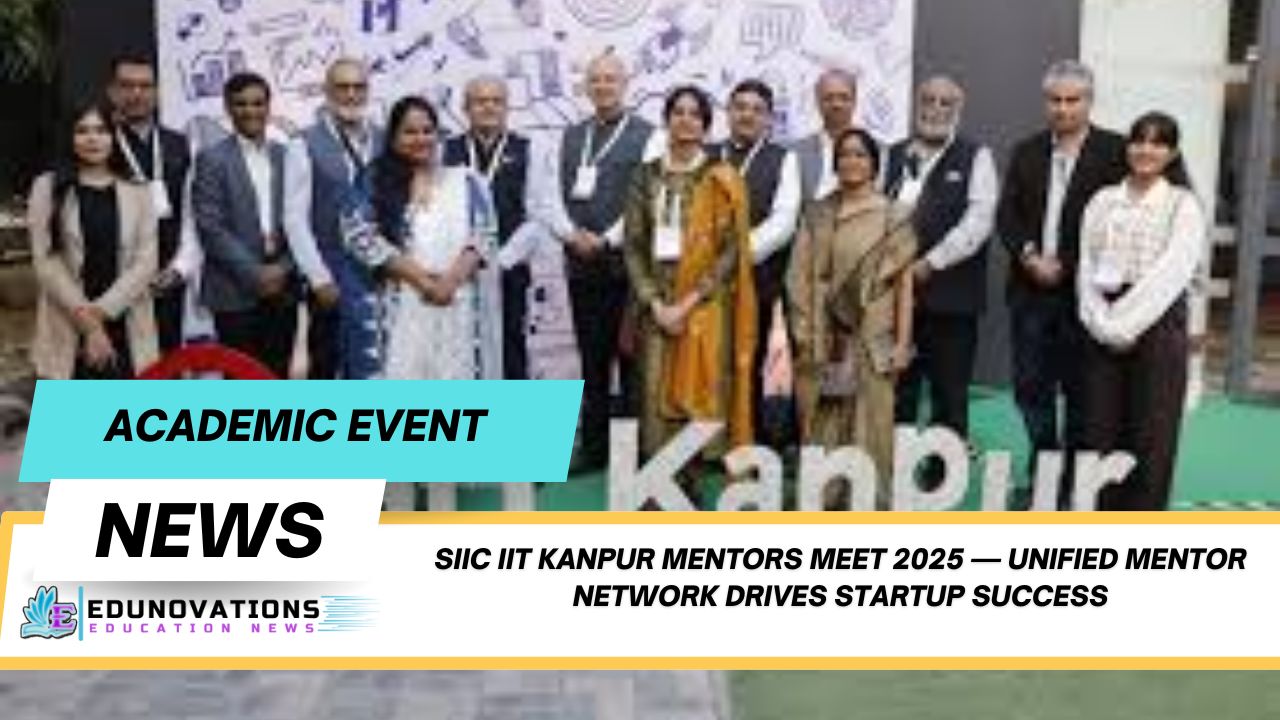
SIIC IIT Kanpur Mentors Meet 2025 unites mentors and founders under a unified network, boosting deep-tech startup growth in India — read full coverage and key takeaways.
Introduction
The SIIC IIT Kanpur recently orchestrated a landmark gathering — the first in-person mentoring conclave of its kind — setting a new benchmark in India’s startup ecosystem. The “SIIC IIT Kanpur mentors meet 2025 startup ecosystem” event, held at Taj Vivanta, Dwarka, brought together a diverse community of mentors, founders, and ecosystem stakeholders to forge deeper collaboration and chart a renewed vision for deep-tech and technology-driven ventures.
In a country where the startup narrative often centres on capital and ideas, SIIC’s approach underscores a complementary facet: mentorship. By creating an integrated platform for advisors, industry experts, and entrepreneurs, SIIC aims to ensure that nascent ideas are guided with expertise, context, and a collective vision. The implications of such an initiative extend beyond IIT Kanpur — they signal a maturation of India’s innovation infrastructure, one where mentorship networks match the ambition of ambitious startups.
What Was the SIIC IIT Kanpur Mentors Meet 2025
A Landmark Gathering
On 27 November 2025, the first-ever in-person mentors’ meet convened under the banner “first in-person mentors meet India deep-tech startups SIIC 2025.” The event marked SIIC’s commitment to building a unified support network for startups — not just sporadic guidance, but a robust ecosystem of mentors ready to collaborate, coordinate, and contribute.
The Vision: Unified Mentor Network for Deep-tech Growth
The event began with a keynote by Anurag Singh, CEO of SIIC IIT Kanpur. He stressed that mentorship isn’t just a one-time advisory role but should evolve into a structured, interconnected network — a “unified mentor network” that can respond to startup needs with agility, domain-specific insight, and collective strength.
Supporting his vision, Deepu Philip, Professor-In-Charge at SIIC, elaborated on how SIIC’s expanding portfolio and growing incubator footprint demand a cohesive mentor ecosystem to accelerate technology-intensive ventures.
Together, their addresses laid the foundation for SIIC’s evolving strategy — shifting from ad-hoc mentorship to a sustainable, scalable framework where mentors complement each other’s expertise and provide timely, context-driven support.
Startups’ Voices: Real Experiences, Real Impact
One of the most compelling parts of the meet was the storytelling session on “Mentorship Experiences by Startups,” moderated by Hari Hegde. Founders shared candid accounts of how mentors had helped them navigate — not just product design — but critical challenges: regulatory compliance, fundraising, strategic pivots, technology validation, and investor negotiations.
These real-world narratives revealed the significant but often overlooked role mentors play in shaping startup journeys. In many cases, founders credited timely mentor intervention for saving their ventures from wrong turns or missed opportunities.
Structured Knowledge Sharing: Workshops & Frameworks
Beyond anecdotal exchanges, the meet featured a structured workshop led by Pankaj Thakkar, introducing frameworks for systematic mentor–startup engagement. The aim is to transform mentorship from informal guidance to a measurable, goal-oriented collaboration — ensuring startups receive the right kind of expert inputs at the right stage.
This shift toward systematic mentorship indicates maturity in how incubators view support — not as occasional advice, but as a strategic, integrative component of startup growth.
Collective Strategy: Addressing Ecosystem Challenges
During the open-forum session, participants — mentors and founders alike — discussed pressing challenges facing emerging startups: talent retention, market access, regulatory bottlenecks, funding readiness, and scaling obstacles.
These discussions are not just symbolic. SIIC aims to incorporate the insights into its mentorship strategy for the coming year — building specialized mentor squads for complex issues (like compliance, fundraising, product-market fit), providing more than generic guidance.
In closing remarks, Anurag Singh reiterated that SIIC’s ambition is to set a national standard: “When mentors work as one force, we don’t just guide startups; we accelerate national innovation.”
Why the “SIIC IIT Kanpur mentors meet 2025 startup ecosystem” Matters
Mentorship as a Cornerstone of Startup Success
In fast-evolving domains like deep-tech, artificial intelligence, clean energy, med-tech, and aerospace — mentoring is not a luxury but a necessity. Startups often lack experience in domain-specific regulations, investor expectations, fundraising cycles, and market dynamics. By pooling seasoned experts across verticals, SIIC ensures that startups don’t just have smart ideas — they have feasible, scalable, and timely strategies.
Lower Barrier for Founders with High Potential
First-gen founders, especially those from non-metro backgrounds or with limited exposure, benefit immensely from mentor networks. A unified mentor ecosystem reduces reliance on personal networks or luck. It democratizes access to specialized guidance. For a growing Indian startup landscape, this can translate into more inclusive innovation.
Driving Deep-tech Innovation at Scale
As SIIC nurtures deep-tech ventures, the role of mentorship becomes even more critical. Deep-tech startups typically involve long R&D cycles, heavy regulatory oversight (especially in biotech, healthcare, aerospace), and uncertain product-market fit. A mentor network with domain specialists can help anticipate risks, streamline validation, and prepare startups for investor scrutiny.
Building a Sustainable Innovation Infrastructure
Events like this mark a transition from sporadic support to institutionalized mentorship — a shift from “idea–investor” focus to “idea–mentor–investor–market” cycles. Over time, such ecosystems can support generational growth: more founders, deeper ventures, and higher probability of scalable impact.
What This Means for Other Incubators & New-age Startup Hubs
The success of SIIC’s Mentors Meet 2025 sets a replicable template for other incubators — academic or otherwise — across India. Here’s how others can learn from this model:
- Structured Mentor Network: Rather than treating mentors as occasional advisors, incubators should build a roster of experts across domains, with clarity on when and how they engage with startups.
- Periodic In-person Engagements: Virtual mentorship is useful, but nothing beats a face-to-face meet — for trust-building, deeper discussions, and real-time problem solving.
- Storytelling & Founder Feedback: Encourage founders to share real experiences — successes and failures — to help newer startups learn vicariously.
- Workshops & Process Frameworks: Provide structured tools and frameworks for mentor–startup collaboration, to make mentorship measurable and actionable.
- Collective Strategy & Ecosystem Feedback: Use mentor meets to take pulse of the ecosystem — regulatory challenges, talent gaps, market trends — and refine incubator strategy accordingly.
Such practices can significantly boost the quality of support available to startups and enhance the chances of breakthrough innovations.
Broader Context: Mentorship in Indian Start-up Ecosystem
Mentorship has long been recognized globally as a critical enabler for startups. In India, while many incubation centres exist, structured mentorship remains underutilized. With programs like IITK’s Mentors Meet 2025, there’s a shift toward recognizing mentorship as a scalable, institutional resource rather than a sporadic perk.
Moreover, as more deep-tech, med-tech, and aerospace startups emerge, the need for domain-specific guidance intensifies. Given the complexity and high stakes of these fields — regulatory compliance, capital intensity, long gestation periods — mentorship networks that combine technical, regulatory, and business expertise become indispensable.
By building such a network, SIIC not only empowers its own startups, but also contributes to building India’s national capacity for high-impact innovation.
Integrating with Educational & Student Resources
For students or early-career founders seeking to understand such mentorship ecosystems, resources like educational content, structured courses, and learning material can help. For example, platforms offering NCERT-based courses, notes, MCQs or video lectures can help build foundational knowledge before stepping into deep-tech entrepreneurship. You might explore learners’ resources under sections such as:
- Courses: internal course catalogues for foundational learning
- Current Affairs: to stay updated on ecosystem trends
- Notes/MCQs: for conceptual clarity before building innovative solutions
- Videos/Syllabus/Downloads: for structured self-paced learning
Bridging academic rigor (through foundational courses) and startup readiness (through mentorship networks) can create a strong, well-rounded base — an approach that echoes globally successful startup-education ecosystems.
Experts’ Perspective on Mentor-Led Growth
Industry veterans and startup ecosystem analysts often highlight mentorship as the most undervalued resource for early-stage startups.
- Mentor guidance can help founders avoid common pitfalls — regulatory missteps, poor technology validation, unrealistic business plans.
- For deep-tech ventures, mentors reduce technical and business risks simultaneously.
- Mentorship networks can provide emotional and strategic support — crucial when startups face funding rejections or pivot decisions.
By institutionalizing mentorship — as SIIC IIT Kanpur has — incubators make this resource accessible, reliable, and scalable. Over time, such networks can shift Indian startup culture from “survival mode” to “strategic growth mode.”
Challenges & What Needs to Be Monitored
While the “SIIC IIT Kanpur mentors meet 2025 startup ecosystem” sets a promising precedent, certain challenges remain:
- Ensuring diverse mentor participation — mentors from different domains, backgrounds, expertise (technical, regulatory, business).
- Maintaining continuity — periodic meets are helpful, but sustained support through follow-ups, milestone-based mentoring, and progress tracking is essential.
- Avoiding mentor overbooking — mentors must have bandwidth; overburdening them reduces effectiveness.
- Quality assurance — matching right mentors to right startups, and ensuring mentors have relevant experience.
- Scalability — as the number of incubated startups grows, maintaining the mentor-startup ratio may become difficult.
How these challenges are addressed will determine how impactful the initiative becomes long-term.
Conclusion
The “SIIC IIT Kanpur mentors meet 2025 startup ecosystem” stands out as a transformative stride in nurturing India’s deep-tech startup landscape. By moving mentorship from ad-hoc to institutional, from informal advice to structured collaboration, SIIC is redefining what incubation means.
For founders, investors, academicians, and policymakers — the message is clear: sustainable startup growth demands more than capital and ideas. It needs expertise, guidance, coordination, and a shared vision. Through this meet, SIIC has laid the foundation for a mentor-driven innovation ecosystem — one that can accelerate national-scale impact, deep-tech breakthroughs, and inclusive entrepreneurship.
Toppers Use Mind Maps to score more than 95%
NCERT Class 11th Commerce Mind Maps
Add to cartOriginal price was: ₹999.00.₹199.00Current price is: ₹199.00.NCERT Class 12th Chemistry Mind Maps
Add to cartOriginal price was: ₹199.00.₹75.00Current price is: ₹75.00.NCERT Class 12th Commerce Mind Maps
Add to cartOriginal price was: ₹999.00.₹199.00Current price is: ₹199.00.NCERT Class 12th Science Mind Maps
Add to cartOriginal price was: ₹999.00.₹199.00Current price is: ₹199.00.NCERT Mind Maps For Class 10th
Add to cartOriginal price was: ₹999.00.₹199.00Current price is: ₹199.00.


Purchase Today
FAQs
Q1: What was the main goal of SIIC IIT Kanpur mentors meet 2025 startup ecosystem event?
A1: The main goal was to build a unified mentor network — to bring together mentors, founders, and stakeholders — enabling coordinated, expert support to deep-tech and technology-driven startups across India.
Q2: Who addressed the meet and laid out the strategic vision for mentorship?
A2: Anurag Singh (CEO, SIIC IIT Kanpur) and Deepu Philip (Professor-In-Charge, SIIC) addressed the meet, outlining the importance of an integrated mentor ecosystem for startup success.
Q3: What kind of activities were part of the mentors meet?
A3: The meet included a storytelling session featuring founders, a workshop on structured mentor–startup engagement, open-forum discussions on ecosystem challenges, and networking sessions for mentors and startups.
Q4: Why is a “unified mentor network” important for deep-tech startups?
A4: Deep-tech startups often deal with technical complexity, regulatory compliance, high capital needs, and long gestation cycles. A unified mentor network offers domain-specific guidance, investor readiness support, regulatory help, and strategic mentorship — reducing risk and improving growth potential.
Q5: Can other incubators replicate the SIIC IIT Kanpur model?
A5: Yes. Other incubators — academic or private — can replicate the model by building structured mentor rosters, organizing periodic in-person meets, and creating frameworks for systematic mentor–startup engagement.
Q6: What are possible challenges in implementing such a mentor network at scale?
A6: Challenges include ensuring diverse and relevant mentor participation, maintaining mentor availability, matching mentors appropriately with startups, avoiding overburdening mentors, and ensuring sustained engagement rather than one-time meetings.
Q7: How can students or early-stage founders prepare before joining such mentorship ecosystems?
A7: They can build foundational knowledge via structured courses, notes, MCQs, and video tutorials — ensuring they have clarity on technical and business concepts — before engaging with mentor networks.
Q8: What long-term impact can such mentor meets have on India’s startup & innovation ecosystem?
A8: Over time, such mentor-driven ecosystems can lead to more successful deep-tech startups, higher-quality innovations, inclusive entrepreneurship, better investor readiness, and an overall strengthening of India as a hub for scalable, technology-driven ventures.
Q9: Does mentorship replace funding or investors for startups?
A9: No. Mentorship complements funding and investor support. While funding provides capital, mentorship provides strategy, domain insight, guidance — making the funding more effective and increasing chances of success.
Q10: How does SIIC IIT Kanpur plan to sustain this mentorship model after the 2025 meet?
A10: SIIC plans to build on insights from the meet — by forming specialized mentor squads, integrating mentorship into startup development pipelines, and providing structured frameworks for ongoing mentor–startup collaboration.