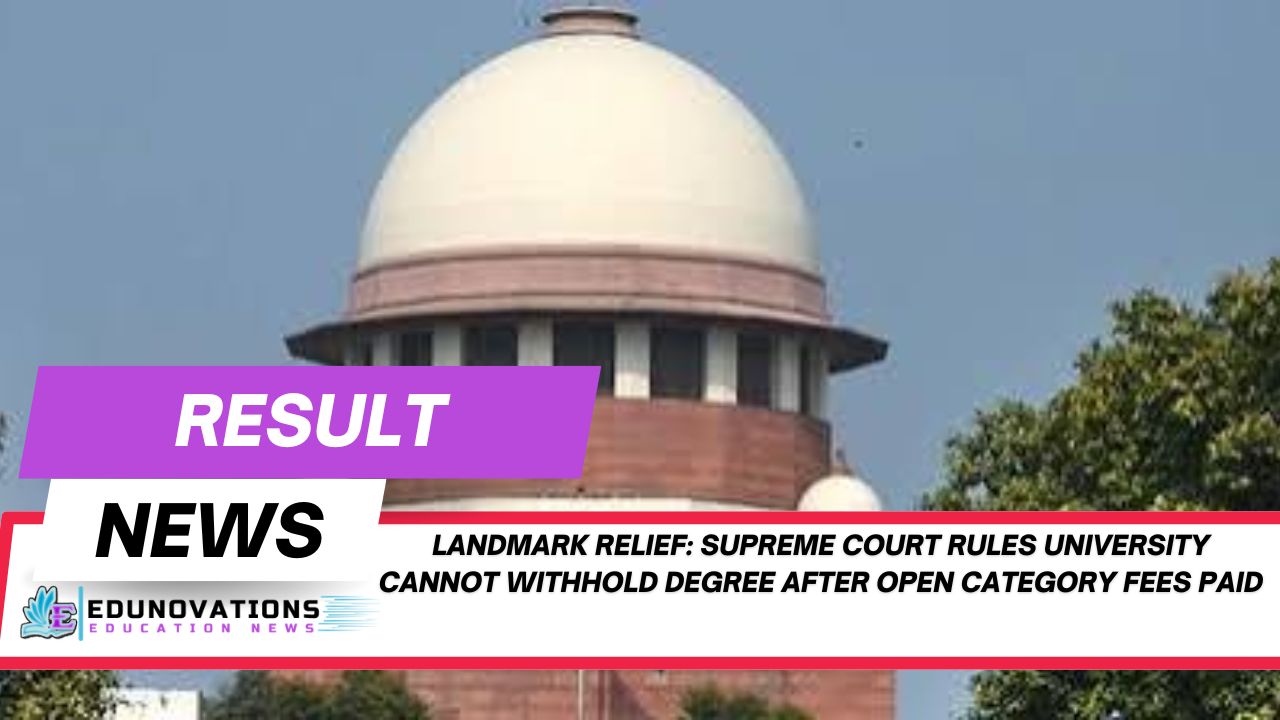
In a major legal precedent protecting student rights across India, the Supreme Court of India ruled that an invalid caste certificate cannot be used to withhold B.Pharm degree
In a major legal precedent protecting student rights across India, the Supreme Court of India ruled that an invalid caste certificate cannot be used to withhold B.Pharm degree documents after a student has completed the academic course and deposited fees applicable to open-category candidates.
The division bench of Justice B.V. Nagarathna and Justice Manmohan allowed the appeal filed by Cynthia Julious Charlie, setting aside previous orders of the Bombay High Court (Nagpur Bench). The Apex Court directed Sant Gadge Baba Amravati University to declare the student’s long-pending sixth and eighth-semester results within three weeks and issue her degree certificate alongside all original academic testimonials.
This decision clarifies the delicate legal balance between caste validation laws and academic equities. While the Supreme Court upheld the cancellation of the student’s Scheduled Tribe (ST) certificate, it emphatically ruled that academic progress and completed qualifications cannot be held hostage indefinitely once a student has fulfilled open-category financial obligations.
Detailed Case Background and Timeline
The legal dispute traces back over a decade to the 2014–15 academic session when Cynthia Julious Charlie enrolled in the four-year full-time Bachelor of Pharmacy (B.Pharm) program at an institution affiliated with Sant Gadge Baba Amravati University in Maharashtra.
At the time of admission, the candidate secured entry under the reserved Scheduled Tribe (ST) category, claiming affiliation with the ‘Gond’ tribe. However, during the initial phase of the academic program, college authorities notified her that she was eligible for admission under the general/open merit quota. Acting upon this communication, the student paid all prescribed open-category tuition fees and college dues throughout her four-year tenure. She successfully completed her coursework in 2018.
The Caste Scrutiny Committee Rejection
While the student was actively pursuing her studies, her caste claim underwent mandatory verification under the Maharashtra Scheduled Castes, Scheduled Tribes, Denotified Tribes (Vimukta Jatis), Nomadic Tribes, Other Backward Classes and Special Backward Category (Regulation of Issuance and Verification of) Caste Certificate Act, 2000.
On May 31, 2017, the Caste Scrutiny Committee invalidated and rejected her ST caste certificate. The committee concluded that she had failed to furnish adequate documentary evidence to substantiate her tribal lineage to the Gond community. Following this order, the university withheld her sixth and eighth-semester mark sheets, degree certificate, and original school-leaving testimonials.
+-----------------------------------------------------------------------------------+
|                            CHRONOLOGY OF LEGAL EVENTS                             |
+-------------------+---------------------------------------------------------------+
| Academic Year     | Admitted to B.Pharm (ST Quota); shifted to Open Fee structure. |
| 2014-15           |                                                               |
+-------------------+---------------------------------------------------------------+
| May 31, 2017      | Caste Scrutiny Committee rejects ST certificate claim.         |
+-------------------+---------------------------------------------------------------+
| 2018              | Student completes all B.Pharm coursework and examinations.    |
+-------------------+---------------------------------------------------------------+
| June 27, 2022     | Bombay High Court dismisses initial challenge against rejection|
+-------------------+---------------------------------------------------------------+
| October 6, 2022   | College Principal issues NOC confirming Open Category status  |
+-------------------+---------------------------------------------------------------+
| February 7, 2025  | Bombay High Court rejects second writ petition for documents  |
+-------------------+---------------------------------------------------------------+
| August 2026       | Supreme Court directs university to declare results & release |
|                   | original degree certificate within 3 weeks.                    |
+-------------------+---------------------------------------------------------------+
The High Court Litigation and Legal Hurdles
Aggrieved by the Scrutiny Committee’s decision, the student filed her first writ petition before the Bombay High Court (Nagpur Bench). On June 27, 2022, the High Court dismissed the petition, observing that the student could not produce valid documents proving her tribal status. Crucially, the court held that under prevailing regulations of the Maharashtra Directorate of Technical Education (DTE), a candidate admitted against a reserved seat could not retrospectively convert their admission into an open-category seat.
Following this dismissal, a significant administrative development occurred. On October 6, 2022, the Principal of the college issued an official communication to the Registrar of Sant Gadge Baba Amravati University. The letter formally certified that the student had completed her education from 2014-15 to 2018-19 as an open-category candidate, having cleared all standard non-subsidized institutional fees. The college requested the university to release her withheld academic credentials.
Second Rejection by Bombay High Court
Armed with this No-Objection Certificate (NOC), the student served a formal legal notice to the university. When officials failed to respond, she filed a second writ petition before the High Court.
However, on February 7, 2025, the Bombay High Court dismissed this second petition as well. The court held that:
- The 2022 decision upholding the caste certificate cancellation had achieved finality because it was not appealed immediately.
- The Principal’s communication had been subsequently withdrawn on October 14, 2024, and could not override DTE admission rules.
- The mere payment of open-category tuition fees did not automatically cure the initial invalidity of a reservation claim.
Faced with severe career stagnation, the student filed a Special Leave Petition (SLP) before the Supreme Court of India.
Supreme Court Analysis and Key Legal Precedents
When the matter reached the Apex Court bench comprising Justice B.V. Nagarathna and Justice Manmohan, counsel representing the student clarified at the outset that she was not seeking monetary compensation or restoration of her tribal status. Instead, the appeal focused strictly on her academic entitlement after having completed all required educational coursework and cleared full open-category financial dues.
The Supreme Court relied heavily on its prior authoritative precedents in Ajay Dattatraya Bandewad v. State of Maharashtra and Mrudula v. State of Maharashtra. In those landmark cases, the court recognized that where a student completes their professional course without displacing a candidate in a fraudulent manner and pays open-category fees, equity demands that their academic qualification be protected.
                       +-----------------------------------+
                       |    SUPREME COURT DUAL MANDATE     |
                       +-----------------+-----------------+
                                         |
            +----------------------------+----------------------------+
            |                                                         |
            v                                                         v
+-----------------------+                                 +-----------------------+
|  ACADEMIC PROTECTION  |                                 |   RESERVATION CAVEAT  |
+-----------------------+                                 +-----------------------+
| • Release 6th & 8th   |                                 | • ST certificate      |
|   semester results.   |                                 |   remains invalid.    |
| • Issue official      |                                 | • Cannot be used for  |
|   B.Pharm degree.     |                                 |   higher studies under|
| • Return original     |                                 |   reserved quotas.    |
|   school testimonials.|                                 | • Barred from public  |
| • Complete process    |                                 |   employment reservation|
|   in 3 weeks.         |                                 |   benefits.           |
+-----------------------+                                 +-----------------------+
The Operative Order
Allowing the appeals, the Supreme Court directed Sant Gadge Baba Amravati University to announce Cynthia Julious Charlie’s sixth and eighth-semester B.Pharm results within three weeks. If found qualified, the university must immediately issue her official degree certificate and return all original certificates lying in its custody.
Simultaneously, the bench established strict boundary conditions to safeguard the integrity of public reservation systems:
- No Future Benefits: The appellant is strictly prohibited from relying on the cancelled ST certificate for higher education admissions or public sector employment.
- Prohibition on Fresh Claims: The candidate is barred from applying for fresh ST category certificates based on the invalid document.
Expert Insights and Implications for Indian Higher Education
Legal experts and legal education analysts note that this judgment addresses a long-standing systemic dilemma in Indian professional colleges. Thousands of students face institutional impasses annually due to administrative delays in caste verification by state scrutiny committees.
Prominent legal scholar and advocate Vatsal Chandra commented on the broader implications of such judicial interventions:
“The Supreme Court’s decision draws a crucial legal line between administrative caste verification and accrued academic equity. When an educational institution recovers full, unsubsidized open-category fees from a candidate, withholding their degree after four years of study serves no public purpose and amounts to academic waste. By barring future reservation claims while preserving the degree, the Apex Court balanced public interest with individual equity.”
Key Takeaways for Students and Academic Institutions
- Separation of Degree from Caste Status: Completing a course under open-category financial terms creates a distinct legal right to academic certification, irrespective of subsequent caste scrutiny outcomes.
- Fee Classification Matters: Paying non-reserved, standard open tuition fees serves as a vital evidentiary safeguard in courts when contesting withheld mark sheets.
- No Retrospective Exploitation: Candidates whose caste certificates are invalidated cannot use their past degrees to claim affirmative action benefits in post-graduate courses or government jobs.
For students preparing for competitive legal, civil service, or state exams, reviewing constitutional precedents regarding public employment and education rights is essential. You can enhance your preparation through NCERT Courses, keep updated with legal news on Current Affairs, access comprehensive Notes, practice latest MCQs, watch educational Videos, check official Syllabus, download free study materials via Free NCERT PDFs, and visualize complex topics with NCERT Mind Maps. Additionally, educational institutions seeking custom web portals can consult Mart Ind Infotech for specialized development services.
Toppers Use Mind Maps to score more than 95%
NCERT Class 11th Commerce Mind Maps
Add to cartOriginal price was: ₹999.00.₹199.00Current price is: ₹199.00.NCERT Class 12th Chemistry Mind Maps
Add to cartOriginal price was: ₹199.00.₹75.00Current price is: ₹75.00.NCERT Class 12th Commerce Mind Maps
Add to cartOriginal price was: ₹999.00.₹199.00Current price is: ₹199.00.NCERT Class 12th Science Mind Maps
Add to cartOriginal price was: ₹999.00.₹199.00Current price is: ₹199.00.NCERT Mind Maps For Class 10th
Add to cartOriginal price was: ₹999.00.₹199.00Current price is: ₹199.00.




Purchase Today
Frequently Asked Questions (FAQs)
1. Can university withhold degree if caste certificate is cancelled?
No, according to the Supreme Court ruling in Cynthia Julious Charlie v. Vice Chancellor, a university cannot permanently withhold a degree if the student completed the course and paid full open-category fees. However, the student loses all future reservation benefits associated with that caste certificate.
2. What was the Supreme Court ruling on withholding degree over caste certificate issues?
The Supreme Court ruled that invalidation of a Scheduled Tribe or Scheduled Caste certificate cannot justify withholding academic mark sheets and degrees if the student fulfilled open category tuition fees and satisfied all course academic requirements.
3. How does the b pharm degree invalid caste certificate open category fees case affect future students?
This judgment serves as a binding precedent under Article 141 of the Constitution of India. Pharmacy and technical education students across India whose caste certificates are rejected by scrutiny committees can seek release of their educational documents if they paid non-concessional open-category fees during their studies.
4. What are the legal rights under caste scrutiny committee certificate rejection student degree rights?
When a Caste Scrutiny Committee rejects a caste claim, the candidate loses entitlement to fee concessions and quota seats. However, if the institution retains them as open-category students and collects full fees, the student retains the right to obtain their academic mark sheets, provisional pass certificates, and final degree.
5. What happens if caste certificate is rejected after completing course in professional degrees?
If a caste certificate is invalidated post-completion, the degree earned remains valid for employment or private practice, provided the student paid open category fees. However, the candidate cannot use the degree or past reservation status to claim reserved seats in higher education or government jobs.
6. What precedent did the Supreme Court rely upon in this case?
The Apex Court bench relied on its earlier decisions in Ajay Dattatraya Bandewad v. State of Maharashtra and Mrudula v. State of Maharashtra, which similarly upheld student academic rights against institutional document withholding.
7. Can a student use a degree obtained under this ruling for government job reservations?
No. The Supreme Court explicitly directed that the student cannot rely on the cancelled certificate or past reserved status for any future benefit in public employment or government job quotas.
8. How long does a university have to declare results after a Supreme Court release order?
In this landmark decision, the Supreme Court mandated a strict deadline of three weeks from receiving the certified copy of the order for Sant Gadge Baba Amravati University to publish withheld semester results and issue the final degree.
9. What happens to original school testimonials submitted during admission?
The Supreme Court mandated that all original educational testimonials and documents submitted during admission must be returned to the student along with the official degree certificate.
10. Does paying open category fees automatically regularize invalid caste admissions?
Not automatically in all contexts, but for completed courses, courts apply the doctrine of equity. If an institution charges full open-category fees, it cannot subsequently claim that the candidate enjoyed unauthorized state concessions to withhold their degree.