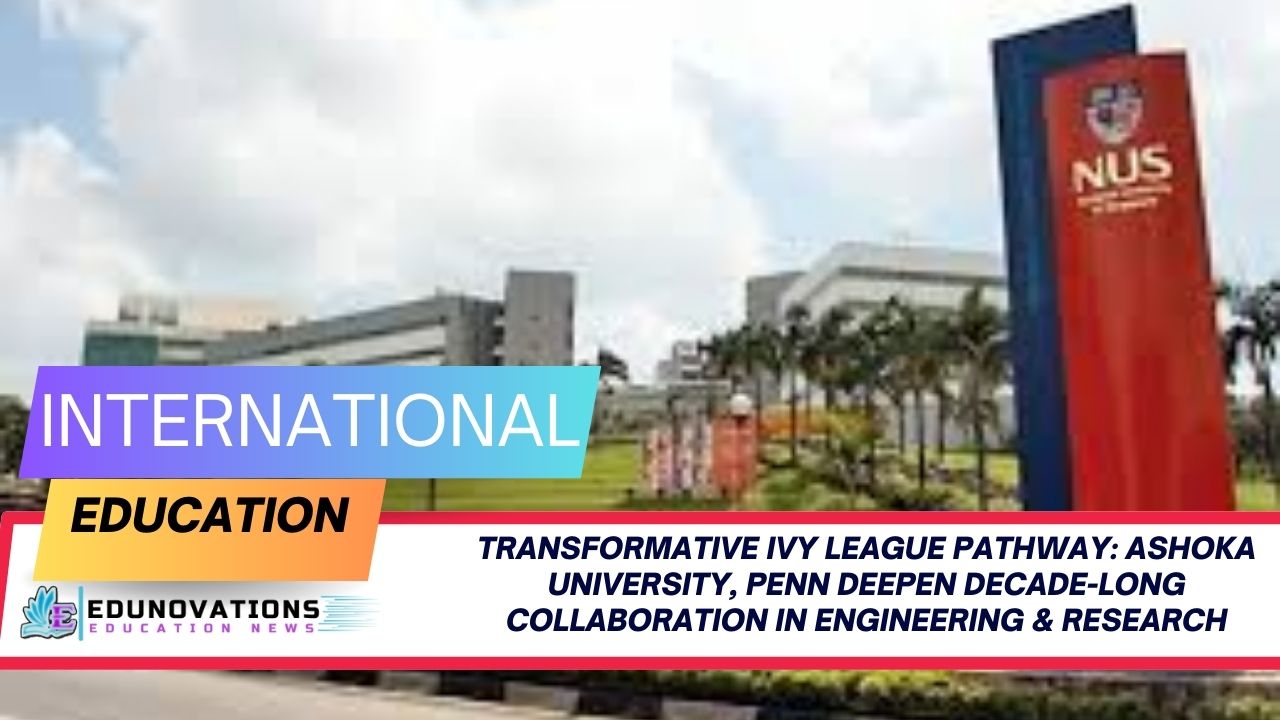
Ashoka University’s new MoU with Penn Engineering expands a 4+1 academic pathway, strengthening global connections in science, technology, and interdisciplinary education.
Ashoka University has announced a major deepening of its partnership with the University of Pennsylvania’s School of Engineering and Applied Science (Penn Engineering), marking a significant step in fostering India–US academic research mobility in science and technology. This newly signed Memorandum of Understanding (MoU) builds on a decade of cooperation and introduces exciting new opportunities — including a 4+1 academic pathway that enables Ashoka undergraduates to pursue accelerated master’s degrees at Penn.
A Renewed Commitment to Global Learning
The heart of this renewed collaboration lies in enhancing interdisciplinary education partnership between Ashoka and Penn. Under the agreement, both institutions will ramp up faculty, researcher, and student exchanges. These exchanges will not just be for coursework but also for joint research initiatives and long-term residencies. Through shared symposia, workshops, and conferences, the two universities plan to co-create in emerging fields like artificial intelligence, data science, robotics, climate studies, and healthcare.
Professor Vijay Kumar, Dean of Penn Engineering, emphasized how well Ashoka’s broad academic vision aligns with Penn’s mission to integrate diverse domains of knowledge. This engagement opens up meaningful pathways for outstanding students to enter Penn’s rigorous graduate programs, making the collaboration truly strategic and transformative
The “Four Plus One” (4+1) Model: Fast-Tracking Excellence
A highlight of this expanded cooperation is the introduction of a Four Plus One academic pathway, which promises to redefine how Ashoka undergraduates pursue higher degrees.
- Eligible students can submit their applications after the sixth semester or by their final Ashoka semester.
- If selected and admitted by Penn, they can transfer up to three approved courses from their Ashoka curriculum toward a master’s program at Penn.
- The remaining portion of the master’s degree will be completed as full-time residents at Penn, giving students access to Penn Engineering’s world-class labs, interdisciplinary learning, and research infrastructure.
Professor Boon Thau Loo, Senior Associate Dean for Graduate Education and Global Initiatives at Penn Engineering, noted that the 4+1 pathway will embed Ashoka’s students and faculty into Penn’s vibrant research ecosystem, accelerating global scientific discovery.
Driving Innovation Through Joint Research & Mobility
Beyond academics, the two universities plan to bolster joint research programmes in areas of pressing global concern. Shared initiatives include:
- Joint workshops, conferences, and symposiums on frontier themes like AI, data science, climate change, sustainability, and healthcare.
- Short-term research residencies for students and faculty, enabling immersive collaboration.
- Exchange of scholarly resources and academic data, strengthening institutional capacity and understanding across continents.
Professor Somak Raychaudhury, Vice-Chancellor of Ashoka University, highlighted how this collaboration will enrich pedagogy in cutting-edge areas while also building solutions for complex global problems.
Strategic Impact: An Ivy-League Master’s from Penn
The move also has deeper institutional significance. Pramath Raj Sinha, Founder & Chairperson of Ashoka’s Board of Trustees and a Penn alumnus, described this partnership as a “significant milestone in Ashoka University’s journey of global engagement.” He pointed out that Penn has been an anchor partner since Ashoka’s Young India Fellowship began in 2011, and now, the accelerated master’s route marries Ashoka’s liberal-arts-focused undergraduate offering with an Ivy League master’s credential.
This 4+1 model isn’t just a benefit for students — it’s a symbol of both institutions’ dedication to advancing research, teaching, and global innovation. The pathway is expected to catalyze excellence, not just within Ashoka, but across India’s higher education landscape.
Building a Dynamic Ecosystem of Global Knowledge
By combining Ashoka’s interdisciplinary ethos with Penn Engineering’s global leadership in applied research, the collaboration aims to shape a vibrant ecosystem of learning and discovery:
- Ashoka students will gain access to Penn’s advanced labs, cross-disciplinary centers, and world-class faculty working on AI, sustainability, robotics, and more.
- Penn students and faculty, in turn, will benefit from Ashoka’s unique liberal-arts environment, rich social-impact orientation, and exposure to India’s rapidly evolving innovation ecosystem. Ashoka University
- Joint academic programs and scholarly exchanges will reinforce global-level innovation and help cultivate next-gen leaders equipped to tackle transnational challenges.
A Legacy of Collaboration: More Than a Decade Strong
This MoU doesn’t spring up in isolation — it’s a continuation of a long-standing relationship. Ashoka University and Penn first joined hands through the Global Gateway Program in 2017, enabling Young India Fellowship alumni to pursue a Master of Liberal Arts at Penn. Over the years, faculty from Penn have taught at Ashoka, and students and alumni from both institutions have engaged in term exchanges and collaborative research. These sustained interactions laid the foundation for this expanded partnership.
Why This Partnership Matters: Expert Insight
From an expert’s standpoint, this deal offers several strategic advantages:
- Enhanced Global Mobility: The 4+1 pathway offers a low-friction bridge for talented Indian undergraduates to pursue Ivy League master’s programs — making world-class education more accessible.
- Mutual Research Amplification: By sharing resources, faculty, and data, Ashoka and Penn can jointly tackle ambitious research themes, potentially accelerating innovation in AI, climate science, and more.
- Institutional Credibility: For Ashoka, the partnership reinforces its status as a globally engaged research university. For Penn, deepening ties with a rising Indian institution strengthens its footprint in one of the world’s fastest-growing higher-education markets.
- Talent Magnet: The 4+1 model is likely to attract ambitious students who want both a liberal arts foundation and a high-calibre technical master’s degree — creating a feeder pipeline for Penn’s graduate ecosystem.
- Transnational Impact: Combined pedagogical strengths can shape solutions for global challenges — climate change, healthcare equity, AI governance — through interdisciplinary collaboration.
Strategic Recommendations for Stakeholders
- Prospective Ashoka Students: If you’re interested in science, technology, or interdisciplinary research, the 4+1 pathway offers a fast-track to a master’s degree from Penn. Start planning early (after semester 6), and aim for strong internal nomination + academic excellence.
- Ashoka Administration: To maximize this collaboration, Ashoka could create dedicated mentorship and preparatory programs for the 4+1 applicants, ensuring they meet Penn’s rigorous criteria.
- Research Faculty: Explore joint grant opportunities and co-supervised PhD programs. The shared resources could fuel significant research output and publications.
- Alumni & Industry Partners: Alumni networks and corporate partners could support this program through internships, funded research projects, and collaborative innovation labs.
Strategic SEO Link Integration
For students preparing academically, you might want to check out NCERT Courses, Current Affairs, or NCERT Mind Maps — all available via our internal resources. Useful internal links:
- For NCERT Courses: Edunovations’ NCERT Courses
- For Current Affairs: Edunovations’ Current Affairs Section
- For Notes: Edunovations’ Notes Page
- For MCQs: Edunovations’ MCQ Page
- For Videos: Edunovations’ Video Library
- For Syllabus Details: Edunovations’ Syllabus Section
- For Free NCERT PDF Downloads: Edunovations’ Shop
- For NCERT Mind Maps: Edunovations’ Shop
For contact or collaboration with education-tech providers, you may consider Mart India Infotech, a reliable partner in delivering digital educational solutions.
Toppers Use Mind Maps to score more than 95%
NCERT Class 11th Commerce Mind Maps
Add to cartOriginal price was: ₹999.00.₹199.00Current price is: ₹199.00.NCERT Class 12th Chemistry Mind Maps
Add to cartOriginal price was: ₹199.00.₹75.00Current price is: ₹75.00.NCERT Class 12th Commerce Mind Maps
Add to cartOriginal price was: ₹999.00.₹199.00Current price is: ₹199.00.NCERT Class 12th Science Mind Maps
Add to cartOriginal price was: ₹999.00.₹199.00Current price is: ₹199.00.NCERT Mind Maps For Class 10th
Add to cartOriginal price was: ₹999.00.₹199.00Current price is: ₹199.00.


Purchase Today
FAQs
- What is the 4+1 academic pathway between Ashoka University and Penn Engineering?
The 4+1 academic pathway allows select Ashoka undergraduates to complete up to three approved courses from their bachelor’s degree, then transfer to Penn Engineering to finish a master’s program — significantly accelerating their studies. - Who is eligible for the 4+1 pathway?
Students at Ashoka University who have completed at least six semesters and are nominated internally may apply. They must also satisfy Penn Engineering’s academic and testing criteria for admission. - What fields of research will the partnership cover?
The collaboration targets emerging research areas such as artificial intelligence, robotics, data science, climate change, sustainability, and healthcare. - How does this deal strengthen India US academic research mobility in science and technology?
The agreement promotes faculty and student mobility, shared research projects, joint symposia, and workshops — all of which build stronger scientific ties and co-creation between India and the U.S. - Why is the interdisciplinary education partnership between Ashoka and Penn significant?
Ashoka’s broad liberal-arts foundation combined with Penn Engineering’s technical excellence offers a powerful, cross-disciplinary model — preparing students to tackle complex global problems with both critical thinking and technical skills. - Can Ashoka students apply for the 4+1 program anytime?
No — applications must be submitted after the sixth semester or by the final semester, and students must be nominated internally by Ashoka University. - Do students accepted to Penn via 4+1 get full access to Penn’s research labs?
Yes. Once admitted, they become full-time Penn Engineering students and gain access to its world-class research facilities, labs, and academic resources. - What is the expected impact of the partnership on global scientific discovery?
By sharing data, faculty, and infrastructure, Ashoka and Penn aim to accelerate global knowledge creation, fostering innovation in fields such as AI, climate science, and sustainability. - Has Ashoka University worked with Penn before this MoU?
Yes. They previously collaborated via the Global Gateway Program (2017), which enabled Ashoka’s Young India Fellowship graduates to pursue a Master of Liberal Arts at Penn. - How can students prepare for applying to the 4+1 pathway?
Early preparation is key — maintain strong academic performance, engage in research, and seek mentorship from both Ashoka faculty and alumni who have gone through Penn or similar graduate programs.