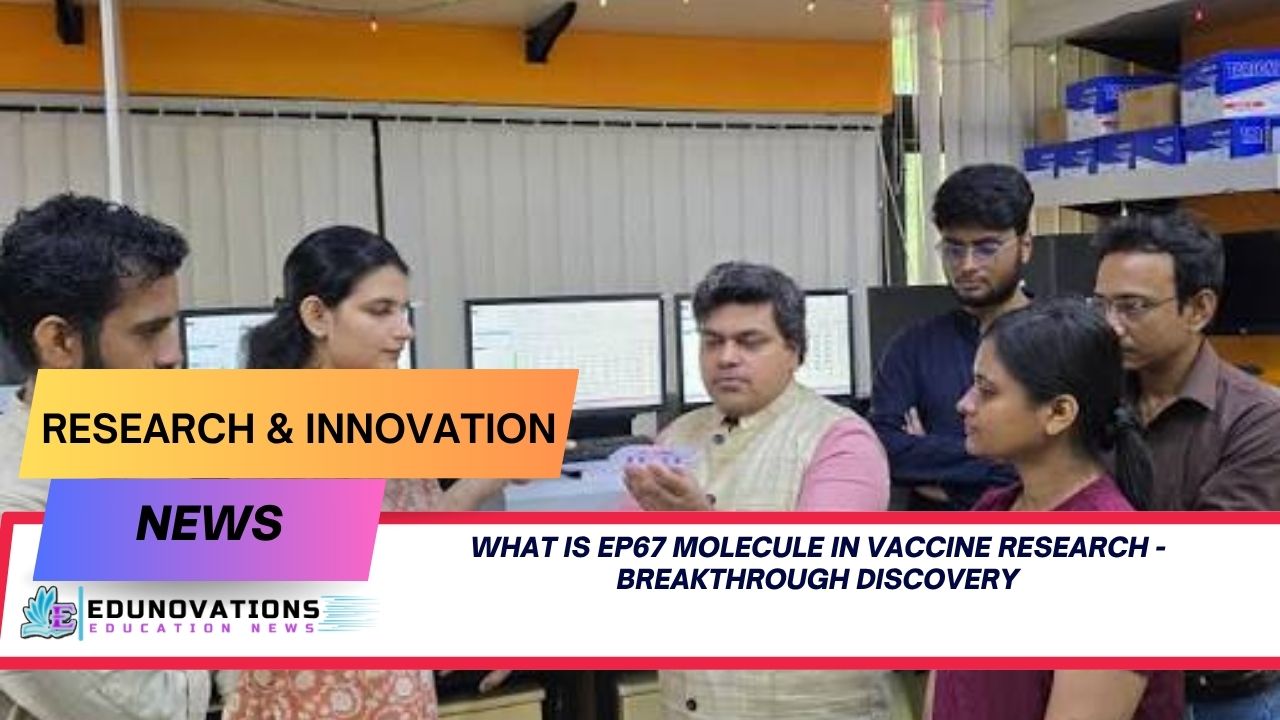
Discover what is EP67 molecule in vaccine research and how a groundbreaking study from IIT Kanpur is transforming future immunology and medical treatments.
The landscape of modern medicine and global health is constantly evolving, driven by relentless scientific inquiry and technological advancement. In an era where viral and bacterial pathogens continually adapt, the race to design safer, more efficient, and long-lasting vaccines remains a top priority for global research institutions. Recent breakthroughs from premier research facilities are shedding light on innovative ways to prime the human immune defense mechanism without triggering harmful side effects or excessive inflammation. Understanding these complex biological processes is crucial for students, researchers, and science enthusiasts who want to stay updated on cutting-edge developments. For those pursuing rigorous academic paths, exploring structured resources like NCERT Courses can build a strong foundational understanding of fundamental biology and cellular mechanisms.
Understanding the Mechanics of Human Immunity
To comprehend why recent scientific advancements are creating waves in the medical community, one must first look at how the human body naturally responds to infections. When a harmful pathogen breaches our biological barriers, our immune cells release specialized signaling proteins. Among these, a small protein known as C5a plays a pivotal role in sounding the alarm, priming the immune system to fight back aggressively. However, biology operates on a delicate balance. When too much C5a remains active for an extended period, it triggers severe inflammation, leading to unintended tissue damage and discomfort.
The human body naturally manages this through regulatory enzymes that quickly break down C5a once the threat has cleared. Inspired by this ingenious natural safety mechanism, researchers have sought to replicate only the beneficial aspects of this process while eliminating the dangerous inflammatory aftermath. Such profound scientific milestones are frequently tracked by scholars preparing for competitive exams through Current Affairs portals, ensuring they remain informed about cutting-edge global innovations.
The Engineering of Advanced Vaccine Adjuvants
Adjuvants are specialized ingredients added to vaccines to enhance the body’s immune response, ensuring that the protection provided is both robust and long-lasting. Traditional adjuvants have sometimes struggled to find the optimal sweet spot between eliciting a strong defense and avoiding unwanted tissue inflammation.
To bridge this gap, scientists have successfully engineered a stripped-down, synthetic copy of the C5a protein. This engineered molecule consists of a short chain of just ten amino acids. Designed to mimic the helpful components of C5a safely, it wakes up crucial immune components—specifically dendritic cells and macrophages—which are essential for establishing long-term immunological memory. At the same time, it leaves neutrophils, the cells primarily responsible for collateral tissue inflammation, largely unaffected. This precision engineering marks a monumental shift in how next-generation immunizations are conceptualized.
For students and educators looking to dive deeper into these topics, utilizing comprehensive Notes can simplify complex biochemical pathways into digestible study material.
The Role of EP67 in Fighting Viral and Bacterial Threats
At the heart of this recent breakthrough is an experimental molecule that has captured the attention of immunologists worldwide. By focusing on how this synthetic peptide interacts with cellular receptors, researchers have unlocked new pathways for therapeutic interventions. Pre-clinical studies involving animal models have demonstrated that when this specialized adjuvant is incorporated into viral immunizations—including those targeting respiratory viruses like COVID-19—test subjects mount a vastly superior defense and recover at a significantly faster rate than those receiving the immunization alone.
Furthermore, this experimental molecule has shown surprising efficacy in combating persistent bacterial challenges, including strains of methicillin-resistant staphylococcus aureus that typically shrug off standard antibiotic treatments. This dual capability against both viral and bacterial threats opens up exciting new avenues for prophylactic and therapeutic medicine.
To test your comprehension of these advanced biological concepts, practicing with targeted MCQ’s can help solidify key facts and data points for academic assessments.
Decoding Cellular Receptors and Structural Biology
A major hurdle in traditional drug and vaccine design has been understanding the exact binding sites and target receptors on human cells. Without knowing the precise molecular target, optimizing a candidate molecule for clinical use is largely speculative.
The targeted receptor belongs to a massive family known as G protein-coupled receptors, or GPCRs. These critical receptors reside within the outer membrane of cells, acting as vital communication channels that relay biochemical signals inward. In fact, approximately one in three prescription medicines currently available on the market functions by interacting with a GPCR, making them the single largest group of drug targets in human biology.
Using advanced laboratory techniques such as cryo-electron microscopy—a cutting-edge imaging method that flash-freezes molecules to capture them in near-atomic detail—scientists have successfully captured the exact moment the adjuvant locks onto its cellular target. The resulting high-resolution images reveal that the molecule folds into a distinct hook shape, slotting precisely into the center of the receptor to activate it gently and effectively.
Visual learners and analytical thinkers can enhance their retention of these complex structural biology concepts by exploring curated Videos that break down cellular receptor interactions step by step.
Expert Insights and Academic Perspectives
The significance of this research extends far beyond basic laboratory observations; it provides a concrete blueprint for designing safer, more targeted treatments. Leading scientists emphasize that knowing the exact atomic configuration of these receptor-ligand interactions allows researchers to fine-tune amino acid sequences, making candidate molecules sturdier and more precise.
Prominent figures in the scientific community have praised these interdisciplinary efforts. Professor Arun K. Shukla, a renowned structural biologist and lead researcher behind this landmark study from the Department of Biological Sciences and Bioengineering at the Indian Institute of Technology Kanpur, noted that mapping these near-atomic structures bridges a critical gap in translational immunology. “Understanding the precise handshake between the molecule and the receptor gives us an unprecedented design playbook,” experts in the field observe, highlighting how structural clarity transforms empirical testing into rational, predictable engineering.
Such cutting-edge advancements are reshaping standard academic curricula across the country. Educational institutions and schools looking to modernize their digital infrastructure and science learning portals often collaborate with industry leaders like Mart Ind Infotech to build engaging web platforms. Additionally, students aligning their studies with institutional frameworks can easily access the required Syllabus guidelines to stay on track.
Future Implications for Global Health
As pre-clinical testing progresses toward formulation refinement and dosage optimization, the medical community anticipates a new wave of safer immunological products. By reducing systemic inflammation while boosting cellular defense mechanisms, these innovations promise to minimize adverse post-immunization reactions and expand protection to vulnerable populations.
For those eager to read deeper into the underlying source materials, or looking for offline reading options, downloading Free NCERT PDFs provides an accessible entry point into fundamental science. To further map out interconnected biological topics visually, students can utilize comprehensive NCERT Mind Maps to connect cellular respiration, immunology, and pharmacology into a unified mental framework.
Ultimately, the convergence of advanced structural biology, high-resolution cryo-EM imaging, and rational molecular design heralds a transformative chapter in modern medicine. As research continues to push boundaries, the gap between experimental biology and clinical application closes, paving the way for a healthier, more resilient global population.
Toppers Use Mind Maps to score more than 95%
NCERT Class 11th Commerce Mind Maps
Add to cartOriginal price was: ₹999.00.₹199.00Current price is: ₹199.00.NCERT Class 12th Chemistry Mind Maps
Add to cartOriginal price was: ₹199.00.₹75.00Current price is: ₹75.00.NCERT Class 12th Commerce Mind Maps
Add to cartOriginal price was: ₹999.00.₹199.00Current price is: ₹199.00.NCERT Class 12th Science Mind Maps
Add to cartOriginal price was: ₹999.00.₹199.00Current price is: ₹199.00.NCERT Mind Maps For Class 10th
Add to cartOriginal price was: ₹999.00.₹199.00Current price is: ₹199.00.




Purchase Today
Frequently Asked Questions
- what is EP67 molecule in vaccine research? EP67 is an experimental, stripped-down synthetic peptide consisting of ten amino acids designed to mimic the beneficial defensive aspects of the natural C5a protein without causing harmful inflammation.
- how vaccine adjuvants activate immune cells? Adjuvants enhance immunization efficacy by safely engaging specific receptors on key immune components like dendritic cells and macrophages, provoking a stronger and longer-lasting protective response.
- IIT Kanpur EP67 vaccine study PNAS The research study led by Professor Arun K. Shukla’s laboratory at IIT Kanpur detailing the structural interaction of EP67 was published in the prestigious journal Proceedings of the National Academy of Sciences (PNAS) in July 2026.
- difference between C5a and EP67 adjuvant While natural C5a triggers strong immunity alongside severe, harmful inflammation, EP67 replicates only the helpful defensive signaling while leaving inflammatory pathways largely unaffected.
- how do GPCR targets work in modern medicine? G protein-coupled receptors sit in cell membranes to relay external chemical signals inward, acting as the largest class of drug targets with roughly one in three prescription medicines acting upon them.
- What role do dendritic cells and macrophages play in immunity? These specific immune cells act as frontline sentinels that help the human body recognize pathogens and build robust, lasting immunological memory following an infection or immunization.
- Why is cryo-electron microscopy important in structural biology? Cryo-electron microscopy flash-freezes biological molecules, allowing scientists to capture high-resolution, near-atomic images of how molecules bind to their specific cellular receptors.
- Which institutions collaborated on the IIT Kanpur EP67 study? The study was a collaborative effort involving researchers from IIT Kanpur, the University of Southern California, and the University of Queensland, supported by bodies like the ICMR, ANRF, DBT, and DST.
- How does EP67 help protect against bacterial infections like MRSA? Pre-clinical tests indicate that EP67 stimulates broad immune activation that unexpectedly helps the body successfully fight off persistent bacterial strains resistant to conventional antibiotics.
- What are the next steps for EP67 following the PNAS publication? Subsequent phases of research focus on refining chemical formulations, optimizing dosing parameters, and advancing through comprehensive pre-clinical and clinical trials.