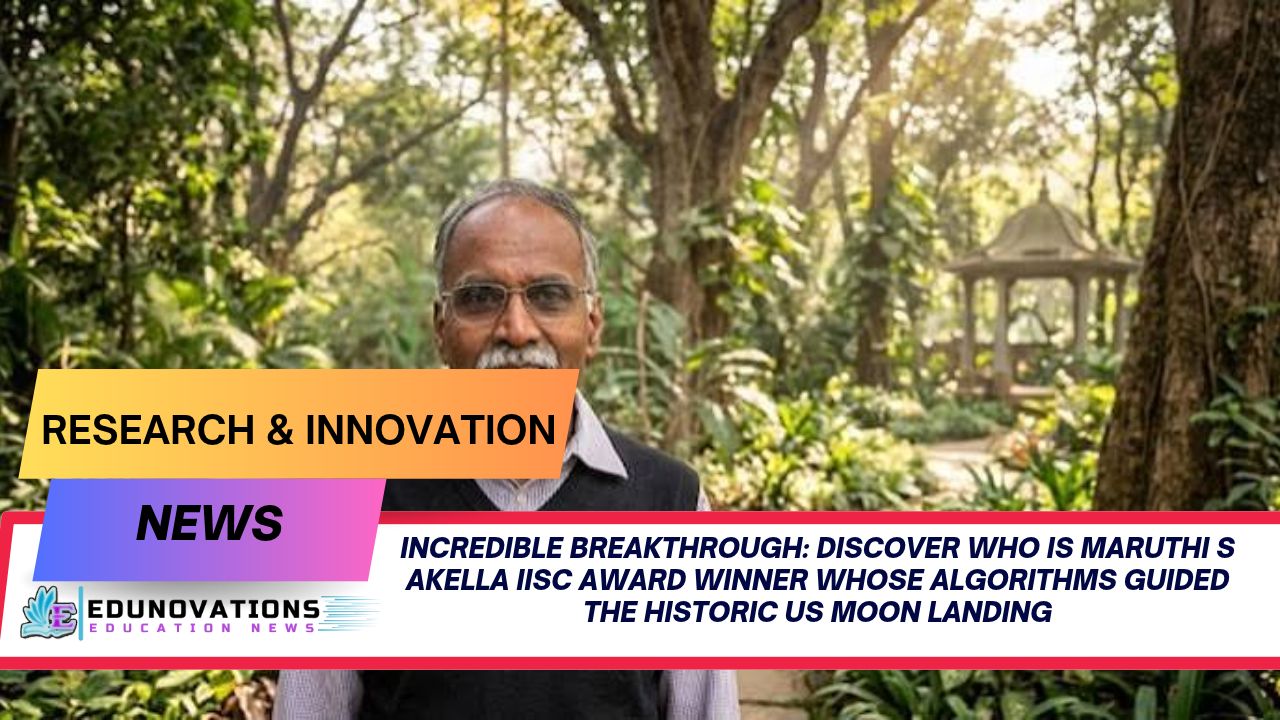
Uncover who is maruthi s akella iisc award winner, the UT Austin professor whose guidance algorithm powered the first US Moon landing in 50 years and earned an asteroid name.
The relentless pursuit of space exploration has long captured human imagination, marking milestones that redefine our technological capabilities. In a monumental triumph for global scientific research, the Indian Institute of Science (IISc) Bengaluru has announced its prestigious Distinguished Alumnus and Young Alumnus Awards. Among the luminaries being honored is an extraordinary aerospace visionary whose cutting-edge mathematical models propelled humanity back to the lunar surface. For students, researchers, and space enthusiasts eager to understand who is maruthi s akella iisc award recipient, this inspiring narrative bridges rigorous academic excellence at IISc with groundbreaking aerospace achievements in the United States.
As educational institutions increasingly emphasize STEM learning—supported by robust platforms providing NCERT Courses and up-to-date Current Affairs—the story of Professor Maruthi S. Akella stands as a beacon of what dedicated scholarly pursuits can achieve. From mastering orbital mechanics in Bengaluru to shaping the future of autonomous spaceflight in Texas, his journey is a testament to perseverance, innovation, and global scientific collaboration.
The Journey from IISc Bengaluru to Global Aerospace Leadership
Understanding who is maruthi s akella iisc award winner requires looking back at his foundational academic years in India. Born with an intense fascination for how complex dynamical systems operate, Professor Akella pursued his Master of Engineering (ME) degree in Aerospace Engineering at the Indian Institute of Science (IISc), successfully graduating in 1994.
IISc has historically served as an incubator for world-class scientific minds, producing leaders who drive technological transformations across government research organizations, private enterprises, and premier global universities. Reflecting on this legacy, IISc Director Professor G. Rangarajan emphasized that the annual alumni honors recognize individuals whose exceptional contributions significantly advance their professions, enrich society, and elevate the institution’s global stature.
Following his foundational studies in India, Professor Akella moved to the United States to pursue advanced doctoral research, eventually securing a prestigious academic tenure. Today, he holds the esteemed Cockrell Family Chair in Engineering at the University of Texas at Austin. Furthermore, he serves as the founding director of the Center for Autonomous Air Mobility at UT Austin, is the Editor-in-Chief of The Journal of the Astronautical Sciences, and has actively contributed to Indo-US scientific collaboration as a VAIBHAV Fellow hosted by IISc.
Students exploring comprehensive academic concepts often rely on structured study materials, such as detailed Notes, practice MCQ’s, instructional Videos, and structured Syllabus guides. Just as mastering fundamental engineering principles is essential for academic success, Professor Akella’s mastery of advanced mathematics laid the groundwork for mission-critical space applications.
Decoding the Historic IM-1 Lunar Lander Mission
The crowning achievement that brought Professor Akella global acclaim involves his research group’s vital contribution to the Intuitive Machines IM-1 lunar lander mission. To fully grasp who is maruthi s akella iisc award honoree is to understand the immense technical hurdles overcome during this historic endeavor.
In February 2024, the IM-1 mission achieved what no American spacecraft had accomplished in more than five decades: a successful soft landing on the lunar surface. Since the conclusion of NASA’s Apollo program in the 1970s, landing a US-built spacecraft on the Moon remained an elusive milestone fraught with engineering perils.
Spacecraft guidance, navigation, and control (GNC) represent some of the most rigorous challenges in aerospace engineering. During a lunar descent, a spacecraft must autonomously calculate its position, velocity, and trajectory in real time while managing propellant consumption and terrain hazards. Professor Akella’s research group specialized in crafting advanced adaptive control frameworks and onboard guidance algorithms.
- Real-Time Autonomous Navigation: The algorithms developed by his team allowed the IM-1 lander to make instantaneous trajectory corrections without relying entirely on real-time ground station interventions.
- Attitude Estimation and Control: Ensuring the spacecraft maintained optimal orientation while descending through the tenuous lunar exosphere required ultra-precise state estimation models.
- Resilience Against Uncertainties: Space environments introduce unpredictable gravitational anomalies and sensor noise, which the adaptive control strategies successfully neutralized.
For educators and school administrators looking to foster similar technical curiosity in classrooms, modern digital transformation is equally vital. Institutions seeking advanced administrative and e-learning integration can connect with Mart Ind Infotech to build robust digital infrastructure.
An Asteroid in the Stars: The Legacy of Minor Planet 5376
Scientific recognition of this magnitude often transcends terrestrial honors. In October 2024, the International Astronomical Union’s (IAU) Working Group for Small Bodies Nomenclature officially approved a tribute that immortalized Professor Akella among the stars.
The minor planet designated as 5376, originally discovered in 1990 by astronomers S. Ueda and H. Kaneda in the main asteroid belt between Mars and Jupiter, was officially named “Maruthiakella”. Having an asteroid named after oneself is among the rarest honors bestowed upon a living scientist, symbolizing how deeply a researcher’s intellectual contributions resonate within the global astronomical community.
This celestial recognition highlights the broader significance of asteroid named after maruthi s akella, tying his theoretical work in orbital mechanics directly to the celestial bodies he studies. Observers and researchers tracking deep-space dynamics note that such honors validate decades of quiet, painstaking mathematical modeling that often goes unnoticed by the general public until a major breakthrough occurs.
Students and aspirants eager to dive deeper into planetary science and space exploration can access a wealth of educational resources, including Downloads of Free NCERT PDFs and interactive NCERT Mind Maps to simplify complex astronomical and physical concepts.
The IISc Distinguished Alumni Awards 2026: Full Winner List and Context
The formal recognition of Professor Akella forms part of a larger celebration announced by the Indian Institute of Science. The 2026 honors highlight exceptional individuals across diverse scientific and technological domains. Reviewing the iisc distinguished alumnus award 2026 list reveals a powerhouse of intellects shaping modern science, defense, and digital infrastructure:
- Professor Maruthi R. Akella – Recognized for pioneering spacecraft guidance, orbital mechanics, and contributions to the IM-1 lunar landing mission.
- Professor B.S. Manjunath – Computer scientist at the University of California, Santa Barbara, renowned for computer vision, image informatics, and foundational work on the BisQue open-source platform and MPEG-7 standards.
- Professor Dipankar Das Sarma – Eminent condensed matter physicist and ANRF National Science Chair, recognized for advancing materials physics and securing India’s access to international synchrotron facilities.
- Dr. Jagannath Nayak – Director General of Missiles and Strategic Systems at DRDO, honored for leading indigenous development of high-accuracy Fibre Optic Gyroscopes for defense programs like Akash, Nag, and Astra.
- Professor Rajat Moona – Director of IIT Gandhinagar, celebrated for shaping India’s digital infrastructure, including technologies behind driving licenses, e-passports, EVMs, VVPAT, FASTag, and supercomputing advancements.
In addition to the distinguished alumni, IISc also conferred Young Alumnus Medals on three rising researchers under the age of 40: Dr. Abhishek Sinha (TIFR Mumbai) for theoretical computer science and network optimization; Dr. Geethu Joseph (TU Delft) for sparse control and autonomous systems; and Dr. Himanshu Joshi (IIT Hyderabad) for computational biophysics and DNA nanotechnology.
The awards ceremony is scheduled to take place on December 19, 2026, at the JN Tata Auditorium on the IISc Bengaluru campus.
Academic Excellence and Aerospace Engineering: A Synergy
The intersection of rigorous academic training and real-world application is vividly illustrated in maruthi r akella iisc aerospace engineering pedigree. Completing an ME degree in 1994 provided him with a rigorous theoretical bedrock that he later expanded through advanced doctoral work and decades of professorial research.
Experts in control theory often point out that spacecraft guidance is essentially about managing feedback loops under extreme constraints. When asked about his pedagogical and research philosophy, Professor Akella has frequently highlighted that students must embrace foundational mathematics before attempting complex space systems design. This philosophy mirrors the structured learning paths promoted by academic platforms that provide students with essential tools for lifelong learning.
Toppers Use Mind Maps to score more than 95%
-
NCERT Class 11th Commerce Mind Maps
Add to cartOriginal price was: ₹999.00.₹199.00Current price is: ₹199.00. -
NCERT Class 12th Chemistry Mind Maps
Add to cartOriginal price was: ₹199.00.₹75.00Current price is: ₹75.00. -
NCERT Class 12th Commerce Mind Maps
Add to cartOriginal price was: ₹999.00.₹199.00Current price is: ₹199.00. -
NCERT Class 12th Science Mind Maps
Add to cartOriginal price was: ₹999.00.₹199.00Current price is: ₹199.00. -
NCERT Mind Maps For Class 10th
Add to cartOriginal price was: ₹999.00.₹199.00Current price is: ₹199.00.



Purchase Today
Frequently Asked Questions
1. Who is Maruthi S. Akella and why is he in the news?
Professor Maruthi S. Akella is an aerospace engineering expert and IISc alumnus who serves as the Cockrell Family Chair in Engineering at UT Austin. He made headlines after being named a recipient of the IISc Distinguished Alumnus Award for 2026 and having his research applied to the IM-1 lunar lander mission.
2. What was Maruthi S. Akella’s role in the US Moon landing?
His research group contributed critical onboard guidance and adaptive control algorithms that helped guide Intuitive Machines’ IM-1 mission, achieving the first successful US Moon landing in over 50 years.
3. Which asteroid was named after Professor Maruthi S. Akella?
Minor planet 5376, located in the main asteroid belt between Mars and Jupiter and discovered in 1990, was officially named “Maruthiakella” by the International Astronomical Union.
4. When will the IISc Distinguished Alumni Awards 2026 be presented?
The formal awards ceremony will be held on December 19, 2026, at the JN Tata Auditorium on the IISc campus in Bengaluru.
5. What are the key research areas of Maruthi S. Akella?
His research covers spacecraft attitude estimation, orbital mechanics, adaptive control, vision-guided robotics, and autonomous air mobility.
6. Where did Maruthi S. Akella complete his initial higher education in India?
He completed his Master of Engineering (ME) degree in Aerospace Engineering at the Indian Institute of Science (IISc) Bengaluru in 1994.
7. Who are some of the other notable winners on the IISc Distinguished Alumni list?
Other prominent awardees include DRDO Director General Jagannath Nayak, IIT Gandhinagar Director Rajat Moona, physicist Dipankar Das Sarma, and computer scientist B.S. Manjunath.
8. What is the significance of the IM-1 lunar mission?
The IM-1 mission marked a historic milestone as the first commercial and American spacecraft to successfully land on the Moon in more than five decades.
9. What academic positions does Professor Akella currently hold?
He is the Cockrell Family Chair in Engineering at UT Austin, founding director of the Center for Autonomous Air Mobility, and Editor-in-Chief of The Journal of the Astronautical Sciences.
10. How does Professor Akella’s work impact future space missions?
His advanced guidance and control algorithms provide foundational frameworks for autonomous spacecraft navigation, enabling safer and more precise interplanetary and lunar exploration.